


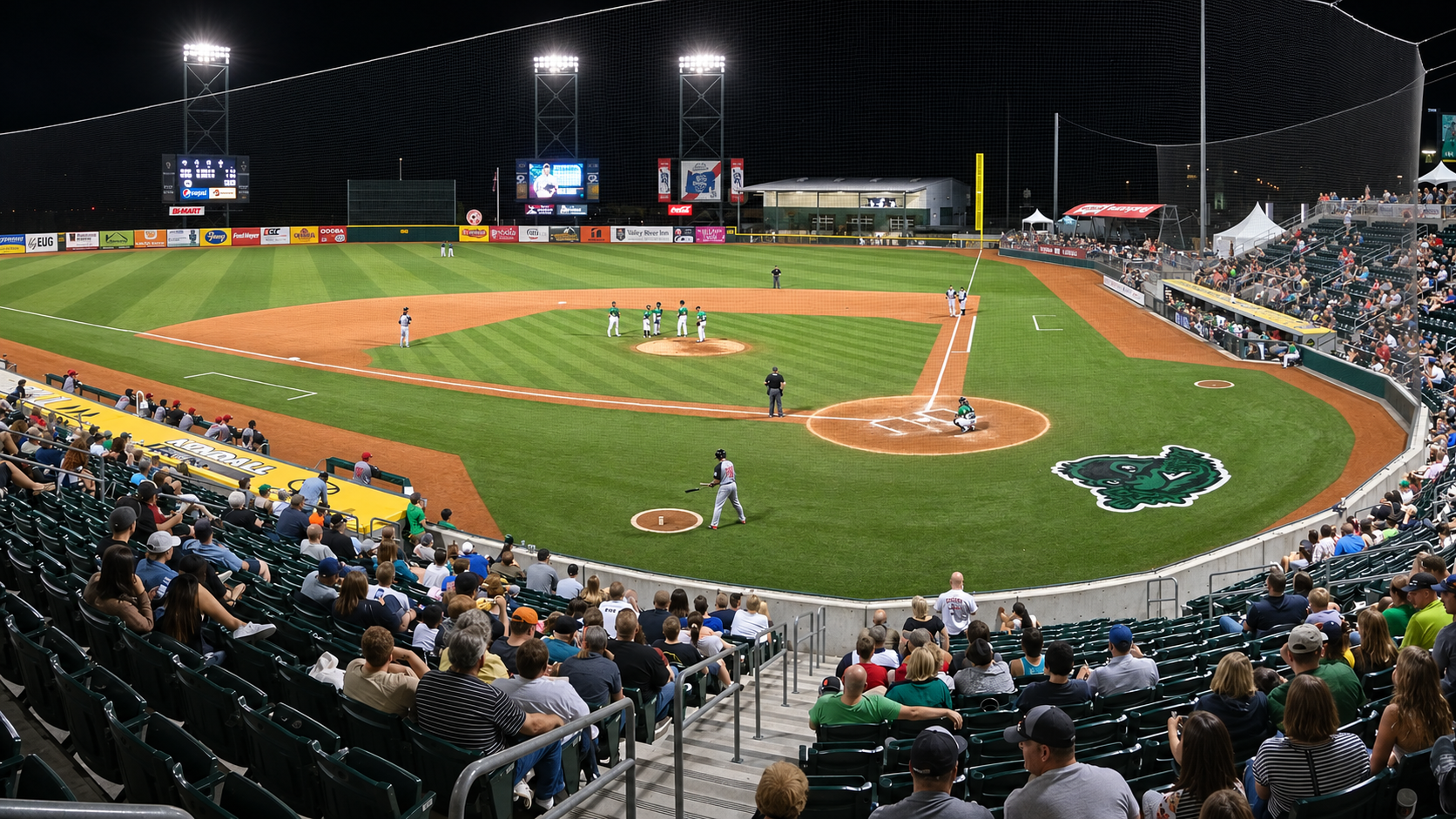
The Eugene Emeralds will turn their attention back to Eugene after Medford and team ownership ended efforts to build a baseball stadium at Hawthorne Park, leaving Southern Oregon without the proposed minor league franchise and city leaders facing a different course for downtown redevelopment.
The decision, announced Friday, November 13, followed a City Council study session Thursday that brought the project’s financial demands and construction schedule into sharper focus. Councilors were weighing a potential public contribution exceeding $80 million while the team sought a commitment quickly enough to open the ballpark in April 2029.
Both parties agreed to stop pursuing the project after considering the council’s concerns and the work still needed to meet that schedule. Questions about financing, effects on residents and the proposed location remained unresolved.
For Medford, the largest obstacle was the amount of public money the stadium could require. Consultants estimated the Hawthorne Park project at approximately $75.2 million. City staff developed a more conservative scenario approaching $90.5 million, accounting for additional municipal expenses and financial allowances.
Staff identified costs involving project oversight, contingency funding, playground replacement, equipment, and traffic and pedestrian improvements. With an assumed $10 million contribution from the team or other outside participants, the city or Medford Urban Renewal Agency would still have faced approximately $80.5 million under the higher estimate.
Emeralds owner DG Elmore offered $10 million toward the ballpark, contingent on a quick schedule and an agreement acceptable to both sides. Medford would have owned the facility, while the team would have leased it. The amount of rent had not been determined.
Mayor Michael Zarosinski questioned the scale of the city’s potential commitment and the resources it would draw away from other priorities. Councilor Nick Cards wanted additional time to explore whether the state and other community partners would participate financially.
That search for additional support would have competed with the team’s construction timetable. An April 2029 opening would likely have required council direction the following week, leaving little time to settle major funding questions before advancing the project.
The proposed ballpark was designed for 3,004 spectators, including fixed seats, club and suite seating, and a grass berm. Plans also included player development and maintenance buildings. The stadium would have occupied the northern portion of Hawthorne Park while retaining southern park areas and existing parking.
The location drew opposition from residents concerned about losing downtown park space. Parking availability also remained contested. Councilor John Quinn challenged assumptions about spaces available to stadium visitors and questioned how the investment would affect the city’s ability to pursue a conference center.
An alternative at Harry & David Field did not provide a path forward. Although the feasibility work examined renovating and expanding that facility, Elmore Sports Group had indicated it would not contribute financially to improvements there or relocate the Emeralds to that site. The ownership group’s position left Hawthorne Park as the location around which negotiations proceeded.
The stadium had been considered alongside hotel, commercial and conference facilities under the broader Creekside Quarter concept. Potential urban renewal funding placed the ballpark in competition with other redevelopment needs, including downtown parking and infrastructure.
The agreement to end discussions stops the stadium proposal before Medford commits to constructing the facility. Preliminary planning had advanced, but construction financing and lease terms remained unsettled.
For Southern Oregon residents, the decision ends the current prospect of bringing the Emeralds, a High-A affiliate of the San Francisco Giants, to the Rogue Valley. It also removes the proposed stadium from the downtown development plans now moving forward.
Medford officials intend to continue pursuing redevelopment opportunities through initiatives including MURA 2.0, with attention to infrastructure, private investment and downtown business activity. The stadium decision does not end those broader efforts.
The Emeralds still face the task of securing a long-term stadium solution in Eugene. The club previously said it would remain there through at least the 2027 season. An earlier proposal for a new stadium stalled after Eugene voters rejected a $15 million bond measure in 2024.
Elmore’s decision to concentrate on Eugene establishes the team’s next direction, but no replacement stadium agreement accompanied Friday’s announcement.