


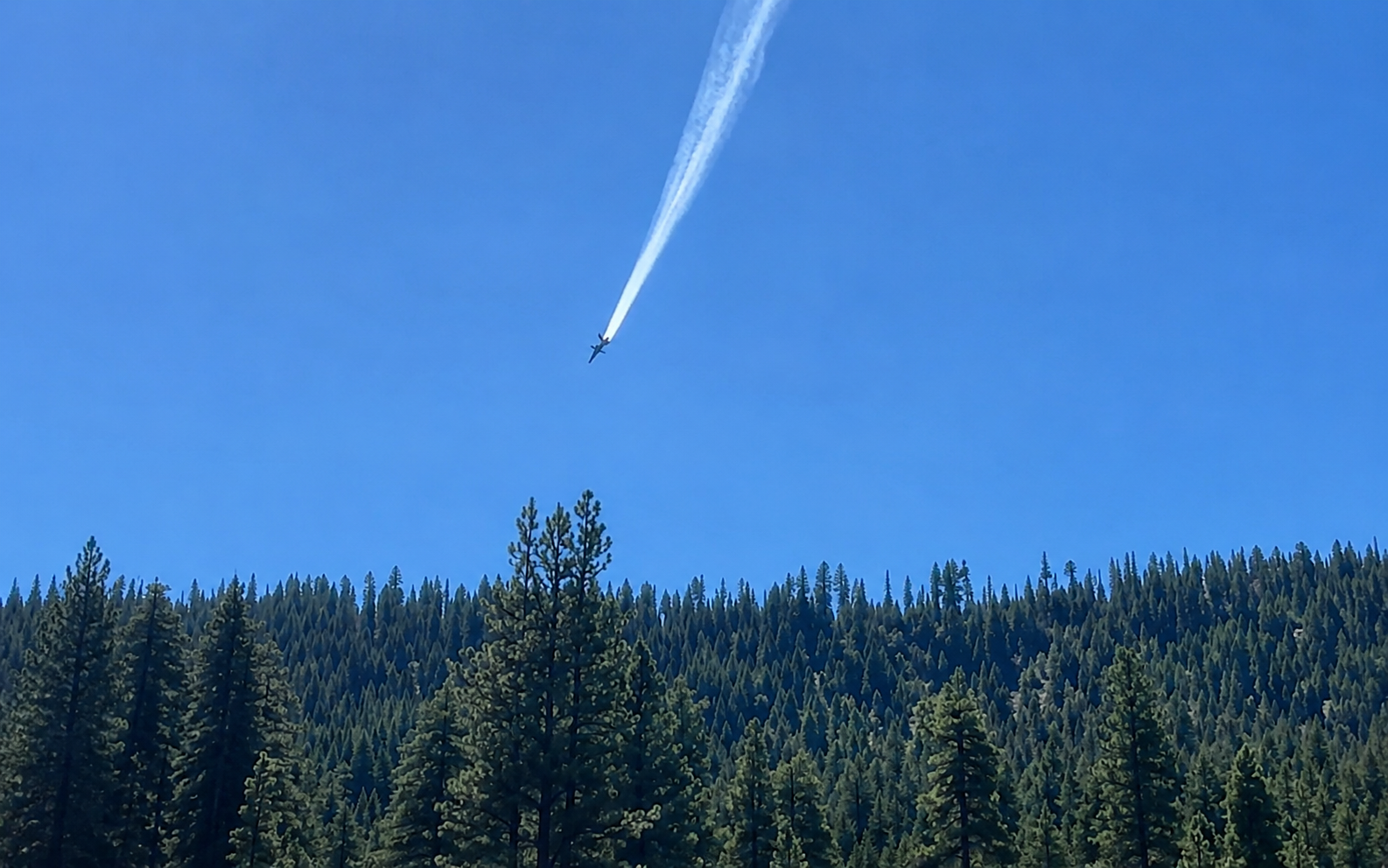
A military training flight over the forests of central Washington ended in a dramatic emergency after a fighter aircraft crashed near Rimrock Lake, triggering a wildfire and drawing a large response from firefighters, law enforcement personnel, and military investigators.
The crash occurred Saturday in remote terrain south of Rimrock Lake in Yakima County, an area surrounded by dense forest and popular recreational destinations near Mount Rainier. Within moments of impact, flames ignited in nearby vegetation, creating an additional challenge for emergency responders already racing to reach the wreckage.
Authorities confirmed that the pilot successfully ejected before the aircraft struck the ground. Emergency crews located the pilot and transported him to a hospital, where he was treated for injuries described as minor. The pilot’s survival is being viewed as a fortunate outcome in an incident that could have carried far more serious consequences.
In the hours following the crash, firefighters from multiple agencies converged on the scene as smoke rose from the forest. The impact ignited a wildfire that initially spread across approximately two acres. While small in size compared to many wildfires that occur across the Pacific Northwest each summer, the fire developed under conditions that have already begun to concern fire officials as seasonal vegetation continues to dry.
Campers in the surrounding area were evacuated as a precaution while emergency crews worked to secure the scene and prevent the fire from spreading into nearby timber. Portions of the surrounding road network were temporarily closed to allow fire equipment and emergency personnel access to the remote location.
Rapid response efforts proved effective. Firefighters established containment lines around the blaze and conducted suppression operations from both the ground and the air. Officials later reported that the fire showed little to no growth after the initial attack, significantly reducing the threat to nearby forest lands, recreation areas, and structures.
As emergency operations transitioned into recovery efforts, investigators were able to reach the crash site and begin documenting evidence. Photographs released from the area showed personnel working near the wreckage while fire crews continued mop-up operations designed to eliminate lingering hot spots.
One of the largest questions immediately following the crash involved the identity of the aircraft. Initial reports described the aircraft only as a military jet, prompting widespread speculation among aviation observers. Subsequent information released by military officials identified the aircraft as an F/A-18 Hornet assigned to Marine Aircraft Group 11, part of the 3rd Marine Aircraft Wing based at Marine Corps Air Station Miramar in California.
The F/A-18 Hornet has served as one of the military’s primary multirole fighter aircraft for decades and remains a familiar sight in training operations throughout the western United States. Military aircraft routinely operate in training corridors across the Pacific Northwest, including areas stretching across Washington and Oregon.
Investigators have not released a cause for the crash. Military aviation accident investigations typically involve detailed examinations of aircraft maintenance records, flight history, weather conditions, communications data, pilot actions, and recovered wreckage. Such investigations often require months before final findings are made public.
Beyond the aviation aspects of the incident, the crash served as another reminder of how quickly wildfires can ignite during the summer months. A single impact in dry vegetation was enough to start a fire that immediately demanded a coordinated response from firefighters and emergency personnel.
While the wildfire remained limited in size and no fatalities were reported, the incident briefly combined two of the region’s most serious seasonal concerns: aviation emergencies and wildfire danger. Thanks to the pilot’s successful ejection and the rapid actions of first responders, what began as a military aircraft disaster avoided becoming a far larger tragedy.
The crash site remains under investigation as military officials continue working to determine what caused the aircraft to go down in the forests of central Washington.