


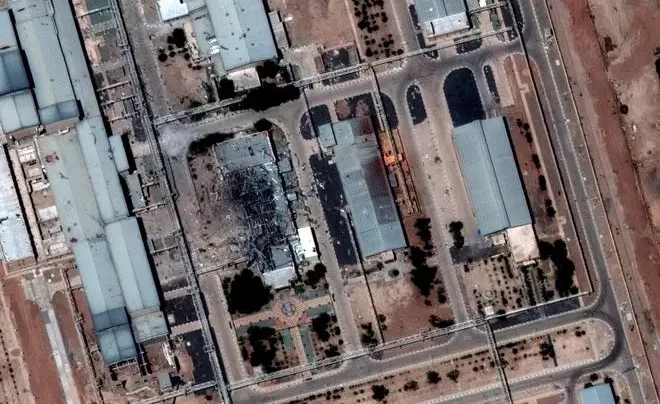
President Donald J. Trump took to Truth Social on Sunday to assert that the recent U.S. airstrikes on Iran’s nuclear facilities had caused “monumental damage,” describing the operation as an “obliteration” of key sites tied to Iran’s nuclear ambitions. His comments followed Saturday night’s coordinated military strikes that targeted the Fordow, Natanz, and Isfahan nuclear facilities—three sites long believed to be at the heart of Iran’s uranium enrichment program.
Trump, now in his second term as president, claimed satellite imagery confirms that the strikes devastated the Iranian nuclear infrastructure, a statement that quickly triggered both international scrutiny and debate among global security analysts. “Obliteration is an accurate term,” Trump wrote, signaling to both allies and adversaries that the United States considers the mission a success in weakening Iran’s ability to pursue a nuclear weapon.
Initial reports from independent satellite monitoring agencies do show extensive surface-level destruction at multiple locations within the targeted complexes. At Natanz, analysts observed burn scars, damaged buildings, and signs of intense fire activity. At Fordow, cratering was visible on ridgelines and above-ground infrastructure. However, many of Iran’s most sensitive nuclear assets are located deep underground—often beneath reinforced layers of rock and concrete—which makes full damage assessment difficult without direct site inspections.
International Atomic Energy Agency officials confirmed on Sunday that they are in the process of assessing the extent of the destruction. While IAEA experts acknowledged that structural harm to some facilities appears substantial, they cautioned against drawing final conclusions until their inspectors are granted access. The agency did note that power outages and logistical delays may prevent Iran from immediately resuming enrichment at normal capacity.
Despite the administration’s confident tone, defense analysts worldwide have issued more reserved evaluations. Experts from nuclear nonproliferation groups and think tanks in Europe and the United States have warned that while the strikes likely delayed Iran’s nuclear timeline, they may not have permanently dismantled the program. Iran retains both the scientific knowledge and the necessary technology to rebuild—especially if retaliatory actions further strain diplomatic efforts.
In Tehran, the Iranian government condemned the attacks as a violation of its sovereignty and vowed retaliation. The country’s National Security Council reportedly met in an emergency session Sunday to discuss its response options. Military units across the region, including proxy forces aligned with Iran, have since been placed on alert, raising fears of escalating tensions in an already volatile Middle East.
Markets responded swiftly to the news, with oil prices briefly spiking amid fears of a broader regional conflict. While prices stabilized by late Sunday, analysts remain concerned about the long-term economic ripple effects if Iran chooses to retaliate against U.S. allies or disrupt shipping lanes in the Persian Gulf.
The Pentagon has offered limited details on the operation itself, only confirming that it involved precision-guided munitions designed to penetrate hardened targets. Congressional leaders have called for classified briefings this week to review the strategic objectives, rules of engagement, and potential blowback from the strike.
President Trump’s use of the term “obliteration” has been met with mixed reactions, with some praising the administration’s decisive action and others cautioning that the full scope of the damage—and its global consequences—remains uncertain. As intelligence agencies continue their assessments and international inspectors wait for access, the world watches closely to see whether the mission marked a major turning point or simply the latest flare-up in a long and dangerous standoff.