


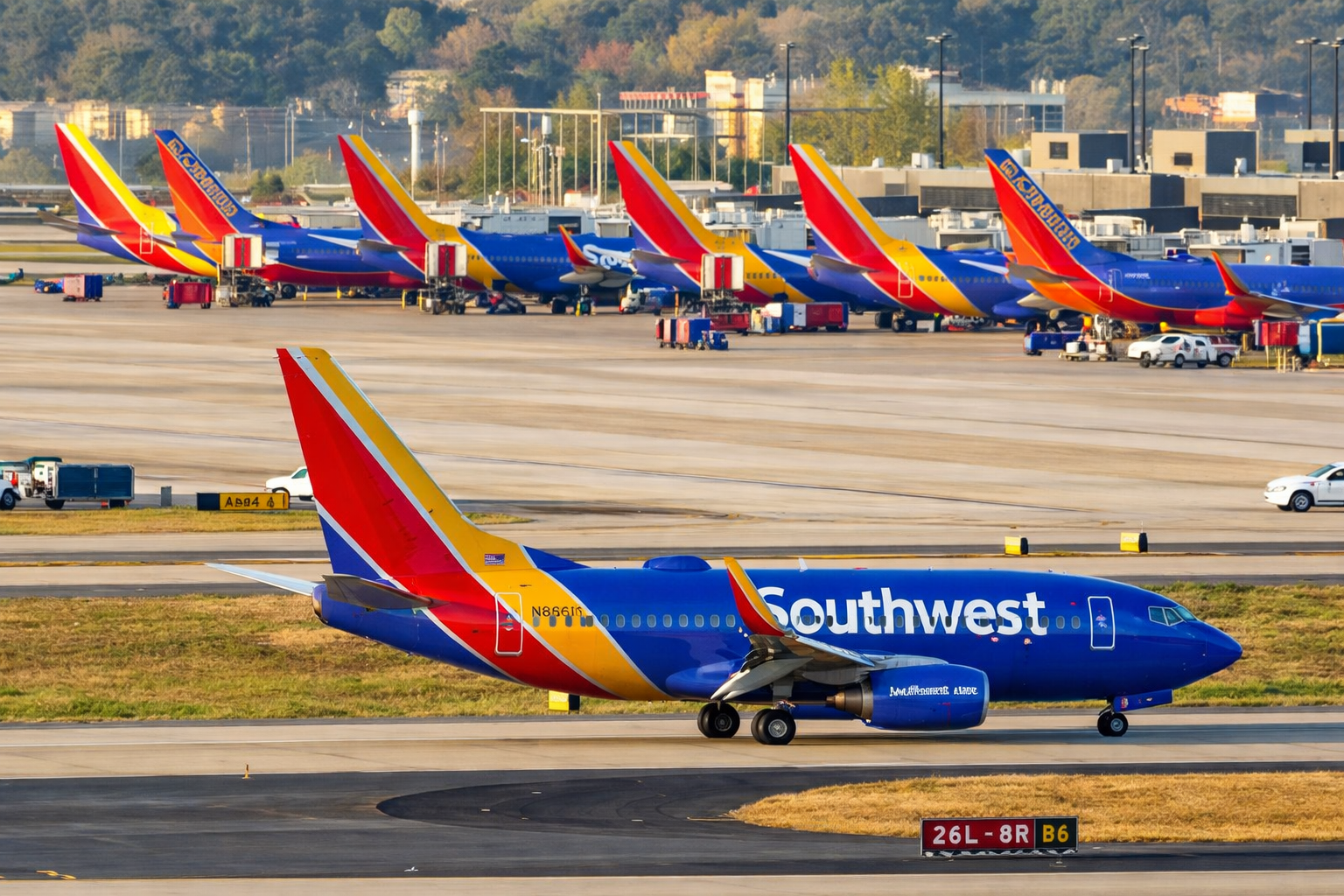
A routine commercial flight bound for South Florida turned into an unexpected security response late Friday after a reported concern aboard a Southwest Airlines aircraft prompted an emergency diversion to Atlanta, triggering a coordinated response from local and federal authorities.
The aircraft, operating as Southwest Airlines Flight 2094, departed Nashville, Tennessee, on a scheduled route to Fort Lauderdale, Florida. Somewhere during the flight, crew members reported what the airline later described as a potential security issue involving a passenger onboard. While the exact nature of the behavior that raised concern has not been publicly detailed, airline officials treated the matter with the level of seriousness required under federal aviation security protocols.
Rather than continuing to its destination, the flight crew made the decision to divert to Hartsfield-Jackson Atlanta International Airport, one of the country’s largest and most heavily secured aviation hubs. The airport’s size and resources make it a strategic location for responding to in-flight incidents requiring immediate law enforcement or federal involvement.
The aircraft landed safely in Atlanta during the evening hours without incident. Shortly after arriving on the ground, officers from the Atlanta Police Department boarded the plane to locate and remove the individual connected to the reported concern. Federal authorities, including investigators from the Federal Bureau of Investigation, were also notified as part of the standard process when a potential aviation security matter arises.
Passengers aboard the aircraft reportedly experienced a tense final stretch of the flight as the crew prepared for the unscheduled landing and authorities positioned themselves to intervene once the plane reached the gate. Despite the disruption and heightened security presence, no injuries were reported among the passengers or the flight crew.
Investigators began reviewing the situation almost immediately after the aircraft arrived. Authorities interviewed individuals connected to the incident and assessed whether the reported concern represented a credible threat to the aircraft or those on board. After examining the circumstances surrounding the report, officials determined that there was no confirmed security threat.
The passenger at the center of the situation was removed from the aircraft during the investigation. Authorities later concluded that no criminal charges would be filed in connection with the incident.
Although the situation ultimately did not result in a verified threat, aviation officials emphasize that diversions such as this reflect the strict safety posture maintained throughout the commercial airline industry. Flight crews are trained to treat any possible security risk as legitimate until proven otherwise, and diversion to the nearest major airport remains one of the primary tools available to protect passengers and crew.
The temporary interruption left travelers stranded in Atlanta while the aircraft and circumstances surrounding the report were cleared by investigators. Southwest Airlines later arranged for passengers to continue their journey to Fort Lauderdale on a replacement aircraft, though the unexpected stop resulted in several hours of delay.
Events like this illustrate the reality of modern air travel, where safety procedures are designed to move quickly and decisively when something appears out of the ordinary. Even situations that ultimately prove harmless can trigger immediate action once a flight crew or passenger reports behavior that raises concern.
In this case, the precautionary response ensured that the aircraft landed safely, authorities had the opportunity to evaluate the situation on the ground, and passengers were able to continue their travel once investigators determined that no ongoing threat existed.