


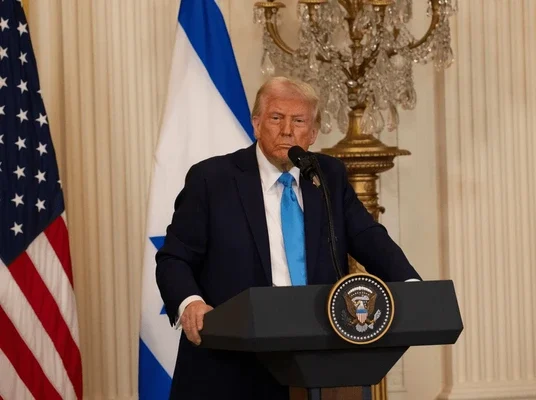
(WASHINGTON, D.C.) —Speaking from the Oval Office just after 9 p.m. EDT on Saturday, President Donald Trump delivered a nationally televised address detailing the U.S. air operation that targeted three Iranian nuclear facilities earlier in the day and outlining his administration’s next steps to “contain Iran’s destabilizing ambitions while avoiding a wider regional war.”
In a 12-minute speech carried by major networks and streamed online, the president said the precision strikes hit Iran’s Fordow, Natanz and Isfahan complexes—sites long suspected by U.S. intelligence of housing advanced uranium-enrichment equipment. According to Trump’s account, American stealth bombers and cruise missiles launched from the Persian Gulf “completed their missions and exited Iranian airspace without losses,” with initial battle-damage reports indicating “severe degradation of Iran’s nuclear infrastructure.” The Pentagon has not yet released independent imagery, and casualty figures on the ground remain unconfirmed.
Trump framed the action as a limited, pre-emptive measure intended to prevent Tehran from crossing what he called a “red line on weaponization.” He cited recent International Atomic Energy Agency findings that Iran had accelerated enrichment activities in violation of the now-defunct 2015 nuclear accord, from which the United States withdrew in 2018. The president argued that diplomatic pressure and economic sanctions alone had failed to deter “an imminent threat to American allies and forces in the region,” adding that Washington remains open to “swift negotiations if Iran chooses peace over provocation.”
While administration officials briefed congressional leaders by secure conference earlier in the evening, reaction on Capitol Hill quickly split along party lines. Several Republican senators praised the strikes as a proportionate show of strength intended to avoid a protracted ground conflict. Democratic leaders, however, demanded a full classified briefing for all members and questioned the legal authorization for the operation, noting that Congress has not passed a new war-powers resolution covering Iran.
Tehran’s state media condemned the attack as an act of “naked aggression” and vowed retaliation “at a time and place of our choosing,” but Iranian officials offered no immediate details. Reports of sporadic anti-aircraft fire near Natanz circulated on social media, though internet disruptions across several Iranian provinces made independent verification difficult late Saturday. The Islamic Revolutionary Guard Corps claimed it had downed at least two U.S. drones, a statement U.S. Central Command said it could not corroborate.
International reaction was swift. Russia and China requested an emergency United Nations Security Council meeting, arguing the strikes risk destabilizing oil markets and derailing broader non-proliferation efforts. European Union foreign policy chief Josep Borrell urged “maximum restraint by all actors,” while Saudi Arabia and Israel signaled support for Washington’s position, describing Tehran’s nuclear ambitions as an existential threat. Brent crude futures briefly spiked above $100 per barrel in after-hours trading before settling lower on reports that Persian Gulf shipping lanes remained open.
At the White House, National Security Adviser Christopher Miller told reporters the administration does not anticipate additional strikes “unless Iran escalates further,” describing Saturday’s mission as “singular and limited.” He confirmed that U.S. carrier strike groups in the Arabian Sea and Mediterranean would remain on heightened alert, and that Patriot and THAAD missile batteries across the Gulf states had been reinforced as a precaution.
The address marked only the second time in his presidency that Trump has announced the use of force against a sovereign nation in a prime-time speech, following the 2018 missile strike on Syria’s chemical weapons facilities. By invoking both deterrence and an open door to talks, the president sought to reassure Americans wary of another Middle East conflict while signaling to allies that Washington remains committed to preventing a nuclear-armed Iran.
A fuller assessment of the strikes’ effectiveness—and of Tehran’s likely response—may emerge in the coming days as satellite imagery becomes available and international inspectors seek access. For now, the administration’s gamble is that a short, focused display of military power will halt what it sees as Iran’s march toward the bomb without igniting a conflict it has long pledged to avoid.