


There are actors who play villains, actors who play eccentrics and actors who spend entire careers trying desperately not to be typecast. Then there was Tim Curry, who could walk into a movie wearing too much makeup, an absurd costume or an expression suggesting that everyone else in the room was hopelessly beneath him and somehow make the whole thing work.
Curry died this week at his Los Angeles home at the age of 80, closing a career that stretched across nearly six decades of film, television, theater, music and voice work. He leaves behind the sort of body of work that makes describing him with a single title almost impossible. Actor is correct. Singer is correct. Broadway performer, voice artist, comedian and professional cinematic troublemaker are all correct as well. Curry had range, but more importantly, he had presence. When he arrived, audiences tended to notice.
He could be charming while behaving terribly. He could be frightening while clearly enjoying himself. He could sneer, glare and deliver a line with enough aristocratic contempt to make an insult feel almost complimentary. Few performers possessed his particular talent for portraying a complete bastard while simultaneously becoming the person audiences most wanted to keep watching.
That strange and wonderful ability announced itself loudly with Dr. Frank-N-Furter.
Curry originated the role in the stage production of The Rocky Horror Show in London in 1973 before carrying the character into the 1975 film The Rocky Horror Picture Show. Wearing fishnets, heels, pearls, heavy makeup and enough confidence to power a small metropolitan area, Curry created something much larger than a movie character. Frank-N-Furter became a cultural landmark, and Curry became forever associated with one of the strangest success stories in film history.
The movie was not initially treated as the immortal piece of popular culture it eventually became. Its extraordinary life developed later through midnight screenings, audience participation and generations of viewers who discovered that being gloriously strange could be far more interesting than behaving normally. Half a century later, audiences were still throwing rice, shouting at screens, dressing like characters and introducing another generation to Curry’s magnificent entrance.
Yet reducing Tim Curry to Rocky Horror would be like describing a thunderstorm as slightly damp.
He went on to build an extraordinary collection of characters that frequently shared only one quality: nobody else could have played them quite the same way.
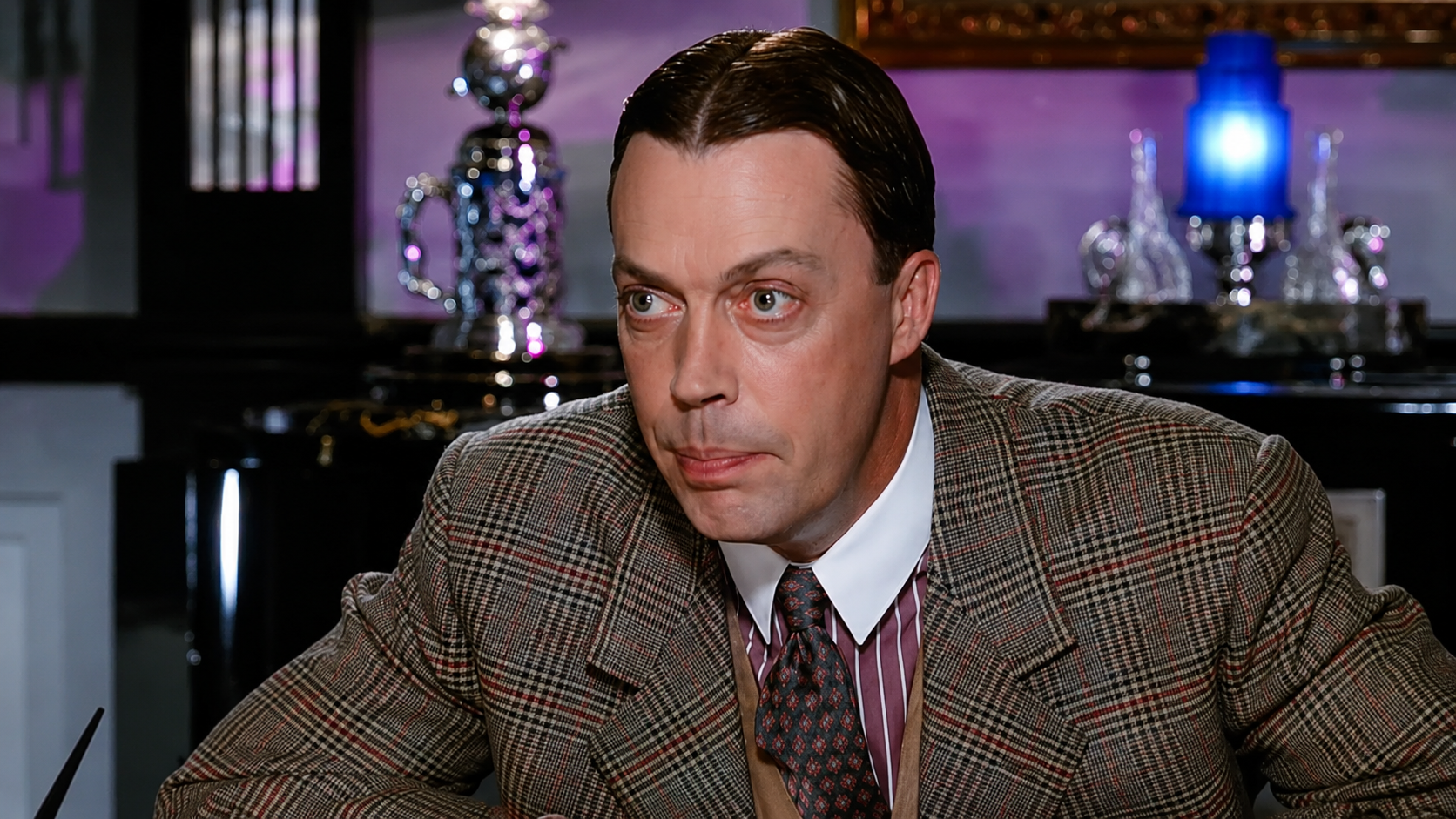
In 1985’s Clue, Curry played Wadsworth, the butler attempting to navigate a mansion filled with murder, blackmail, weapons, suspicious guests and increasingly ridiculous explanations. The movie gave Curry an ideal playground for his physical comedy and impeccable timing. By the time Wadsworth was racing through rooms reconstructing the evening’s events at approximately the speed of a caffeinated auctioneer, Curry had turned exposition into comedy.
Clue initially struggled at the box office. Time was considerably kinder. The movie became a cult favorite, and Curry’s performance became one of the defining pieces of his career.
Then there was Pennywise.
For anyone who encountered Stephen King’s It on television in 1990 at precisely the wrong age, Tim Curry owes you several nights of sleep.
His Pennywise the Dancing Clown managed to be terrifying without modern digital effects or elaborate cinematic machinery. Curry had his face, his voice, a clown costume and a smile that told children everywhere that storm drains should probably be avoided indefinitely. He could shift from playful to monstrous with astonishing speed, demonstrating again that the same actor who could make audiences howl with laughter could make them profoundly uncomfortable a few years later.
He was Rooster Hannigan in Annie, the enormous and demonic Lord of Darkness in Legend, Long John Silver in Muppet Treasure Island and the suspicious concierge Mr. Hector in Home Alone 2: Lost in New York. That last performance provided a particularly pure sample of the Curry formula. Mr. Hector was pompous, suspicious, officious and frequently unpleasant, yet Curry made every narrowed eye, curled lip and irritated reaction so entertaining that the character became memorable despite being surrounded by much larger comic set pieces.
Curry’s career was hardly confined to movies.
He earned three Tony Award nominations during a distinguished theater career that included Amadeus, My Favorite Year and Monty Python’s Spamalot. Long before Hollywood audiences knew his face, he had worked extensively on the British stage, including appearing in Hair and with the Royal Shakespeare Company. His theatrical training remained visible throughout his screen career. Curry understood how to use posture, timing, movement and silence as effectively as dialogue. His characters rarely seemed accidental. Every raised eyebrow appeared to have been rehearsed.
Then there was that voice.
Deep, theatrical, elastic and instantly recognizable, Curry’s voice became practically a separate career. He worked extensively in animation, television, audiobooks and video games, voicing characters in Peter Pan and the Pirates, The Wild Thornberrys, FernGully: The Last Rainforest, Star Wars: The Clone Wars and numerous other productions. Nigel St. Nigel in Psych. His performance as Captain Hook in Peter Pan and the Pirates earned him a Daytime Emmy Award, and his audiobook work earned him a Grammy nomination.
He was also a recording artist, releasing the albums Read My Lips, Fearless and Simplicity between 1978 and 1981. Curry possessed a powerful baritone that could sound theatrical one moment, mischievous the next and genuinely formidable when required. Music was not a celebrity side project for him. It had been part of his artistic life from the beginning.
In 2012, Curry suffered a major stroke that left him partially paralyzed and using a wheelchair. It was a devastating medical event, but it did not erase the wit, intelligence or unmistakable personality that audiences had known for decades. He continued voice work, participated in public appearances and conventions and eventually returned to the screen in limited roles. In 2024, he appeared in the horror film Stream, and in 2025 he published his memoir, Vagabond, reflecting on the sprawling and remarkably unconventional career behind him.
There was something fitting about Curry remaining connected to his audience after the stroke. His career had never depended entirely upon movement, appearance or costume. The essential instrument was always the man himself. A look, a pause, an inflection or that unmistakable voice could accomplish more than another actor might manage with an entire page of dialogue.
His professional accomplishments are substantial. Three Tony nominations. A Daytime Emmy. A Grammy nomination. Major theatrical productions. Successful films. Cult classics. Television. Animation. Music. Video games. A career lasting nearly 60 years.
Numbers, however, cannot adequately explain Tim Curry.
His legacy lives in movie theaters where Rocky Horror still plays decades after most films from 1975 have disappeared from public memory. It lives in people who cannot see a storm drain without thinking about Pennywise. It lives in Clue fans who know that watching Wadsworth explain a murder somehow becomes funnier every time they see it. It lives in the unmistakable sound of his voice and in dozens of performances where Curry understood that going bigger was sometimes exactly the right artistic decision.
Most actors spend their careers trying to disappear into their characters. Tim Curry sometimes appeared to do the opposite. He invited the character to disappear into Tim Curry, and somehow the arrangement worked magnificently.
He could be elegant, ridiculous, sinister, sophisticated, vulgar, frightening, warm and hilariously obnoxious, sometimes within the same performance. He possessed the exceedingly rare ability to look as though he knew perfectly well how absurd everything around him was while remaining completely committed to it.
That may explain why his work has aged so remarkably well. Curry never seemed embarrassed by imagination. He did not apologize for theatricality. When a role called for subtlety, he could deliver it. When it called for a cape, horns, fishnets, pirate clothing, clown makeup or enough attitude to flatten every other character in the room, he apparently considered that perfectly reasonable too.
Tim Curry spent nearly six decades proving that memorable characters do not have to be likable, respectable or remotely normal.
Sometimes they simply have to be unforgettable.
He certainly was.