


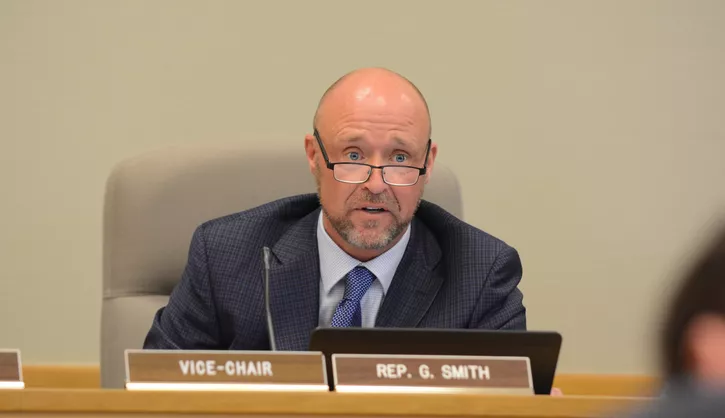
State Representative Greg Smith is once again under the microscope—this time facing a formal investigation by the Oregon Government Ethics Commission (OGEC) over allegations he used his role as a public agency executive to improperly boost his own pay and failed to disclose a conflict of interest in the process.
According to documents and sources close to the case, OGEC voted unanimously earlier this month to move forward with an inquiry into Smith’s conduct while serving as executive director of the Columbia Development Authority (CDA), a position he held concurrently with his seat in the Oregon House of Representatives. At issue is whether Smith unlawfully approved pay raises for himself and staff while preparing a federal grant application—without first securing approval from the CDA board, which oversees financial decisions for the agency.
That grant application, now infamous, led to swift federal fallout. In February, the U.S. Department of Defense suspended roughly $800,000 in funding to the CDA after officials discovered that it included false claims regarding salary approvals. The result was not only the freezing of crucial funds but a loss of trust in a program already under intense scrutiny due to its leadership structure and management practices.
The CDA board formally rescinded the pay increases in September 2024 after discovering they had not been authorized. The board’s action came amid growing concerns and mounting pressure from multiple parties, including state officials and local government watchdogs. Internal communications among board members reflected frustration and confusion, with some discussing the possibility of censuring or even removing Smith from his leadership role.
Now, OGEC investigators have been directed to determine whether Smith violated Oregon’s ethics laws by failing to disclose his personal financial interest in those raises—an omission that, if substantiated, could result in fines, sanctions, or even removal from public office.
This isn’t the first time Smith has drawn the commission’s attention. Earlier this year, OGEC issued a formal “letter of education” after Smith failed to disclose income from multiple public clients—including Harney County and Eastern Oregon University—despite state law requiring such transparency. That particular review, considered minor, ended with no financial penalty. Still, it set the stage for deeper questions about Smith’s ongoing entanglement of public roles, private contracts, and legislative power.
While the CDA drama unfolds, critics argue that the ethics commission must act decisively to restore public trust. With state lawmakers increasingly holding overlapping public positions—often with significant influence over taxpayer-funded budgets—the question of conflict of interest has never been more urgent.
The investigation now underway could serve as a test case for how Oregon handles such ethical gray zones. The people of Eastern Oregon and the entire state deserve clarity, accountability, and resolution—not just another slap on the wrist or quiet dismissal behind closed doors. Given the seriousness of the allegations and the federal funding implications, OGEC’s actions—or inaction—will be watched closely.
Hopefully this time, the commission and its investigative team will fully do their jobs, follow the facts wherever they lead, and deliver a resolution that upholds the values of public service. Our hopes remain high, as they always do, that the rule of law and transparency will prevail over political convenience. Smith, a legislator since 2001 and Oregon’s longest-serving House member, may soon have to answer to more than just his constituents.
In a political climate increasingly defined by blurred lines and unchecked power, one thing is clear: ethics in government isn’t just a legal requirement—it’s a public expectation. The question now is whether Oregon’s ethics watchdog has the teeth to enforce it.