


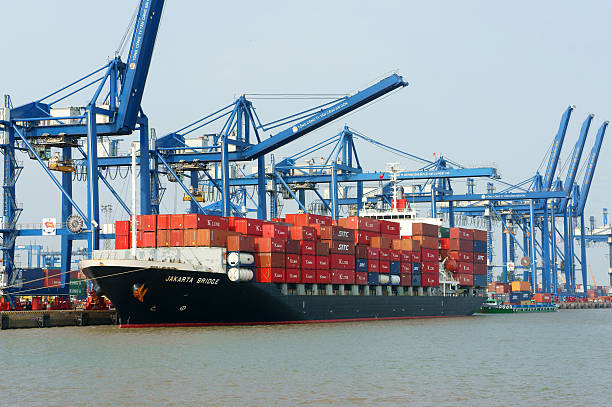
Oregon lawmakers are strengthening international trade ties in Southeast Asia with the signing of a new agreement between the Port of Portland and Long An International Port, a modern shipping hub in southern Vietnam. The deal, formalized during the Oregon Trade Mission to Vietnam, reflects both regions’ intent to deepen cooperation in maritime logistics and expand economic opportunities across the Pacific.
The signing took place at Thong Nhat Hall as part of the Tay Ninh E-Commerce and Export-Import Supply Chain Networking Forum 2025. It was a highlight of the week-long trade mission led by Oregon Legislative Trade Caucus Co-Chairs Daniel Nguyen and Shelly Boshart Davis. Nguyen, who also chairs the House Committee on Economic Development, Small Business, and Trade, has emphasized the potential for Oregon businesses to benefit from stronger partnerships in one of the world’s fastest-growing economies.
At the heart of the agreement is a Memorandum of Understanding that lays the foundation for cooperation in cargo handling, supply chain efficiency, and sustainable shipping practices. Both ports plan to share expertise in consolidating cargo flows and reducing carbon emissions, a commitment that reflects growing pressure on global trade networks to adopt greener standards. For Oregon exporters, the deal promises streamlined access to Southeast Asia, while for Vietnam it provides a direct link to one of the West Coast’s most important gateways for international trade.
The partnership represents more than just logistics. It signals the evolution of Oregon’s trade strategy, which has increasingly shifted toward Asia as a priority market. Vietnam in particular has become a significant partner. Over the past two decades, Vietnamese manufacturing has surged, supplying goods ranging from textiles to electronics to U.S. markets, while Oregon has exported agricultural products, timber, and high-tech equipment. The trade balance has steadily expanded, making Vietnam an attractive partner for both private industry and policymakers.
Oregon’s interest in Vietnam also reflects the state’s broader ambition to diversify trade connections beyond its traditional reliance on East Asian giants like China, Japan, and South Korea. Vietnam’s younger workforce, rapidly developing infrastructure, and openness to foreign investment make it a natural complement to Oregon’s high-tech industries and agricultural exporters. The agreement signed in Tay Ninh represents a calculated step toward embedding Oregon more firmly in these rising supply chains.
For Vietnam, the timing is equally important. Long An International Port is a centerpiece of the country’s modernization strategy, designed to serve as a deep-water hub for the Mekong Delta. By partnering with Portland, it gains a stronger foothold in U.S. trade routes, helping to ensure that Vietnamese goods flow more smoothly into American markets. The collaboration also underscores Vietnam’s emergence as a regional competitor to more established trading powers in Asia.
The trade mission itself reflects Oregon’s proactive approach to international relations at the state level. While foreign policy is a federal responsibility, state governments have increasingly taken a lead role in cultivating business ties abroad. For lawmakers like Nguyen, building bridges between ports is about positioning Oregon’s economy for resilience in an era of shifting global trade dynamics.
In the long term, the memorandum could have implications beyond shipping. Stronger trade connections often lead to cultural and educational exchanges, business partnerships, and investment opportunities. For a state like Oregon, where exports are a vital part of economic health, the potential ripple effects are significant.
What began as a ceremonial signing in Tay Ninh is likely to carry weight in boardrooms, farms, and factories back home. As Oregon businesses look to navigate uncertain global markets, the Port of Portland’s new partnership with Long An International Port provides both symbolism and substance—a reminder that in a global economy, the path to prosperity often begins far beyond local shores.