


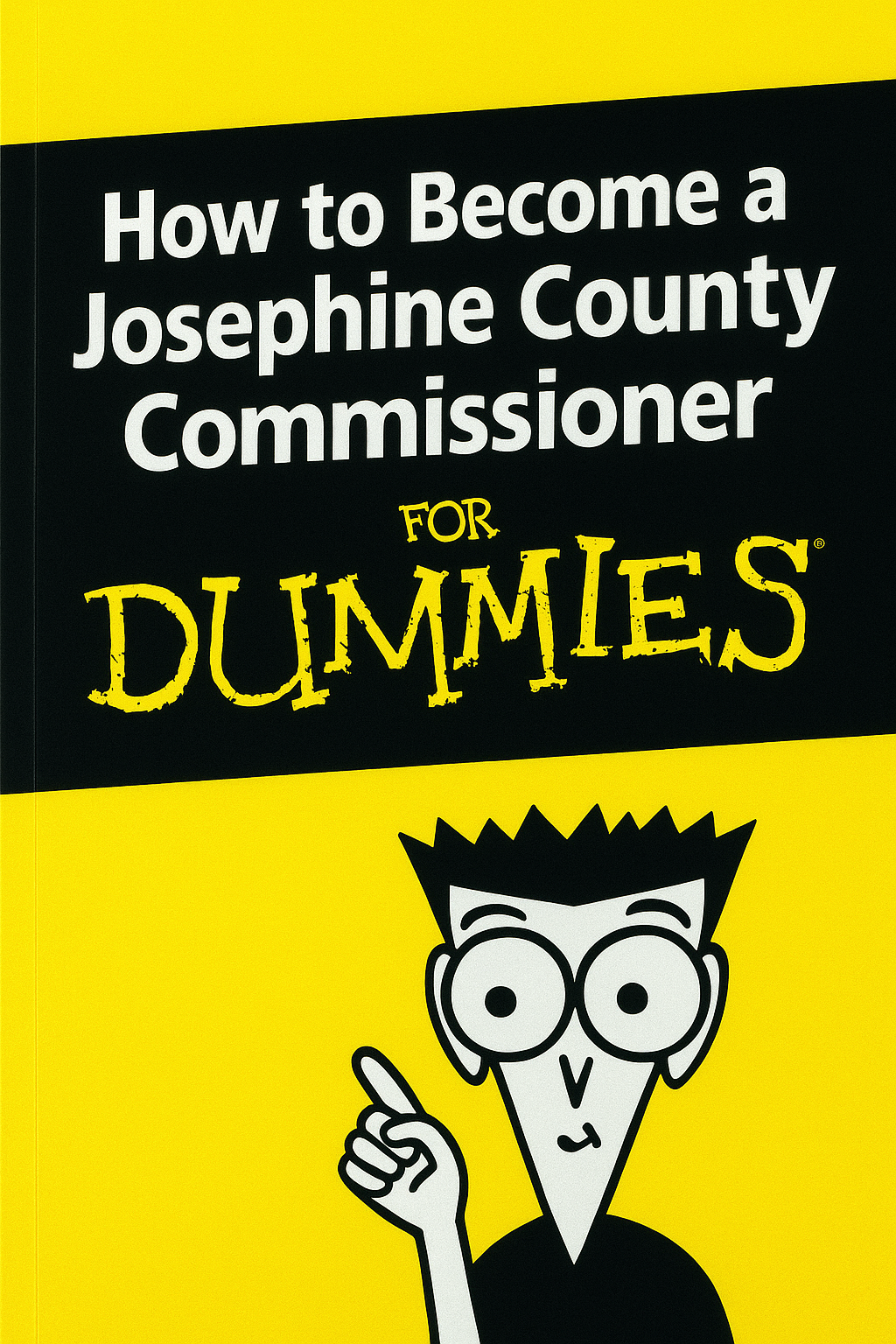
So, you want to be a Josephine County Commissioner? Congratulations, friend. You’ve chosen a path that, on paper, comes with responsibility, ethics, transparency, and a legal charter older than some of the neckties still hanging in the courthouse closet. But in practice, at least in our corner of Southern Oregon, the rulebook often looks less like Oregon Revised Statutes and more like a satirical Mad Libs scribbled at the back of a county fair beer tent.
According to state law, county commissioners are supposed to adopt ordinances that follow the law, hold open meetings that are truly open, manage budgets with citizen input, appoint people fairly to boards and committees, file ethics disclosures, avoid conflicts of interest, and generally keep their noses clean. Josephine County even has a home-rule charter—our own local constitution—that spells out commissioners’ duties, term lengths, and procedures. On paper, it’s neat, tidy, and democratic.
But this isn’t Josephine County Commissioners for Saints. This is For Dummies. And the version of the manual that seems to have actually been written by our current board looks a lot different. In most counties, you campaign by talking to voters, laying out your vision, and promising to serve with integrity. In Josephine County, however, the “Dummies” edition starts with the Golden Rule: lie, deny, and deflect. If the truth gets in the way, push it aside like an inconvenient pothole on Foothill Boulevard. Our commissioners have practically trademarked the art of the non-answer. Ask about the budget shortfall and you’ll hear about a shadowy “threat” at a past meeting instead. Question the wisdom of a new appointment and expect to be told that transparency is overrated. In this county, elections aren’t won on ideas; they’re won on volume—and not budgetary volume, but the kind that echoes off courthouse walls when a commissioner scolds a constituent.
The law is crystal clear that meetings must be open to the public, announced ahead of time, and recorded in minutes. Citizens are supposed to have a say. That’s why Oregon’s Public Meetings Law exists. But the “Dummies” edition reads differently. Public comment is limited to three minutes and often met with eye rolls. Passionate speakers are shushed. “Executive session” becomes a magician’s smoke bomb, used whenever things get sticky. Transparency is met with sighs and vague explanations about security that sound like they came from a bad spy novel. The result is meetings that feel less like open forums and more like parent-teacher conferences where the parents are grounded for asking too many questions.
By law, the county budget must be crafted with input from a citizen budget committee. Hearings are required. Numbers must be posted. Sunshine is expected. But in the Dummy version, the budget is treated like a mystery novel. Facts are redacted, citizen input brushed aside, and appropriations passed faster than you can say “supplemental budget transfer.” Anyone trying to follow the dollars might as well be reading hieroglyphics. Instead of prioritizing services like roads, law enforcement, or libraries, the commissioners tend to prioritize self-preservation. Budgets become political shields rather than planning tools.
Oregon’s ethics laws are equally clear. Don’t use your office for personal gain. Don’t accept gifts beyond limits. Disclose your financial ties. Avoid bullying the public. Yet in Josephine County, the Dummy handbook recommends the opposite. Conflict of interest? Pretend it doesn’t exist. Gift limits? Redefine “gift” until it means free donuts in the break room. Statements of Economic Interest? File them as casually as you’d sign for a UPS package, if at all. And when criticism arrives, don’t respect it—attack it. Citizens are dismissed as hecklers, journalists are painted as troublemakers, and transparency advocates are branded as threats. Ethics are treated not as guardrails but as obstacles.
When it comes to land use and appointments, commissioners are supposed to follow zoning laws and state planning rules while appointing volunteers to boards based on merit. In practice, the Dummy approach is to spin the wheel. Appointments go not to the qualified but to the loyal. Land-use decisions feel like backroom favors. If you’re friendly to the board, you get a seat. If you’re critical, you get silence.
Oregon law guarantees public access to records, but here again the Dummy version turns it into a game of hide and seek. Requests are delayed, deflected, or buried under jargon until the requester finally gives up. Transparency is treated like sunlight in a vampire novel—something to be avoided at all costs.
And yet, beneath the satire lies a truth that isn’t funny at all. The role of a county commissioner is one of the most important elected offices in Josephine County. Commissioners shape land use, oversee millions in tax dollars, and represent us on regional and state boards. Their decisions affect everything from public health to public safety. The system is designed for accountability, transparency, and ethics. But when commissioners ignore the charter, shrug off state law, and mock the very citizens they serve, the damage is real. Trust erodes. Engagement declines. And democracy, already fragile, starts to crack.
If Josephine County is stuck with commissioners reading from the “For Dummies” edition, then the joke is on us. But the punchline doesn’t have to be permanent. Voters, citizens, and community advocates still have the power to rewrite the script. The original rulebook—the charter, the statutes, the ethics code—isn’t broken. It’s just being ignored. What’s broken is the culture of entitlement and disdain coming from the courthouse dais. The real “For Dummies” lesson is simple: don’t let the dummies keep the pen. Take it back. Demand transparency. Expect ethics. Elect leaders who respect the people they serve. Because Josephine County deserves more than a parody. It deserves commissioners who can read the real manual, not just the joke version.