



The Josephine County Board of Commissioners released a new update on October 31, 2025, that reads more like a public relations exercise than a progress report. Branded as a summary of “ongoing county initiatives,” the statement promises responsible financial management, open governance, and community progress—but offers little evidence of any measurable results.
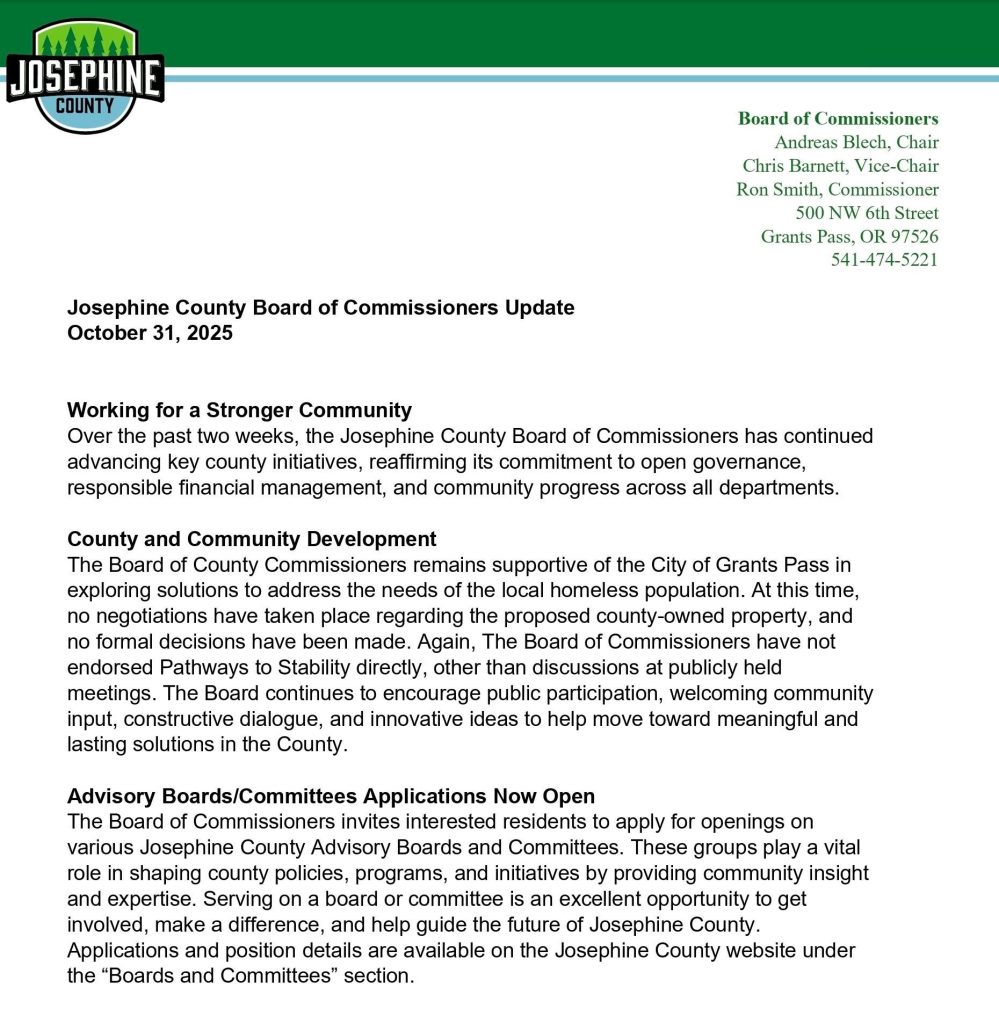
The release opens with lofty language about “working for a stronger community,” emphasizing that the Board has been advancing key county initiatives over the past two weeks. However, the statement does not specify which initiatives have advanced, what outcomes have been achieved, or what tangible benefits the public can expect to see. Instead, it leans heavily on recycled phrases about transparency and cooperation—an increasingly familiar theme from a Board that has recently faced public skepticism about its priorities, attendance, and internal coordination.
The most substantial portion of the press release concerns the county’s position on homelessness—a subject that has generated significant public discussion and confusion in recent months. The statement reaffirms the Board’s general support for the City of Grants Pass in addressing local homelessness but clarifies that no negotiations or agreements have taken place regarding county-owned property or the “Pathways to Stability” project. It also stresses that the Board has not officially endorsed the initiative, except through limited discussions in public meetings.
This clarification seems less about progress and more about damage control, as local residents have questioned whether the county was quietly backing a specific project or property deal. By distancing itself from any formal endorsement, the Board may have hoped to quiet rumors—but in doing so, it has raised new questions about what role, if any, Josephine County actually plans to play in regional homelessness efforts.
Nowhere in the update does the Board describe what it has done to support solutions. There is no mention of funding allocations, collaborative agreements, or measurable actions taken to address homelessness, infrastructure, or community services. The document reads like a list of intentions without any evidence of achievement.
In its closing section, the update invites residents to apply for openings on county advisory boards and committees—a standard administrative announcement that appears in nearly every quarterly bulletin. While citizen participation is a cornerstone of county governance, the timing of this call for volunteers does little to distract from the absence of any new policy or initiative worth reporting.
Taken as a whole, the release is a masterclass in bureaucratic phrasing. It uses positive but empty terms—“open governance,” “responsible management,” “community progress”—that sound reassuring but say almost nothing concrete. There are no new programs, no completed projects, no legislative accomplishments, and no specifics on where taxpayer dollars are being directed.
If the intent was to reassure the public that the Board is hard at work, the result may have backfired. To many readers, the statement underscores a growing pattern: lengthy, self-congratulatory updates that lack substance, paired with ongoing public frustration over transparency and accountability.
The timing is also notable. The release comes amid heightened scrutiny of county leadership following several absences by commissioners during key meetings and ongoing controversy surrounding communications with city officials and local nonprofits. For residents looking for clarity, this latest document provides none.
In the end, the Josephine County Board of Commissioners’ October 31 update serves as an example of how government communication can say a great deal without truly saying anything at all. The Board claims to be “working for a stronger community,” yet the only clear message emerging from this release is that meaningful information remains in short supply.
For now, Josephine County residents are left with more questions than answers—about homelessness, about county priorities, and about what exactly their elected officials are doing beyond issuing statements filled with polished but hollow reassurances. Until the Board offers concrete data, measurable progress, and genuine transparency, updates like this will continue to feel less like communication and more like carefully crafted noise.