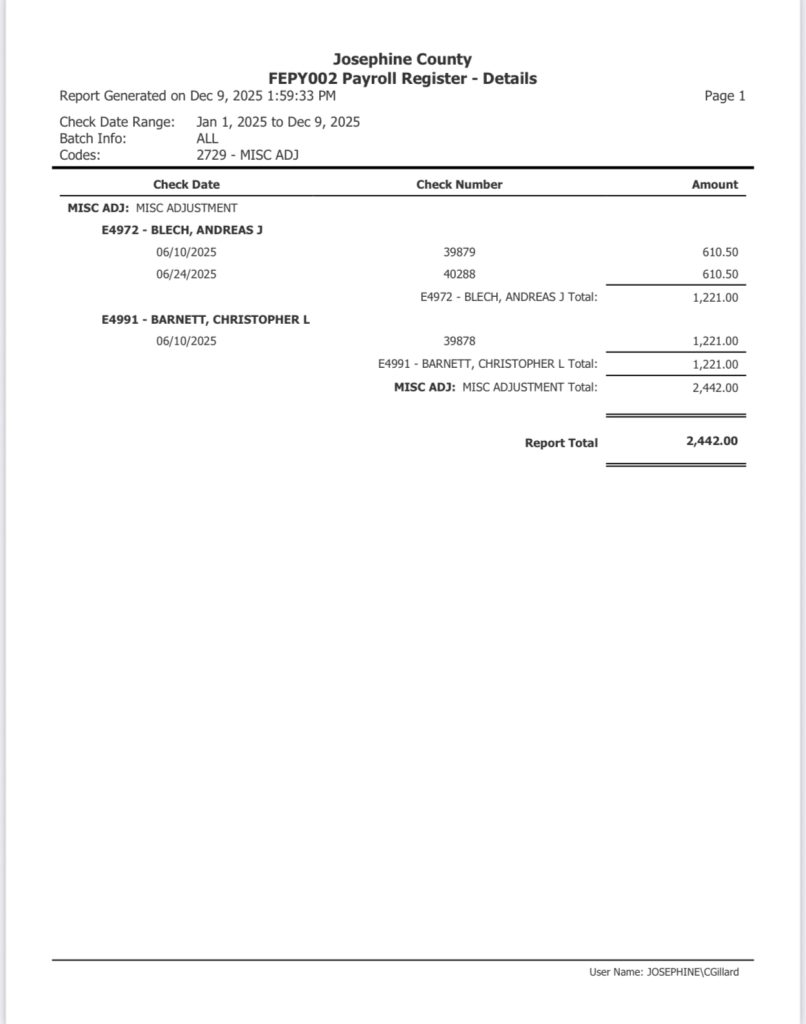
After months of public debate, records requests, and unanswered questions, Josephine County payroll documents now confirm that County Commissioner Chris Barnett and former County Commissioner Andreas Blech reimbursed the county for costs associated with the controversial “CoinGate” incident, though the documentation arrives long after the controversy first erupted.
The newly released records, obtained through a public records request and dated December 9, show payroll adjustments made in June 2025. According to the county’s payroll register, Barnett received a miscellaneous payroll adjustment of $1,221 on June 10, while Blech received two separate payroll adjustments of $610.50 on June 10 and June 24, totaling $1,221. Combined, the adjustments equal $2,442, an amount closely aligned with the approximately $2,500 cost previously cited for the custom challenge coins.
The coins became a flashpoint earlier this year after it was revealed that public tax dollars had been used to order custom Josephine County challenge coins bearing Commissioner Barnett’s name. The purchase was made without prior board approval or a public discussion, raising concerns about appropriate use of taxpayer dollars and prompting widespread scrutiny from residents and local media.
At the height of the controversy, both Barnett and Blech publicly stated that the funds had been repaid or would be reimbursed. However, repeated public records requests seeking documentation of those reimbursements were met with delays, vague responses, or estimates of staff time required to locate records, rather than the records themselves.
The payroll register now confirms that the reimbursements were processed in June, roughly six months before the documentation was produced and approximately nine months after initial records requests were filed. The delayed disclosure has reignited questions not about whether the money was repaid, but why confirmation of that repayment took so long to surface.
Had the payroll documentation or receipts been released when the issue first arose, the controversy may have been resolved far earlier. Instead, the absence of timely records allowed speculation to grow, eroding public trust and extending a dispute that ultimately centered on transparency rather than dollars.
The records show the reimbursements were processed as payroll adjustments rather than direct payments to the county, a method that is legal but less visible to the public without detailed payroll disclosures. That distinction helps explain why the payments were not immediately apparent but does not fully address why the documentation was not proactively released once reimbursement claims were made.
The CoinGate episode has become emblematic of broader concerns regarding transparency and responsiveness within county government. While the payroll records now establish that reimbursement occurred, the prolonged delay in providing confirmation has left residents questioning whether clearer communication and faster compliance with public records laws could have prevented months of controversy.
With the facts now documented, the focus shifts from repayment to accountability. Public confidence depends not only on corrective action, but on timely disclosure. As this episode illustrates, transparency delayed can be just as damaging as transparency denied.