


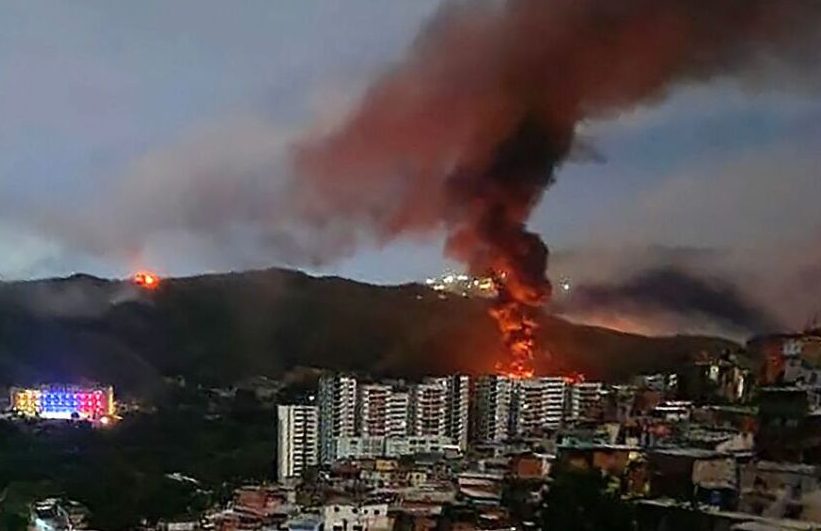
In the early morning hours of January 3, 2026, the United States carried out a large-scale military operation inside Venezuela, triggering explosions in and around the capital city of Caracas and raising immediate questions about the country’s political leadership and regional stability. Residents reported loud blasts, low-flying aircraft, and smoke rising from multiple locations, while parts of the capital experienced power disruptions and widespread confusion as the situation unfolded before dawn.
The operation marked a sharp escalation in long-running tensions between Washington and Caracas. According to statements issued by U.S. leadership, American forces conducted coordinated strikes targeting strategic sites and security infrastructure. President Donald Trump announced that Venezuelan President Nicolás Maduro and his wife had been taken into custody and removed from the country during the operation. As of publication, the precise status and location of Venezuela’s president remained unconfirmed by independent authorities, contributing to uncertainty over who is exercising executive control.
The military action followed months of heightened U.S. activity in the Caribbean region. American naval assets, including the aircraft carrier USS Gerald R. Ford, had been positioned nearby as part of an expanded regional presence. In recent weeks, U.S. forces also seized vessels and conducted maritime strikes that officials said were aimed at disrupting drug trafficking networks operating out of Venezuela. Those actions had already intensified diplomatic strain before the events of Saturday morning.
In response to the strikes, Venezuelan authorities declared a nationwide state of emergency and ordered the mobilization of military and security forces. Government officials denounced the U.S. operation as a violation of national sovereignty and called for internal unity in the face of what they described as an external military threat. With the whereabouts of the president unclear, senior officials moved to secure government facilities and maintain order as the country confronted a rapidly evolving crisis.
International reaction was swift, with governments around the world closely monitoring developments and expressing concern about the implications for regional and global security. Several nations criticized the use of military force and warned that the situation could destabilize Latin America, while others called for restraint and diplomatic engagement to prevent further escalation. Discussions at international institutions were expected as countries weighed the legal and political ramifications of the operation.
Inside Venezuela, daily life was abruptly disrupted. Transportation and commercial activity slowed in major cities as residents sought information amid conflicting reports. Schools and government offices in some areas were closed as authorities assessed damage and security risks. The longer-term impact on Venezuela’s already fragile economy and humanitarian situation remained unclear.
As the day progressed, key questions remained unanswered, including the full scope of the military operation, the chain of command now governing Venezuela, and the potential for additional actions by the United States or its allies. With facts still emerging and official confirmations limited, the situation stood as one of the most significant and consequential developments in U.S.–Venezuela relations in decades, with outcomes that could reshape the political landscape of the region in the days ahead.