


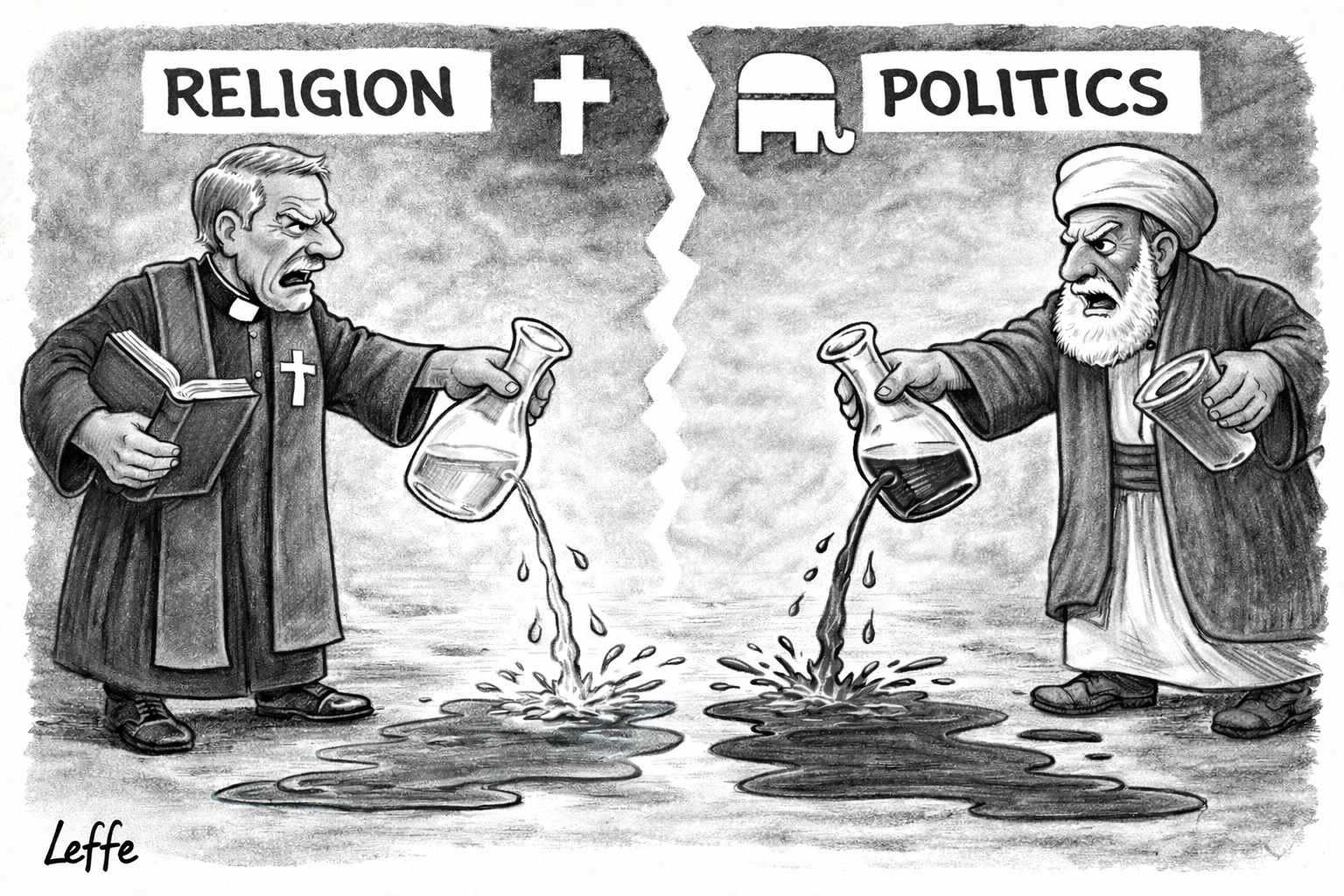
There are two subjects families instinctively avoid at the dinner table for a reason. Politics and religion. Nearly everyone has heard the rule at some point in their lives. Do not talk about politics. Do not talk about religion. The warning exists because both subjects reach into the deepest parts of personal identity, belief, and emotion. They divide even those who love each other most. If these conversations can fracture families gathered in good faith, it should surprise no one that combining them in government creates something far more dangerous.
Yet in Josephine County, the line between political leadership and religious influence has steadily blurred. Candidates increasingly present themselves not simply as public servants, but as moral authorities, invoking scripture, faith identity, and religious affiliation as political credentials. Campaign messaging leans heavily on religious symbolism and spiritual language, appealing to voters through belief rather than policy, competence, or governance experience.
The problem is not faith itself. Faith has long played a role in shaping individual values and moral frameworks. Many voters appreciate leaders guided by personal conviction. The issue arises when religion becomes a campaign tool rather than a personal compass. Public office requires accountability to all residents, not only to those who share a particular theology.
Government operates on budgets, land use decisions, contracts, infrastructure planning, and regulatory oversight. These responsibilities demand transparency, measurable outcomes, and secular governance grounded in law. Religious institutions operate under an entirely different framework. Churches exist to serve spiritual communities, offer charity, and provide moral guidance. They are structured as nonprofit organizations and are intentionally separated from political power to preserve both religious freedom and democratic fairness.
When those two worlds intersect too closely, conflicts of interest become unavoidable.
Josephine County offers a visible example of this tension. Over the past two decades, churches and religious organizations have expanded significantly across the region. Anyone driving through town can observe the growth in church facilities, properties, and affiliated developments. While many of these institutions contribute positively to community life, the broader question remains whether public decision-making has consistently maintained appropriate distance from religious influence.
Land transfers, zoning considerations, development approvals, and special accommodations granted to religious organizations inevitably raise concerns about equitable treatment. When political leaders openly align themselves with religious institutions while overseeing decisions that may benefit those same institutions, public trust erodes. Even the perception of preferential treatment undermines confidence in government neutrality.
The controversy surrounding large-scale developments such as the Flying Lark illustrates how complicated the relationship between private interests, public policy, and community expectations can become. While not solely a religious matter, it reflects a broader pattern in which influence, access, and persuasion shape outcomes in ways that leave residents questioning whose interests are truly being served.
Religion carries immense emotional power. It speaks to conscience, salvation, and belonging. When political figures invoke that power, disagreement becomes framed not as policy debate but as moral opposition. Citizens who question decisions risk being portrayed as opposing faith itself rather than simply exercising civic oversight. That dynamic creates a built-in guilt mechanism that has no place in democratic governance.
A pastor, minister, or spiritual leader already serves a higher calling. Religious leadership demands full devotion to guiding congregations, offering counsel, and nurturing faith communities. Public office demands something entirely different: negotiation, compromise, fiscal management, and representation of diverse viewpoints. Attempting to hold both roles simultaneously invites divided loyalties and impossible expectations.
Politics does not require spiritual authority, and faith does not require political power. When either attempts to borrow legitimacy from the other, both institutions suffer. Religion risks becoming politicized, losing its moral independence. Government risks becoming exclusionary, favoring belief over citizenship.
Josephine County stands at a moment where voters must decide what kind of leadership they want. A community governed by shared laws or one influenced by religious persuasion disguised as public policy. History repeatedly demonstrates that when politics and religion merge too closely, transparency weakens, accountability fades, and division deepens.
Faith belongs in the heart, the home, and the sanctuary. Politics belongs in open chambers governed by law and public scrutiny. The separation between the two is not hostility toward religion; it is protection for both democracy and faith itself.
Josephine County does not need holy politicians. It needs competent leaders. When the pulpit becomes a campaign platform, the result is not moral governance but institutional confusion. Mixing politics and religion is not unity. It is the beginning of imbalance, and for this community, it is a risk we can no longer afford to ignore.