


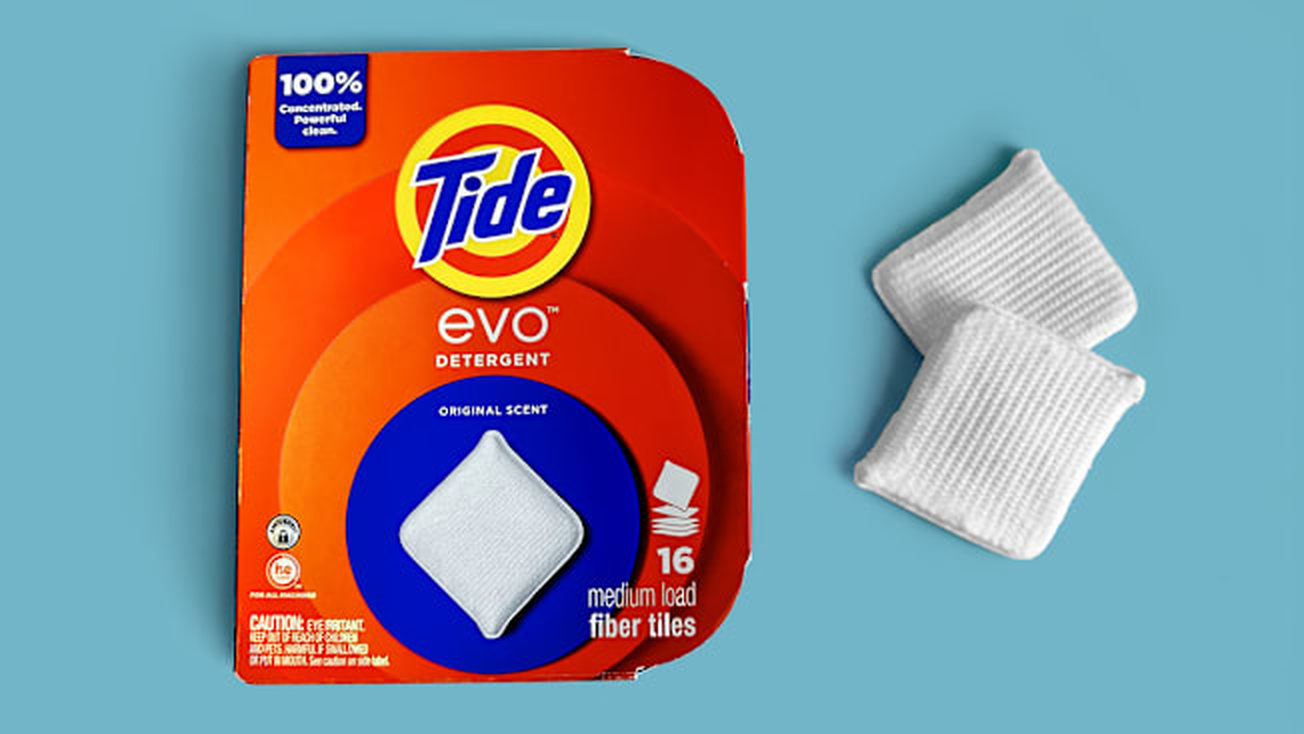
A quiet shift is taking place in the laundry aisle, and it is not about brighter whites or stronger stain fighters. It is about format. With the introduction of Tide Evo, detergent giant Procter & Gamble is attempting to redefine how consumers interact with a product that has remained largely unchanged for decades.
Tide Evo does not come in a jug, a bottle, or even a pod. Instead, it arrives as a thin, solid tile made from compressed detergent fibers. Each tile is premeasured and designed to dissolve in the wash, eliminating the need for pouring, measuring, or dealing with spills. On the surface, the appeal is obvious. The packaging is compact, the process is simplified, and the absence of bulky plastic containers speaks directly to growing concerns about environmental waste.
The innovation lies in its fiber-based structure. By compressing detergent into layered fibers, the product increases surface area, allowing it to dissolve quickly and distribute cleaning agents evenly throughout a load. It is a notable departure from traditional liquid detergents, which are largely water by volume, and even from pods, which rely on a dissolvable film to contain liquid.
Yet for all its modern engineering and environmental positioning, the central question remains unchanged. Does it clean better, and is it worth the cost?
From a performance standpoint, Tide Evo delivers results comparable to other premium detergents. It handles everyday laundry with consistency, breaking down dirt and odors in a manner that will feel familiar to anyone who has used traditional Tide products. There is no dramatic leap in cleaning power, no revolutionary improvement in stain removal. What it offers is not a superior clean, but a different method of achieving the same result.
The more revealing distinction emerges when the numbers are examined. A standard liquid detergent can often be purchased for approximately fifteen dollars and yield around 120 loads. That places the cost per load at roughly twelve cents. Tide Evo, by comparison, typically sells for about twenty dollars for a 42-count box. That translates to nearly fifty cents per load.
The difference is not subtle. Over time, it becomes significant, particularly for larger households where laundry is a constant routine rather than an occasional chore. While the tile format eliminates mess and reduces storage space, it does so at a premium that cannot be ignored. Consumers are effectively paying more for convenience and packaging innovation, not for enhanced cleaning capability.
There is also the question of flexibility. Liquid detergents allow users to adjust the amount based on load size or soil level. Tide Evo removes that variable. Each tile represents a fixed dose, which simplifies the process but limits customization. For lightly soiled loads, it may feel excessive. For heavily soiled items, it may require additional treatment outside the tile itself.
None of this diminishes the product’s appeal for a certain type of consumer. Those who value simplicity, dislike handling liquid detergents, or are actively trying to reduce plastic use may find Tide Evo to be a worthwhile tradeoff. Its clean design and ease of use align with a broader shift toward streamlined household products that prioritize convenience and sustainability.
However, for consumers focused on value, the equation is harder to justify. The cost per load is significantly higher, and the cleaning performance does not surpass what is already available at a lower price point. In practical terms, Tide Evo is not a more efficient way to do laundry. It is simply a different way.
Tide Evo represents an evolution in presentation rather than performance. It signals where the industry may be heading, but it also underscores a familiar reality. Innovation often arrives with a premium, and whether that premium is worth paying depends entirely on what the consumer values more, convenience or cost.