


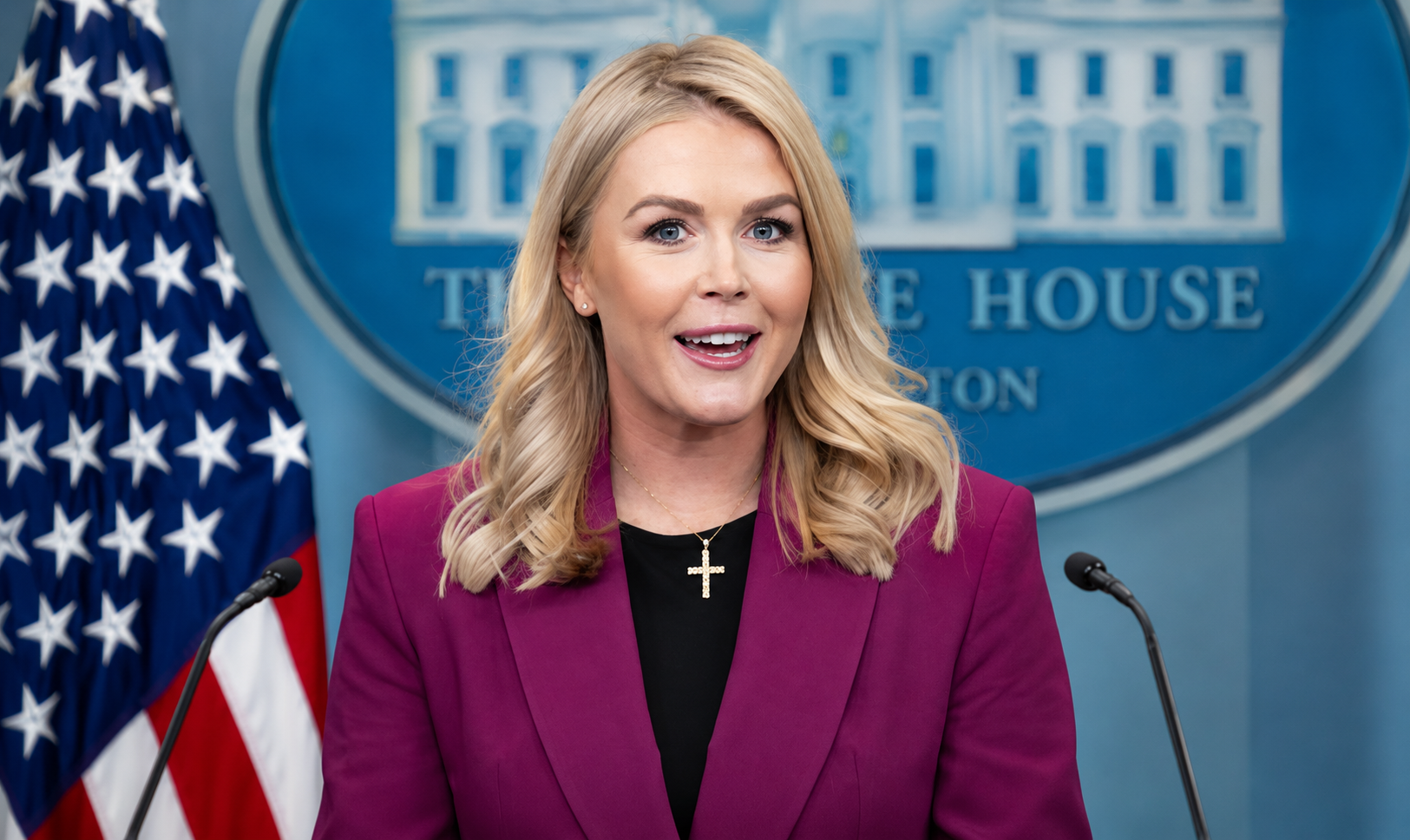
One of the most familiar public faces of President Donald Trump’s second administration is preparing to leave the White House, opening a consequential position inside the president’s communications operation just as Washington moves toward the final months before the 2026 midterm elections. White House press secretary Karoline Leavitt will step down at the end of August, ending a tenure that placed her behind one of the most visible podiums in American politics and made her the youngest person in U.S. history to serve as the president’s chief spokesperson.
Trump announced Leavitt’s departure Wednesday, saying the 28-year-old press secretary had decided to leave the demanding government position to spend more time with her husband and their two young children. Leavitt recently returned to the White House following maternity leave after giving birth to her second child, a daughter, in May. Her departure closes this chapter of her government service after more than a year and a half representing the administration through domestic political battles, economic debates, foreign-policy developments and the daily pressures that accompany speaking publicly for a sitting president.
The change should not be interpreted as a political break between Leavitt and Trump. The president has asked her to remain involved as a top outside adviser, allowing one of his longtime communications allies to leave the formal structure of the federal government while maintaining a role in his broader political orbit. Leavitt has indicated that she intends to continue supporting Trump and Republican political efforts, making her departure from the White House more of a transition in responsibilities than an exit from national politics.
No successor had been announced as of Wednesday evening, leaving the administration with an important personnel decision at a particularly active point in the political calendar. The next press secretary will become the principal public representative of a White House heading toward the November midterm elections, when every seat in the U.S. House and a portion of the Senate will be decided. The person selected will also inherit a communications system that looks considerably different from the traditional White House press operation that existed through much of the modern presidency.
Leavitt arrived at the podium with a political résumé already closely connected to Trump. She worked within the White House press operation during his first administration before serving as communications director for New York Rep. Elise Stefanik. She later entered electoral politics herself, winning the Republican nomination for New Hampshire’s 1st Congressional District in 2022 before losing the general election to Democratic Rep. Chris Pappas. That campaign gave Leavitt experience not only as a political communicator but also as a candidate required to defend her own positions before voters.
Her national profile grew considerably during the 2024 presidential campaign when she became Trump’s national press secretary and regularly appeared on television and other media platforms defending the candidate and explaining campaign positions. Following Trump’s return to the presidency, Leavitt was selected as White House press secretary and assumed the position in January 2025 at age 27. Her appointment immediately established a historical milestone, but her time in the job would become associated with a broader transformation underway inside presidential communications.
Working alongside White House communications director Steven Cheung and other senior administration officials, Leavitt became part of an effort to expand the range of media organizations receiving access to the administration. Podcasters, digital publishers, online commentators and other nontraditional media figures were increasingly incorporated into White House communications, including through a new-media seat in the briefing room. The strategy reflected the administration’s determination to communicate with audiences increasingly receiving their news through podcasts, social platforms and independent digital outlets rather than exclusively through newspapers, broadcast networks and cable television.
That transformation also produced disagreements over press access and the relationship between the presidency and the journalists assigned to cover it. The administration assumed greater authority over participation in the White House press pool, the small rotating group of journalists permitted to accompany the president when physical space prevents the entire press corps from attending. The White House Correspondents’ Association had historically exercised a central role in organizing that system, making the administration’s decision to take greater control a substantial change in the longstanding relationship between the executive branch and the journalists covering it.
Leavitt consequently served during a period when the traditional televised briefing became only one part of a much larger presidential communications network. Formal appearances from the White House briefing room continued, but the administration increasingly relied on social media, digital publishers, alternative media platforms, appearances by senior officials and Trump’s own frequent conversations with reporters. Rather than allowing the daily briefing to serve as the primary window into the administration, information often emerged from several channels simultaneously, requiring the press secretary to operate within a communications environment that moved far beyond the podium itself.
Trump’s own approach has further altered the traditional boundaries of the position. He frequently speaks directly with reporters and uses social media to announce decisions, promote policies and respond to political developments, reducing some of the reliance previous presidents placed on their press secretaries to deliver the administration’s message. Leavitt nevertheless remained responsible for explaining presidential decisions, responding to controversies and defending administration policies while maintaining command of an enormous range of domestic and international issues.
Her successor will inherit those same demands at a politically sensitive moment. Although the White House press secretary serves the federal government rather than a political campaign, presidential communications inevitably receive greater scrutiny during election season as Americans evaluate the administration’s economic record, legislative priorities, immigration policies, foreign affairs decisions and broader direction. With congressional control at stake in November, virtually every major White House announcement will unfold against the backdrop of an increasingly intense national political campaign.
Moving outside government could also give Leavitt considerably different latitude in how she participates in politics. Federal employees operate under legal and ethical restrictions governing political activity that do not apply in the same manner to private political advisers. Her transition therefore allows her to remain within Trump’s political network without carrying the daily institutional responsibilities attached to speaking officially for the United States government, potentially giving her a more flexible role as Republicans enter the final stretch before the midterms.
The personal circumstances behind the decision are equally central to understanding the timing. Serving as White House press secretary requires constant preparation, extensive knowledge of administration policy and the ability to respond rapidly to events developing anywhere in the world. The position routinely extends well beyond scheduled briefings, requiring coordination with the president, senior advisers, federal agencies and communications officials while national and international events continue around the clock. Leavitt returned from maternity leave this summer before deciding to leave the position and devote additional time to her family and two young children.
Her departure will end a relatively short but unusually visible chapter in modern White House communications. From becoming the youngest press secretary in American history to helping oversee an administration that deliberately expanded presidential access beyond the traditional Washington press establishment, Leavitt occupied the position while the boundaries between conventional journalism, digital media and direct political communication continued to shift rapidly.
Trump’s eventual choice of a successor will determine who takes responsibility for explaining his administration through the approaching midterms and the remainder of his presidency. It may also reveal whether the White House intends to preserve the communications structure developed during Leavitt’s tenure or make additional changes as the political environment evolves. Leavitt, meanwhile, is leaving the briefing room without leaving Trump’s political world, exchanging the responsibilities of an official government spokesperson for an outside advisory role that could keep her prominently involved in national politics long after her final White House briefing.