


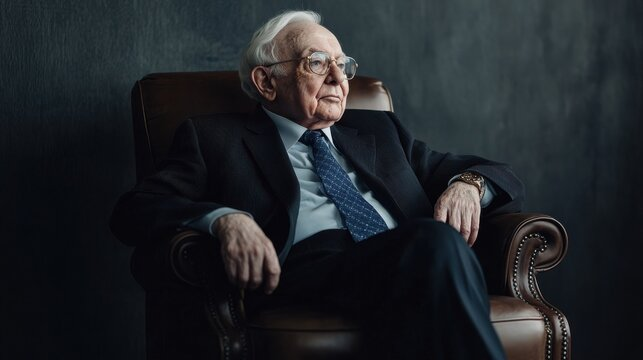
Warren Buffett has stepped down as chairman of Berkshire Hathaway after 56 years in the position, completing the transfer of leadership at a company he spent more than six decades building from a failing textile manufacturer into a corporate enterprise valued at more than $1 trillion.
Buffett, 96, will remain a Berkshire director and assume the title of chairman emeritus. His son, Howard G. Buffett, has been elected chairman, while Greg Abel continues as chief executive officer after succeeding Buffett at the beginning of 2026.
The change ends Buffett’s formal leadership of one of the most remarkable corporate expansions in American business. When he took control of Berkshire in 1965, the company was rooted in a deteriorating New England textile industry. Buffett eventually abandoned the textile business but retained Berkshire itself, converting the company into the vehicle for an investment and acquisition strategy that would stretch across insurance, railroads, utilities, manufacturing, retail and financial markets.
He became chairman in 1970 and spent the next half-century directing capital into companies he considered durable, profitable and capable of producing returns over long periods. Berkshire acquired entire businesses while also accumulating major stock positions in some of the country’s largest corporations.
Insurance became one of the engines behind that expansion. GEICO and Berkshire’s other insurance operations generated premiums that provided substantial capital available for investment before claims were paid. Berkshire used that financial structure alongside earnings from its operating companies to finance acquisitions and investments without depending heavily on conventional corporate borrowing.
The result was a company unlike most of its peers. Berkshire eventually came to control BNSF Railway, GEICO, Berkshire Hathaway Energy and dozens of manufacturing, distribution, retail and service businesses, while maintaining a large portfolio of publicly traded securities.
Its financial record made Buffett one of the most closely watched investors in modern American history. Berkshire produced compounded annual growth of approximately 19.9 percent during Buffett’s tenure as chief executive, compared with roughly 10.4 percent for the S&P 500 over the comparable period. Decades of compounding turned early Berkshire investments into extraordinary gains and helped build Buffett’s personal fortune almost entirely through his ownership of the company.
Buffett also became one of the nation’s largest philanthropists. Beginning in 2006, he started giving away Berkshire shares worth tens of billions of dollars, primarily through charitable foundations, while continuing to hold much of his remaining wealth in Berkshire stock.
Planning for Berkshire without Buffett had been underway for years. Abel, who spent decades inside the organization and previously supervised Berkshire’s non-insurance businesses, was publicly identified as Buffett’s eventual successor in 2021. Buffett announced in May 2025 that Abel would take over as chief executive, and the transition became official Jan. 1, 2026.
Howard Buffett’s elevation to chairman completes that restructuring. He has served on Berkshire’s board since 1993 and will oversee the board rather than manage the company’s daily operations. Abel remains responsible for Berkshire’s businesses and investment decisions, establishing a division of responsibilities that replaces the extraordinary concentration of authority Warren Buffett held for generations.
Berkshire enters that period with operations spanning much of the American economy and a market value exceeding $1 trillion. Buffett remains inside the company as a director, but for the first time since 1970, Warren Buffett no longer occupies the chairman’s seat at Berkshire Hathaway.