


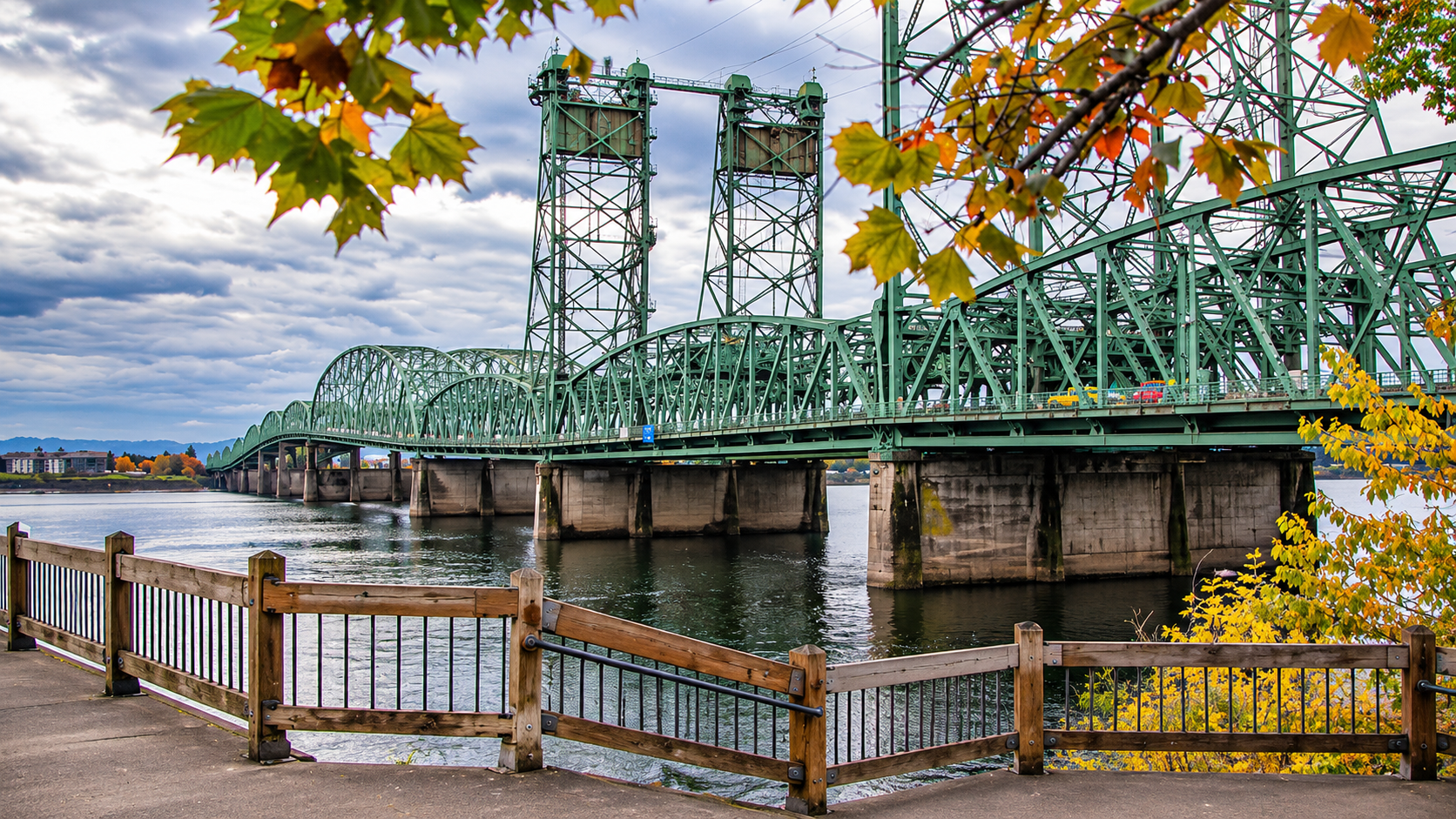
A multibillion-dollar infrastructure project that will reshape one of the Pacific Northwest’s busiest transportation corridors advanced Monday, November 23, as the Interstate Bridge Replacement Program formally issued a request for proposals to design and construct a new Interstate 5 crossing over the Columbia River between Oregon and Washington.
The announcement moves the two states closer to replacing an aging transportation link that accommodates approximately 143,000 vehicles and $132 million in commercial goods daily. With construction anticipated to begin in late 2028, the undertaking carries substantial implications for Oregon’s economy, interstate commerce, transportation infrastructure, public finances and emergency preparedness.
The request for proposals establishes a March 24, 2027, submission deadline for Columbia River Constructors, a joint venture consisting of Kiewit Infrastructure West, Guy F. Atkinson Construction, LLC, and Traylor Bros., Inc. The companies advanced through a qualifications review that evaluated their ability to design and construct the replacement crossing.
Should the proposal satisfy program requirements and receive approval, negotiations for design services are expected to begin in mid-2027. The Washington State Department of Transportation will administer the progressive design-build contract in coordination with the Oregon Department of Transportation, with both agencies overseeing activities within their respective states.
The estimated value of the bridge replacement contract ranges from $3.3 billion to $3.9 billion. That expenditure represents one component of a considerably larger transportation development encompassing approximately five miles of the Interstate 5 corridor. October 2026 financial projections placed the estimated cost of the broader program between $13.5 billion and $15.2 billion, with a probable cost of $14.4 billion.
Financing an infrastructure project of this magnitude remains among the most substantial undertakings facing both states. The program has identified approximately $5.69 billion in funding and anticipated financing through state appropriations, federal infrastructure grants and projected toll revenue. Oregon has committed $1 billion toward the development, while federal contributions include a $1.5 billion Bridge Investment Program grant and a separate $600 million infrastructure grant. Additional Washington state and federal transportation allocations contribute to the financing structure.
Approximately $1.5 billion of the identified financing is projected to come from toll collections, placing a portion of the project’s financial responsibility directly on motorists and commercial transportation operators. An additional $1 billion in prospective federal transit funding is being pursued to support light rail development, subject to federal approval and applicable matching requirements.
Despite the billions already committed or identified, financing remains incomplete. Existing financial commitments are intended to advance the initial construction phase, leaving a substantial funding gap between available resources and the projected cost of completing the entire five-mile transportation corridor.
The existing Interstate Bridge consists of two structures constructed more than four decades apart. The original northbound bridge opened in 1917, followed by the southbound structure in 1958. Both have remained integral to the movement of passengers, commercial freight and essential supplies between Oregon and Washington despite mounting structural and operational deficiencies.
Federal transportation assessments have documented deteriorating infrastructure, inadequate emergency shoulders, narrow travel lanes and foundation vulnerabilities. The northbound bridge’s superstructure has been classified as being in poor condition, while the southbound structure has been classified as fair.
Approximately 14,300 commercial trucks cross the Columbia River at the Interstate Bridge each day, navigating a corridor where federal assessments have documented nearly 12 hours of daily congestion. Traffic collisions, mechanical disruptions and bridge lifts further complicate the movement of freight and passenger vehicles, exposing transportation companies and businesses to delivery interruptions and additional operating expenses.
Under the proposed construction plan, two single-level, fixed-span bridges will replace the existing structures, providing three continuous interstate travel lanes and an additional auxiliary lane in each direction. The development will also reconstruct transportation connections serving Hayden Island in Oregon and State Route 14 in Washington.
Modern emergency shoulders will accommodate designated bus operations, while the southbound structure will incorporate space capable of supporting light rail service. A separated pedestrian and bicycle pathway will occupy a portion of the northbound bridge, expanding transportation access across the Columbia River.
The fixed-span configuration will eliminate mechanical bridge lifts, removing a longstanding source of interstate traffic interruptions associated with accommodating marine vessels beneath the existing crossing.
Beyond congestion and structural deterioration, the replacement project addresses a significant vulnerability within Oregon’s emergency transportation network. The existing bridges rely in part on aging timber foundations embedded in soils susceptible to failure during substantial seismic activity, raising concerns about the crossing’s ability to withstand a major Cascadia Subduction Zone earthquake.
The loss of the Interstate Bridge during a catastrophic seismic event could sever a primary transportation connection between Oregon and Washington, disrupting the distribution of emergency personnel, medical supplies, fuel, food and commercial merchandise. Modern seismic engineering incorporated into the replacement structures is intended to reduce that vulnerability and preserve interstate connectivity following a major natural disaster.
The economic reach of the construction project extends hundreds of miles beyond the Columbia River. Interstate 5 remains Oregon’s principal north-south commercial transportation artery, connecting agricultural producers, manufacturers, timber operations, distribution centers and retailers with domestic and international markets.
Commercial shipments originating in Southern Oregon travel through the Portland region toward Washington, Canadian markets and distribution facilities throughout the Pacific Northwest. Freight originating in Josephine, Jackson, Douglas and surrounding counties is consequently exposed to transportation delays, operating costs and infrastructure limitations along the same interstate corridor.
For Oregon’s agricultural and forest products industries, where transportation expenses influence production costs and access to markets, the reliability of the Columbia River crossing carries economic consequences far removed from the construction site. Highway disruptions can affect delivery schedules, equipment availability and the movement of raw materials and finished products throughout the state.
The multibillion-dollar development also opens potential contracting opportunities for construction companies, engineering firms, equipment suppliers, material manufacturers and specialized trade businesses across Oregon. Federal small-business participation goals associated with the procurement have been established at 16 percent for design services and 19 percent for construction activities.
While construction could generate business opportunities across multiple industries, the introduction of tolling will establish a new transportation expense for motorists and commercial freight operators utilizing the crossing.
Toll collection could begin as early as 2028, potentially requiring motorists to contribute toward construction financing several years before the replacement bridges become operational. Preliminary tolling studies have examined passenger vehicle rates ranging from $1.55 to $4.70 per crossing, with higher charges under consideration for commercial vehicles and potential discounts for qualifying low-income motorists.
Transportation commissions in Oregon and Washington have yet to establish final toll rates, collection policies or applicable discounts. The eventual pricing structure will influence transportation expenses for interstate commuters, freight carriers and businesses whose operations require regular travel between the two states. Toll revenue is expected to contribute toward construction financing, maintenance and long-term bridge operations.
The program cleared a major federal regulatory hurdle on July 1, 2026, when the Federal Highway Administration and Federal Transit Administration issued an Amended Record of Decision, concluding the federal environmental review process. Federal funding obligations subsequently advanced in September, with approximately $546 million designated for preliminary engineering and property acquisition activities.
Construction is projected to span six to seven years, placing potential completion of the replacement crossing in the mid-2030s. The existing bridges are expected to remain operational throughout construction, preserving interstate access while the replacement structures rise immediately to their west. Demolition of the original bridges will follow the transfer of traffic and could require an additional two to three years.
Monday’s announcement now places the immediate focus on the March 2027 proposal deadline, subsequent contract negotiations and the financial arrangements necessary to sustain construction. With only one qualified contracting team advancing to the proposal stage, contract pricing, cost controls and the management of public expenditures remain significant components of the procurement process.
By the anticipated start of construction in 2028, the original Interstate Bridge will have carried traffic across the Columbia River for 111 years. Its replacement will require Oregon and Washington to coordinate billions of dollars in public investment, federal assistance and toll financing while maintaining uninterrupted access, to the extent possible, along one of the West Coast’s primary commercial corridors.
For Oregon, the financial obligations will extend well beyond the Portland metropolitan area, just as the economic consequences of the existing bridge’s limitations already do. Over the coming decade, the state’s investment in the Columbia River crossing will unfold alongside the daily movement of millions of dollars in merchandise, the transportation needs of communities from the California border to the Columbia River, and the continued operation of an interstate network serving the broader Pacific Northwest.