


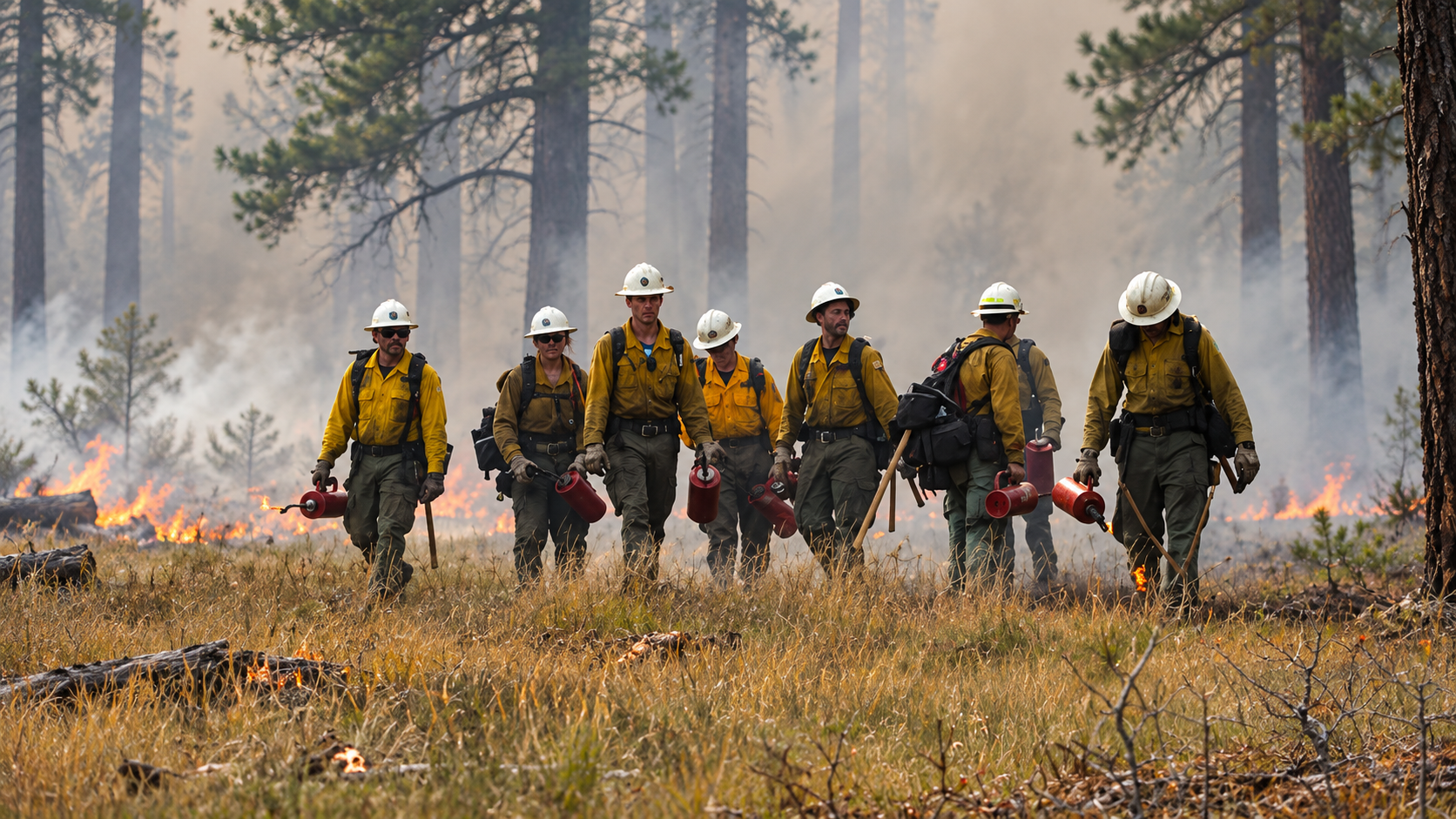
Families of wildland firefighters killed in the line of duty could receive a $100,000 federal payment under bipartisan legislation that would extend eligibility beyond federal employees to qualifying state and local firefighters and private contractors, including workers who help protect Oregon communities.
Oregon Senator Jeff Merkley and Utah Senator John Curtis publicly presented the Honoring Fallen Wildland Firefighters Act on October 5. The proposal addresses financial assistance after a firefighter’s death in a workforce drawn from public agencies and private companies, whose crews often serve together on wildfire assignments.
The measure, Senate Bill 5624, was introduced September 30 and referred to the Senate Committee on Homeland Security and Governmental Affairs. It remains proposed legislation. Congress would have to approve the measure and it would have to become law before families could receive the new payment.
For Oregon, the proposed expansion reaches into a firefighting system that depends on multiple employers and contracted resources. The Oregon Department of Forestry secures private crews, equipment and services through Incident Resource Agreements, including call-when-needed arrangements that allow the department to dispatch resources as fires develop.
Those agreements provide access to firefighting hand crews, fallers, heavy equipment and water-handling resources. They also supply medical services, mobile kitchens and other incident support. A contractor’s presence at a wildfire, however, would not automatically qualify that worker for the proposed death benefit.
The bill limits contractor eligibility to individuals serving a covered public agency through specified contracts who directly perform fire suppression as aerial or ground crew members or equipment operators. Its definition also includes travel to and from those direct suppression activities.
Covered agencies would include the U.S. Forest Service, Interior Department agencies, and state or local firefighting entities. For public employees, the proposal concerns firefighters whose primary duties involve forest, rangeland or other wildland fires rather than structural fires.
That eligibility framework could reach qualifying workers employed in Oregon or dispatched from Oregon to assignments elsewhere. The proposal is national, with coverage based on the firefighter’s work and the circumstances of the death rather than residence in a particular state.
The legislation would amend the Federal Employees’ Compensation Act to establish a lump-sum death gratuity tied to an existing federal statutory maximum, currently $100,000. Qualifying deaths would have to result from injuries connected with wildland firefighting service and incurred in the line of duty.
The text applies to deaths occurring on or after January 1, 2026. If Congress retains that provision and enacts the bill, qualifying deaths earlier this year could fall within its coverage.
The sponsors have compared the proposed payment with the existing death gratuity of up to $10,000 available for qualifying federal employees killed in the line of duty. Federal personnel guidance gives agency heads authority to make that payment to an employee’s personal representative.
The $10,000 figure does not represent the total assistance every surviving family can receive. Federal survivor compensation, retirement benefits and life insurance may also apply, depending on employment, coverage and eligibility. The proposed legislation would establish a new gratuity; the existing comparison should not be read as a complete accounting of benefits available after a firefighter’s death.
The measure has support from organizations representing federal employees, wildland firefighters, state forestry agencies, private wildfire suppression companies and aerial firefighting operations. Supporters listed by Merkley’s office include the National Federation of Federal Employees, Wildland Firefighter Foundation, National Association of State Foresters, National Wildfire Suppression Association and United Aerial Firefighters Association.
Across Oregon, the practical reach of the proposal would depend on whether a fallen firefighter meets its employment, contract and duty requirements. Public agencies and contractors would continue operating under existing benefit systems while the Senate committee considers legislation that could establish a broader federal payment for qualifying families.