


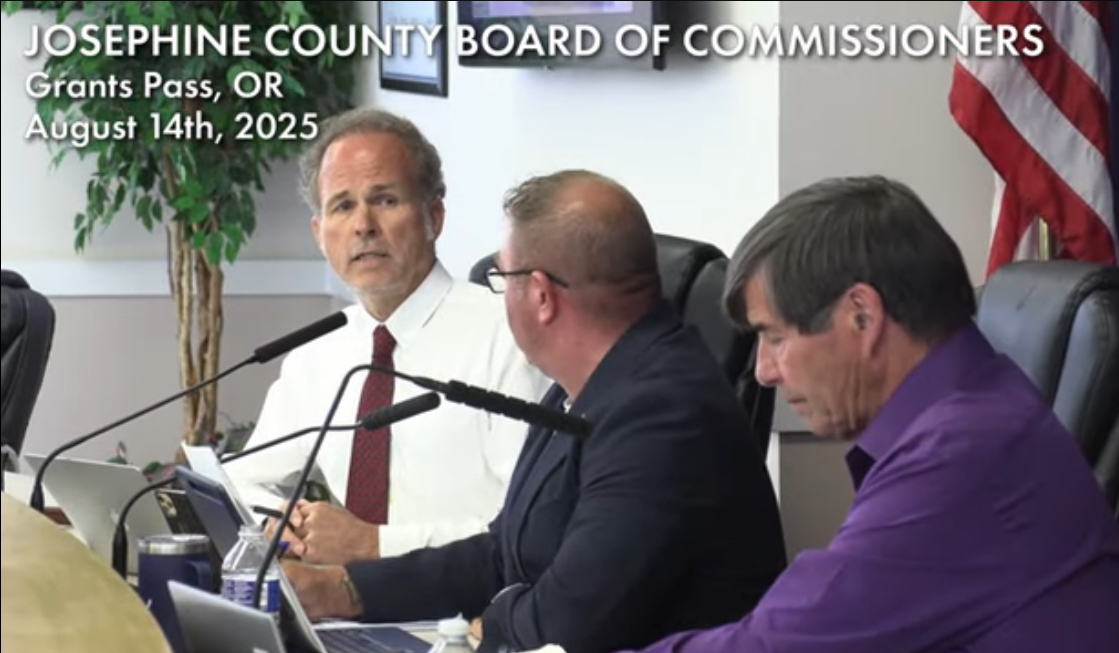
The Josephine County Board of Commissioners has once again turned the community’s library system into a political battleground. On Thursday, the Board approved a new lease for the Grants Pass library branch but reinserted a controversial “termination for convenience” clause — a move that has reignited community frustration and left library supporters questioning the Board’s motives.
The clause, championed by Commissioner Andreas Blech, allows either party to terminate the lease with just 30 days’ notice. It is the same provision the commissioners used in January to abruptly end the library’s long-standing $1-per-year lease, which had been in place since 1959. That decision triggered months of uncertainty, disrupted trust, and cast doubt over whether the county’s leaders were genuinely committed to supporting one of the region’s most relied-upon community resources.
For many residents, Thursday’s vote confirmed what they suspected: that Commissioner Blech has chosen to align himself with the hardline tactics once employed by former Commissioner John West. In the eyes of critics, Blech has revealed his true colors — continuing a pattern of governance that favors control and unilateral authority over collaboration and compromise.
After the January vote to terminate the lease, the commissioners appointed Chris Barnett to negotiate a new agreement with library leadership. From May through July, Barnett and the district’s legal counsel worked out what appeared to be a fair compromise. Under the draft agreement, the library district agreed to assume new costs and responsibilities, including landscaping, routine maintenance, and even an amortized contribution toward the building’s roof replacement. In exchange, the county would commit to a stable five-year lease with no option for early termination except in cases of breach.
That draft was widely viewed as a workable solution, balancing fiscal responsibility with the need for continuity in library services. But with the stroke of Blech’s amendment Thursday, the foundation of that compromise was effectively erased.
Library leaders expressed dismay at the reversal, warning that a 30-day termination clause is incompatible with the realities of running a public library system. Planning, staffing, and maintaining services for thousands of patrons cannot be accomplished under the constant threat of sudden eviction.
The decision has left many in the community asking what exactly drives the commissioners’ ongoing hostility toward the library system. The district has operated the main branch in Grants Pass for decades, providing educational resources, community programming, and safe public spaces. Yet time and again, recent county leadership has acted in ways that destabilize the institution rather than support it.
Some believe the commissioners are withholding transparency, that more is happening behind closed doors than the public has been told. The narrative advanced by Blech and his allies suggests that if the situation is not handled strictly their way, it should not proceed at all. This approach mirrors the heavy-handed politics of John West, whose tenure was marked by similar clashes with community groups.
“It’s no good for anything else if it’s not good for him,” one frustrated observer put it, capturing the sentiment that Blech views governance as a zero-sum exercise in control rather than an opportunity to foster public trust.
For now, the Grants Pass library remains open under the new lease terms, but its future is anything but secure. The reintroduction of the termination clause effectively means the district can never plan beyond a month at a time, undermining its ability to responsibly manage staff, programs, or investments in the facility.
The library board will convene Thursday to review the situation, pledging to keep the public informed as events unfold. Whether the commissioners’ actions ultimately result in another standoff remains to be seen, but the fracture between county leadership and the community it serves has widened yet again.
The episode highlights a broader issue: the relationship between elected officials and the institutions meant to serve residents. Instead of providing stability, the commissioners have sown uncertainty, leaving many to conclude that there is something more at play — some deeper conflict or agenda not yet fully revealed.
In the end, the people of Josephine County are left with a library system that operates under constant threat and a Board of Commissioners that appears more interested in asserting control than in supporting one of the county’s most valuable community assets.