


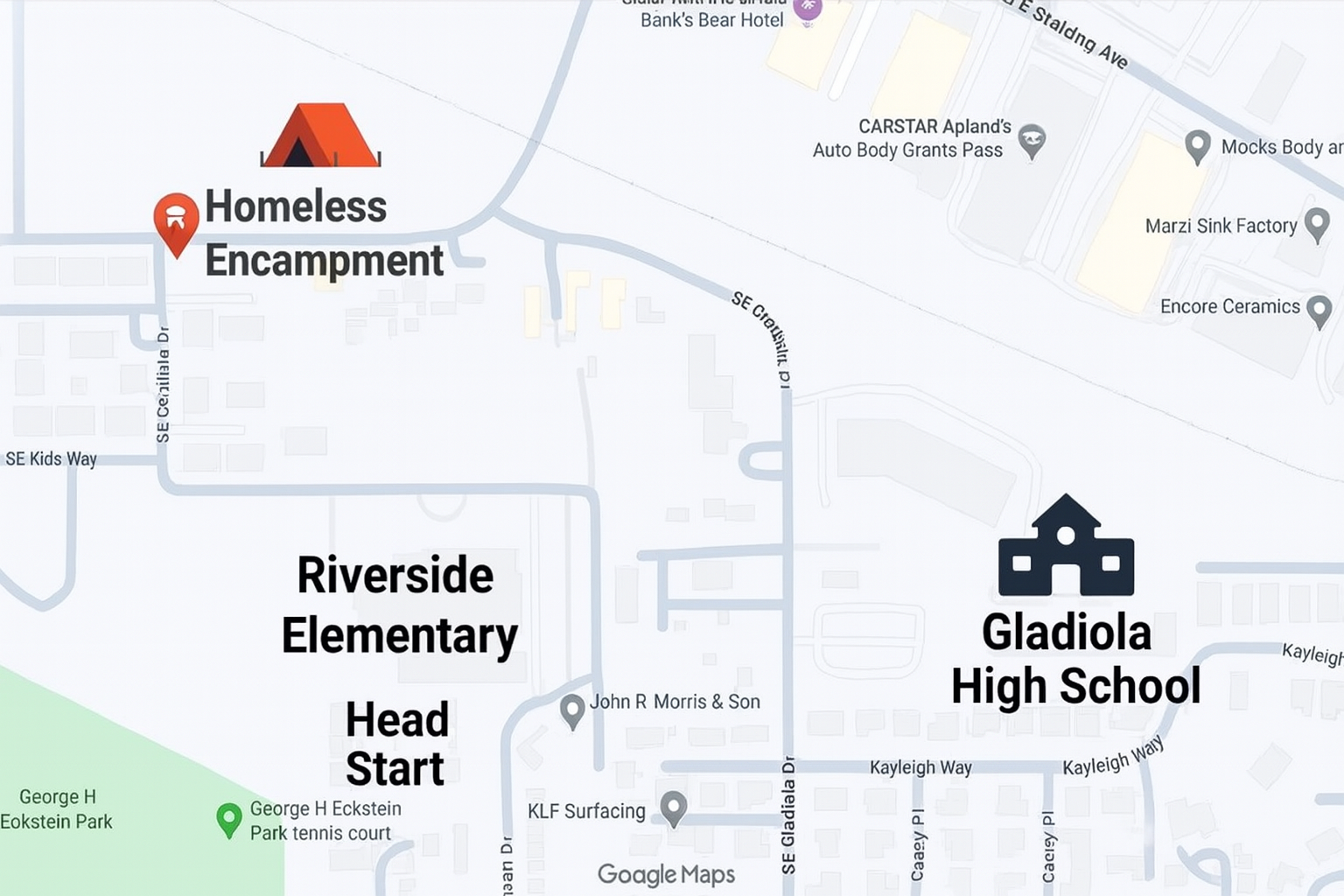
The Grants Pass City Council has officially voted to approve the N Street property as the location for a managed homeless encampment, awarding its $1.2 million Addressing Homelessness Grant to Pathways to Stability. While the City’s decision moves the project one step closer to reality, the final say now rests with the Josephine County Board of Commissioners (BCC), which owns the property. Without the Commissioners’ approval of a lease agreement, the plan cannot proceed — and the community debate surrounding the site continues to intensify.
The N Street location, just before it turns into Agness Avenue, sits near Riverside Elementary, Head Start, and Gladiola High School. That proximity has fueled widespread public opposition, with many parents, educators, and nearby residents calling the site selection both unsafe and poorly considered. The decision has also drawn criticism for how the process unfolded, with several community members questioning whether due diligence and transparency were fully observed.
Under the City’s own Request for Proposals (RFP) guidelines, applicants for the $1.2 million grant were required to show ownership or control of their proposed property, or to provide written documentation from the property owner confirming intent to lease or transfer it. Pathways to Stability, however, did not have control of any property at the time of its application. This omission led to skepticism about why the organization was selected over other applicants who met the stated requirements.
Despite those concerns, the City Council moved forward, citing the urgent need to comply with a legal settlement requiring the City to establish an authorized site for unhoused residents. The Council’s decision, however, has now placed the County in the spotlight. Because the property is under County ownership, the Commissioners must formally approve a lease before Pathways to Stability can occupy or develop the land.
Commissioner Chris Barnett has acknowledged that Pathways to Stability previously appeared before the Board to request permission to lease the property but confirmed that no agreement has yet been made. He described their appearance as informational, not contractual. Now that the City has selected the site, the matter is expected to return to the Board for formal consideration — a decision that could determine whether the project advances or stalls.
Meanwhile, opposition continues to grow. Both the local school district and several civic leaders have spoken out against the site, arguing that it places children and families at unnecessary risk while failing to explore more suitable alternatives. Residents have voiced frustration that their concerns appear secondary to what they view as political maneuvering and favoritism. Several residents say the process has been mishandled from the start — pointing to inconsistent communication, questionable compliance with RFP restrictions, and a perceived rush to secure a solution without proper evaluation of its impacts.
The controversy has also reignited broader discussions about governance and accountability in Josephine County. Some community members argue that the City Council’s decision intrudes on County authority, while others contend that the Board of Commissioners should have been more involved from the beginning to avoid this jurisdictional entanglement. What was intended as a collaborative effort to address homelessness has instead become a flashpoint for public distrust and accusations of cronyism.
As of this week, the project’s future hinges on the County’s next move. The Board of Commissioners must now decide whether to approve the lease for the N Street site — a decision that will signal either support for the City’s plan or a demand for further review and alternative options.
For residents, the issue has become about more than just location. It has become a test of transparency, fairness, and leadership in local government. With tensions high and opinions divided, the coming weeks will reveal whether the County chooses to endorse the City’s chosen path or to chart a new one based on broader community input and accountability.