


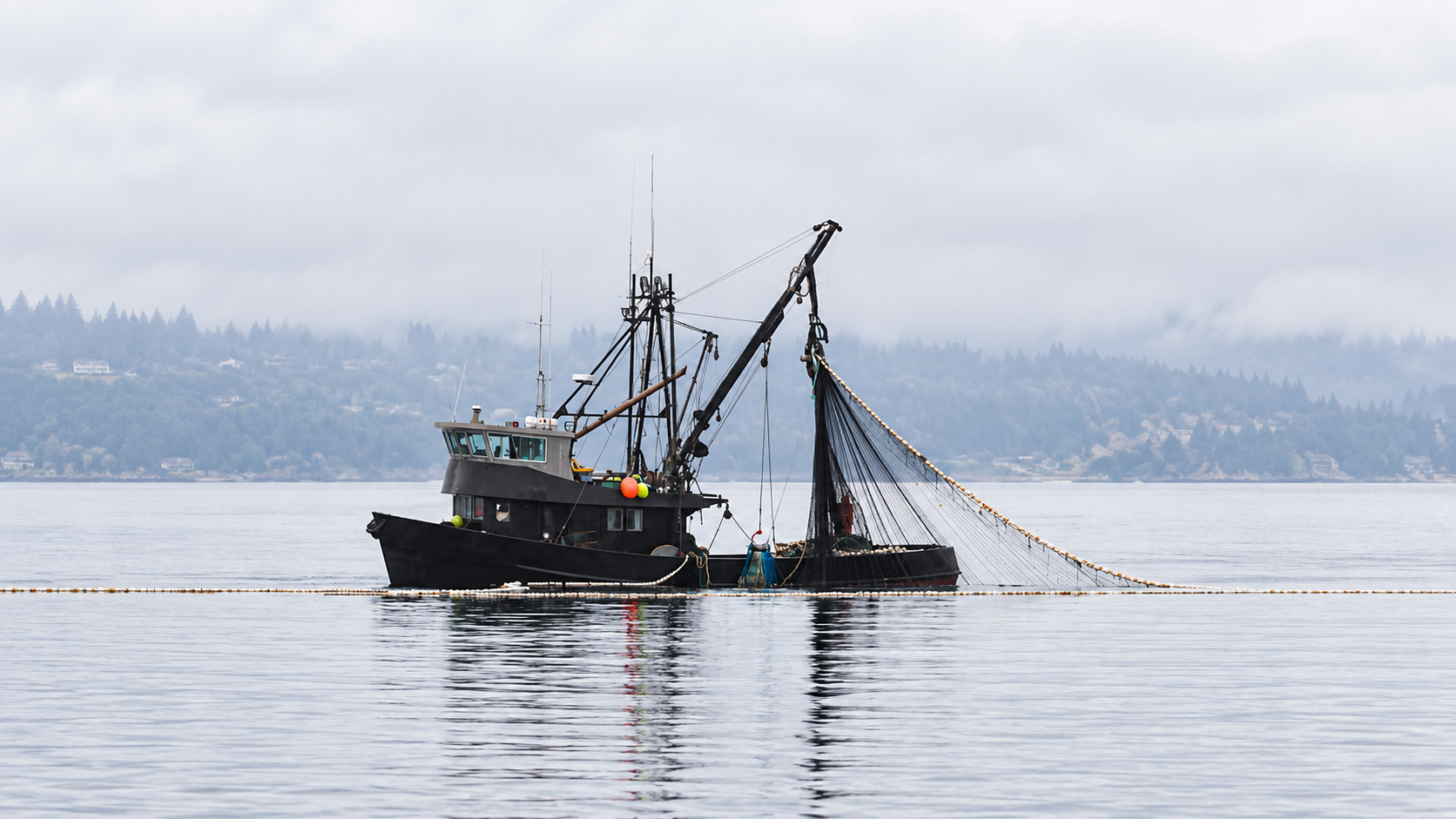
Oregon’s commercial seafood industry is seeking federal purchasing assistance after the war in Ukraine dismantled a foreign market that once bought nearly $95 million in Pacific whiting from American producers each year.
U.S. Sen. Jeff Merkley led a bipartisan Oregon-Washington delegation in requesting that the U.S. Department of Agriculture purchase domestically produced whiting fillets during the 2026 and 2027 federal fiscal years. The September 18 letter asks Agriculture Secretary Brooke Rollins to use the department’s Section 32 authority to direct surplus seafood into federal nutrition programs while restoring demand for West Coast processors.
Pacific whiting, also marketed as Pacific hake, anchors one of the West Coast’s largest commercial fisheries by volume. The industry sustains fishing vessels and processing plants along the Oregon coast while generating business for truckers, cold-storage facilities, equipment suppliers, marine contractors and food distributors across the state.
Ukraine had developed into one of the industry’s most valuable overseas destinations before Russia launched its full-scale invasion in 2022. American whiting exports to the country had climbed to nearly $95 million annually before warfare, economic damage and transportation complications severely curtailed the trade. West Coast companies were left without a comparable buyer for a considerable volume of processed fillets.
The $95 million figure describes the historical annual value of exports to Ukraine, not the amount requested from USDA. The delegation’s letter does not identify a proposed purchase price, tonnage or contract value.
The disappearance of the Ukrainian market has converged with broader financial pressures throughout the seafood business. Processors and fishing operations are paying more for fuel, labor, equipment, refrigeration and transportation while competing against less expensive imported proteins. Trade restrictions and weaker access to foreign markets have further narrowed the industry’s options for selling its catch.
Merkley and Sen. Ron Wyden signed the request with Oregon Reps. Suzanne Bonamici, Cliff Bentz, Maxine Dexter, Val Hoyle, Janelle Bynum and Andrea Salinas. Washington Sens. Patty Murray and Maria Cantwell and Reps. Rick Larsen and Emily Randall also joined the effort.
Bentz’s participation gives the request a direct Southern Oregon connection. His 2nd Congressional District includes Grants Pass, Josephine County and a large portion of rural Southern, Central and Eastern Oregon. Although Pacific whiting is harvested offshore and processed primarily in coastal communities, the industry’s financial reach follows trucking routes, supply networks and food-distribution systems deep into inland Oregon.
The congressional appeal supports an application submitted by the West Coast Seafood Processors Association, whose members handle a substantial share of the Pacific whiting and other commercial seafood landed along the West Coast.
Section 32, created in 1935, permits USDA to buy American agricultural and seafood products when producers encounter surplus inventories, disappearing markets or severe commercial disruption. The government purchases qualifying products rather than issuing unrestricted payments to individual companies.
If USDA approves the proposal, its Agricultural Marketing Service would establish specifications and invite qualified domestic processors to compete for contracts. The purchased whiting could then enter school meal systems, food banks and other federal food-assistance networks, converting unsold commercial inventory into meals for households and students.
Any purchase would require participating companies to meet federal rules governing domestic production, inspection, processing, packaging and delivery. Those requirements determine not only which companies may submit bids, but also how much seafood can be purchased and delivered within the government’s timetable.
The federal government has previously used Section 32 to support West Coast seafood. USDA considered Pacific whiting, rockfish and ocean-perch products for procurement in 2021 and later authorized approximately $22 million in whiting purchases and about $18 million in rockfish purchases after industry representatives documented damage from lost markets.
Earlier procurements also exposed production constraints. USDA reported that thousands of cases of whiting and rockfish could not be awarded during one purchasing round because vendors lacked the capacity to satisfy the contracts. Approval of another purchase would therefore create an opportunity, but processors would still need to demonstrate that they can produce, package and deliver the required volume.
NOAA Fisheries and the Pacific Fishery Management Council regulate Pacific whiting in federal waters extending from three to 200 miles off the coast. The United States shares the resource with Canada, and annual harvest limits are established through a bilateral management system. The American fleet includes shore-based vessels, catcher-processors and ships that receive catch from other vessels for processing at sea.
USDA has not approved the September 18 request or announced a purchase amount, bidding schedule or contract award. Federal action would begin with an Agricultural Marketing Service decision to place Pacific whiting among its authorized Section 32 commodities, followed by a formal solicitation establishing quantity, price and delivery requirements.
For Oregon, the decision will determine whether federal food purchasing can replace part of a market erased by war and keep more West Coast seafood moving through processing plants, transportation networks and nutrition programs rather than accumulating without sufficient commercial demand.