


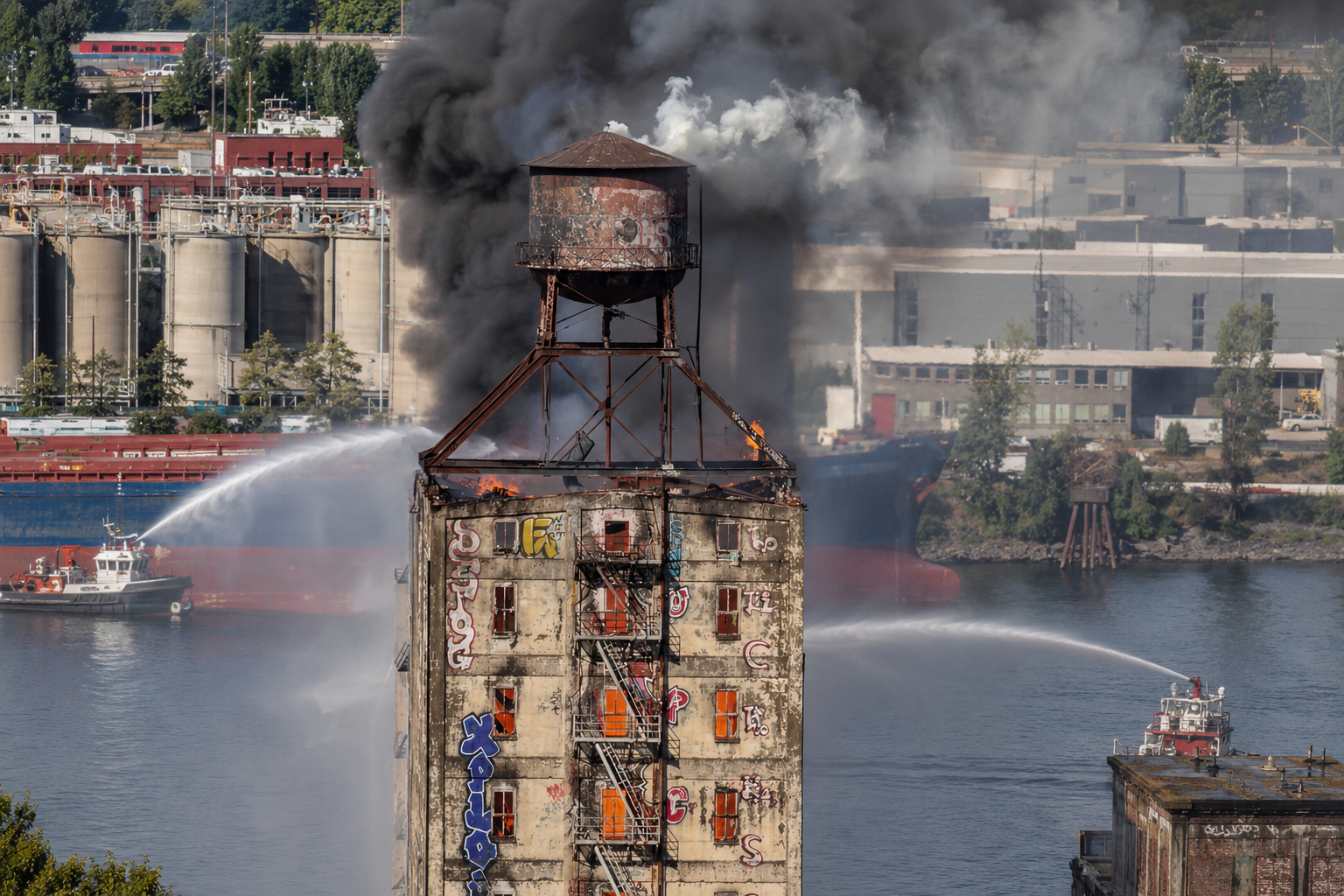
One of Portland’s most recognizable historic industrial landmarks has been reduced to a charred shell after a massive fire swept through the 116-year-old Centennial Mills warehouse on Sunday, August 2, leaving behind a dangerous, unstable structure and marking the end of another chapter in the city’s rich waterfront history.
The blaze, which erupted Sunday afternoon along Northwest Naito Parkway near the Fremont Bridge, quickly grew into one of Portland’s largest commercial structure fires in recent years. Thick columns of dark smoke towered above the city skyline as firefighters battled flames consuming the vacant timber-frame warehouse. Within hours, the historic building had suffered catastrophic damage, forcing emergency officials to transition from an aggressive firefighting operation to one focused on public safety, containment and structural assessment.
Portland Fire & Rescue responded shortly before 4 p.m. after reports of smoke and flames coming from the long-vacant warehouse. Upon arrival, firefighters found heavy fire already moving throughout the aging structure. The building’s size, deteriorated condition and heavy timber construction created conditions that made interior firefighting too dangerous. Crews instead established a defensive strategy, attacking the fire from outside while working to prevent it from spreading to nearby properties and critical infrastructure.
As the fire intensified, additional alarms brought nearly one hundred firefighters and emergency personnel to the scene. Throughout the afternoon and evening, crews remained focused on containing the blaze while monitoring the increasingly unstable structure. Portions of the warehouse experienced structural collapse as flames weakened its support system, prompting officials to establish a large safety perimeter around the property.
The warehouse’s deteriorated condition presented extraordinary challenges. Decades of vacancy had left portions of the building with compromised flooring, missing stairways and significant structural decay even before the fire began. As temperatures inside the building climbed, officials determined that sending firefighters into the structure would expose them to unacceptable risks. Heavy timber buildings are capable of burning for extended periods because massive wooden beams retain heat long after visible flames have diminished, allowing hidden fires to continue smoldering deep within the framework.
Firefighters remained on scene through the night into Monday extinguishing hotspots and monitoring the building for additional collapse. By the following day, officials confirmed that much of the warehouse had been destroyed and that the remaining portions of the structure remained unstable. Engineers and emergency personnel continued evaluating whether any sections of the historic building could be safely preserved, although demolition appeared increasingly likely because of the extensive structural damage.
The fire also created significant disruptions throughout Portland’s transportation network. Northwest Naito Parkway was closed near the warehouse while emergency crews worked at the scene, and surrounding roads experienced traffic restrictions. Officials also evaluated nearby infrastructure to determine whether falling debris or further collapse could threaten utilities, rail service or transportation corridors adjacent to the property. Safety zones remained in place while structural assessments continued.
Although the immediate priority remained public safety, the destruction of Centennial Mills represents a significant cultural and historical loss for Portland.
Originally constructed in 1910 as Crown Mills, the facility became one of Oregon’s largest flour milling operations during the early twentieth century. Grain transported by rail and barge from farms throughout the Pacific Northwest was processed at the waterfront complex before being distributed across the western United States and international markets. The mill became an important part of Portland’s emergence as a major commercial shipping center and stood for generations as a symbol of the city’s industrial economy.
As Portland evolved over the decades, much of the original milling complex disappeared through redevelopment and demolition. The surviving warehouse remained one of the final reminders of the once-expansive operation that had played a vital role in Oregon’s agricultural and maritime industries.
The property itself has undergone numerous ownership changes and redevelopment proposals over the past quarter century. Public agencies acquired the site with hopes of transforming the waterfront into a mixed-use destination featuring housing, commercial space and public amenities while preserving elements of its historic character. Despite years of planning, financing efforts and multiple development concepts, the warehouse remained vacant as redevelopment plans repeatedly stalled. Ownership eventually transferred to private developers, who had been exploring new opportunities for the site before the fire occurred.
Investigators have not yet determined what caused the blaze. Fire investigators will continue examining the scene once engineers determine it is safe enough to conduct a thorough inspection. Because portions of the building collapsed during the fire, determining the exact point of origin may require extensive forensic analysis before officials can announce whether the fire was accidental or intentionally set.
Environmental agencies and local officials are also expected to evaluate debris removal and demolition planning as recovery efforts move forward. The property’s location along Portland’s waterfront requires careful coordination to protect surrounding infrastructure and minimize environmental impacts during cleanup.
The destruction of Centennial Mills serves as another reminder of the difficult balance communities face between preserving historic landmarks and addressing the realities of aging infrastructure. Across the nation, many vacant industrial buildings continue to present challenges for property owners, emergency responders and preservation advocates as redevelopment projects compete with the growing costs of maintaining structures that have outlived their original purpose.
For Portland, the loss extends beyond the destruction of an abandoned warehouse. It marks the disappearance of one of the city’s last surviving links to its industrial waterfront heritage and closes a chapter that spanned more than a century of Oregon history. As investigators work to determine how the fire began and officials plan the future of the property, the vacant shell that once stood as a symbol of Portland’s milling industry now represents both the fragility of historic landmarks and the continuing transformation of one of the Pacific Northwest’s most recognizable urban waterfronts.