


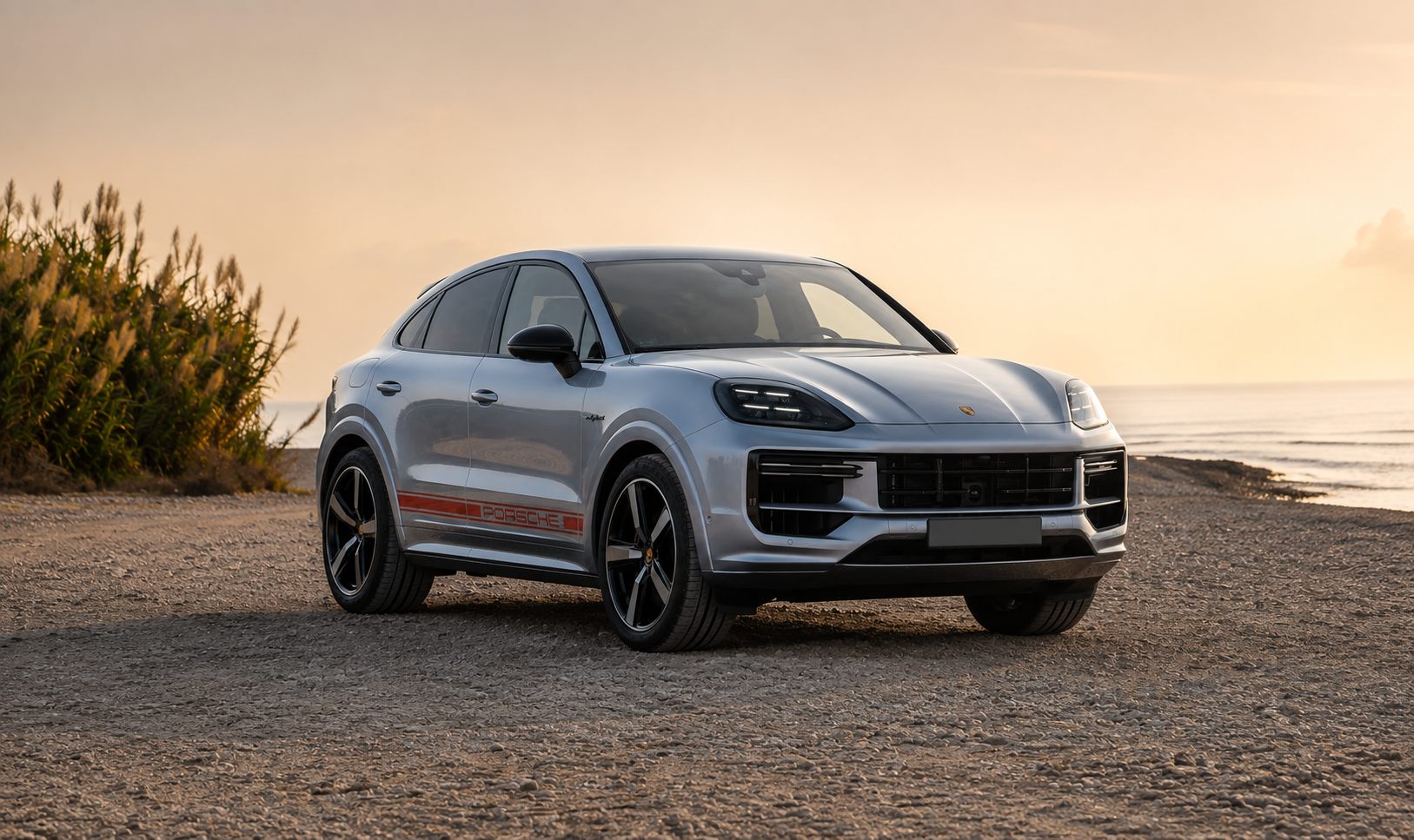
Anyone shopping for a 2026 Porsche Cayenne is entering expensive territory before selecting the first option. The least expensive version starts around $90,000. Work through the S, GTS and Turbo E-Hybrid models and six figures arrive quickly. At the top, a Cayenne Turbo GT starts above $200,000 before Porsche’s famously long options sheet gets involved.
For that money, buyers might reasonably picture Stuttgart, generations of German sports-car craftsmanship and a Porsche factory dedicated to building Porsches.
The Cayenne has a different birth certificate.
It is manufactured in Bratislava, Slovakia, at a Volkswagen Group factory that also produces Volkswagens, Audis and Škodas. The 911 may be synonymous with Porsche’s historic Zuffenhausen home, but the SUV carrying the same crest comes from one of Volkswagen Group’s largest multi-brand manufacturing operations.
That is worth knowing before buying one.
Volkswagen Slovakia’s Bratislava operation is enormous, covering roughly 2.1 million square meters and employing approximately 11,400 people. More than 336,000 vehicles were produced there in 2025. The Cayenne and Cayenne Coupe move through an industrial operation that also builds the Volkswagen Touareg, Audi Q7 and Q8, Volkswagen Passat and Škoda Superb. Production of the new Cayenne Electric has joined the mix as well.
The corporate connections continue underneath the bodywork.
The Cayenne is part of Volkswagen Group’s MLB family of longitudinal-engine vehicle architectures. That engineering family reaches from the Volkswagen Touareg through the Audi Q7 and Q8 and into considerably more expensive territory with the Porsche Cayenne, Bentley Bentayga and Lamborghini Urus.
Six figures of pricing can separate automobiles descending from the same corporate engineering strategy.
Porsche earns that premium by deciding what happens after the basic architecture is established. Engines and powertrain applications, suspension tuning, steering, brakes, chassis calibration, software, interiors, materials and performance development can turn vehicles with common corporate ancestry into dramatically different machines.
Nobody climbing out of a 650-horsepower Cayenne Turbo GT is likely to confuse the experience with a Volkswagen Touareg.
Still, the family tree is there.
It is also enormously profitable industrial logic.
Volkswagen Group does not need Porsche to finance a unique factory and clean-sheet vehicle architecture every time it wants to sell another SUV. Development costs can be spread across brands, suppliers and production volumes that Porsche could never duplicate independently. Factories remain productive, components can be purchased at enormous scale and billions of dollars invested in engineering can support more than one badge.
Porsche can then concentrate money where customers are more likely to notice it.
The formula has produced an SUV with an extraordinary pricing range.
A 2026 Cayenne begins at approximately $89,900 in the United States before destination charges, taxes and optional equipment. The Cayenne S moves beyond $108,000 and the GTS beyond $132,000. The Turbo E-Hybrid approaches $165,000.
The Cayenne Turbo GT occupies another financial category altogether. Its approximately $214,800 starting price puts a factory-produced Volkswagen Group SUV into territory populated by serious exotic machinery.
Calling it a $200,000 Volkswagen is deliberately cheeky. Calling it a product of Volkswagen Group manufacturing is simply accurate.
Porsche did not stumble into this arrangement recently. Volkswagen has been intertwined with Cayenne manufacturing since the model was born.
The original Cayenne entered production in 2002 during a period when the idea of Porsche building an SUV was controversial enough on its own. Bratislava produced the Cayenne’s body and handled substantial assembly work before vehicles traveled to Porsche’s Leipzig facility for completion.
By 2017, even that final German chapter disappeared. Complete production of the third-generation Cayenne moved to Bratislava.
A modern Cayenne can be built, painted and assembled into a finished Porsche in Slovakia without visiting a Porsche factory in Germany.
The arrangement worked because the Cayenne itself worked.
Porsche had spent decades teaching the world to associate its name with sports cars, particularly the 911. That heritage brought prestige but also imposed an obvious commercial limitation. There are only so many customers who can make a two-door sports car work as everyday transportation.
An SUV changed the mathematics.
The Cayenne gave wealthy buyers rear doors, luggage space, ground clearance and family practicality without asking them to surrender the Porsche crest. A customer who admired a 911 but needed room for children, groceries, golf clubs and a week’s luggage suddenly had another reason to stay inside the Porsche showroom.
The vehicle that once looked dangerously out of character became central to Porsche’s modern business.
Its manufacturing arrangement helped make that expansion practical. Volkswagen Group possessed the factories, purchasing scale, engineering infrastructure and platform technology. Porsche possessed one of the most valuable performance identities in the automobile business. Combining the two allowed Porsche to compete aggressively in luxury SUVs without pretending it was still a tiny independent sports-car manufacturer.
The Cayenne Electric carries the same thinking forward. Its production in Bratislava allows Porsche to build electric Cayennes within an established manufacturing network rather than constructing a separate factory simply to preserve the appearance of exclusivity.
That word, exclusivity, deserves closer examination when shopping for any modern luxury vehicle.
A $200,000 automobile no longer has to come from a tiny factory producing a handful of cars at a time. It can emerge from a sophisticated production complex capable of building hundreds of thousands of vehicles annually. It can share architectural DNA with less expensive corporate relatives and still deliver considerably greater performance, equipment and refinement.
The automobile industry learned long ago that customers do not pay solely for the cost of steel, aluminum, electronics and labor. They pay for engineering, design, performance, history and desirability. They also pay for the name on the hood.
Porsche has one of the most valuable names in the business.
The Cayenne demonstrates just how valuable.
A prospective buyer considering a $100,000 Cayenne may find its Volkswagen Group origins completely irrelevant. Someone considering a $215,000 Turbo GT may find them fascinating. Neither reaction changes the vehicle’s performance or manufacturing quality, but knowing the pedigree makes it easier to understand where the money goes and what the Porsche premium actually represents.
The answer is not a handcrafted SUV emerging from some secluded Stuttgart workshop.
It is something much more modern: a Porsche engineered within the financial and industrial muscle of Volkswagen Group, manufactured in a Volkswagen-operated Slovakian factory, sharing an architectural bloodline that stretches across several corporate brands, and finished with enough Porsche engineering and character to command prices ranging from expensive to extraordinary.
For anyone considering putting a Cayenne in the garage, there is no reason that should remain buried beneath horsepower figures and leather samples.
At $90,000, it is interesting.
At $150,000, it becomes relevant.
At more than $200,000, you ought to know exactly where your Porsche came from.