


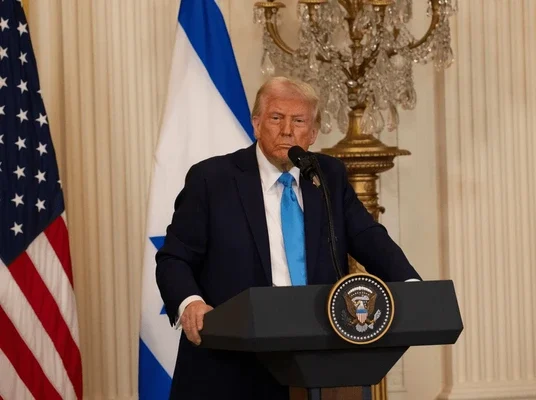
President Donald Trump has issued a bold ultimatum to the Kremlin: agree to a ceasefire in Ukraine within 50 days or face sweeping economic sanctions, including 100 percent tariffs and secondary penalties on nations continuing to do business with Russia. The announcement, made during a joint appearance with NATO Secretary-General Mark Rutte at the White House on July 14, signals a dramatic shift in Trump’s posture toward Russian President Vladimir Putin following months of stalled diplomacy and continued military aggression.
The new strategy comes amid escalating pressure on Moscow to end its full-scale invasion of Ukraine, now in its third year. Under the plan, if Russia fails to secure a peace agreement by early September, the United States will implement tariffs on all Russian goods and impose sanctions on foreign countries and companies that maintain trade relations with the Kremlin. Trump stated unequivocally that the penalties would be “very severe,” emphasizing that he was no longer willing to tolerate what he described as “double-dealing” from Putin.
In a stark departure from prior aid packages, Trump announced that the U.S. will send advanced defense systems to Ukraine, including Patriot missile batteries and interceptor units. However, he made it clear that this military support will be financed by NATO partners—not American taxpayers. The financial burden of the weapons shipments will be carried by allies including Germany, Canada, Sweden, the Netherlands, and Finland, who have all pledged logistical and financial backing.
Ukraine welcomed the announcement, with President Volodymyr Zelenskyy stating that the added weaponry would greatly enhance Ukraine’s ability to defend civilian targets from Russian missile attacks. The Ukrainian government confirmed it would soon receive additional Patriot systems to help fortify cities against long-range assaults.
While some NATO leaders praised the decisive action, others expressed reservations about the 50-day window. Diplomats from several European nations warned that the timeline could allow Russian forces to accelerate offensives in eastern Ukraine—particularly in the Donetsk region—before sanctions take effect. Critics fear that the delay may ultimately benefit Russia militarily, even if it leads to long-term economic consequences.
The Russian response was dismissive. Kremlin spokesperson Dmitry Peskov said parts of Trump’s announcement were being reviewed but characterized the demands as unrealistic. Deputy Foreign Minister Sergei Ryabkov called the ultimatum “unacceptable,” while former Russian President Dmitry Medvedev mocked the announcement as “performative.” Despite Moscow’s outward defiance, economic analysts note that Russia’s economy remains fragile under the weight of existing sanctions and that new measures could sharply contract key industries such as energy exports and heavy manufacturing.
Back in Washington, Trump’s move has gained bipartisan traction. U.S. senators are already drafting legislation that would authorize tariffs up to 500 percent on any country that continues to buy Russian oil or gas. Lawmakers say the measures are designed to undercut Russia’s revenue streams and force Putin to the negotiating table.
Trump described the initiative as a last chance for diplomacy. “The objective is peace, not punishment,” he said. Still, the president reiterated that without real results from the Kremlin, economic retaliation will be swift and far-reaching. Preparations are already underway in the Treasury and State Departments to activate enforcement mechanisms should the deadline expire without progress.
With the clock ticking, the international community is watching closely. If Russia fails to act within the 50-day window, the result could be one of the most aggressive sanctions campaigns in modern history, impacting not just Moscow but any nation choosing to do business with it. Whether the ultimatum brings about the intended ceasefire—or triggers a deeper geopolitical confrontation—will be determined in the weeks ahead.