


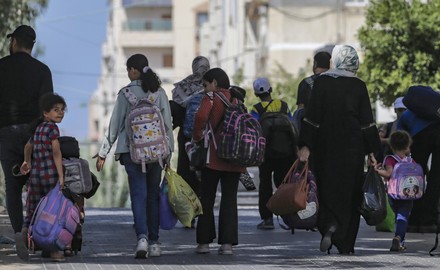
The Israeli military has expanded its operations inside Gaza City, directing residents to leave their homes and move toward what it has termed a humanitarian zone. The directive is part of a broader offensive designed to establish control over the densely populated urban center, where weeks of fighting have already displaced hundreds of thousands of civilians.
According to official statements, the evacuation order is intended to minimize civilian casualties as ground forces advance deeper into Gaza. The humanitarian zone designated by Israel is meant to serve as a temporary refuge where essential aid and services can be coordinated. However, the sudden mass relocation has raised concerns about the feasibility of moving entire neighborhoods under active bombardment, and whether sufficient resources exist in the designated area to sustain the influx of displaced residents.
The escalation in Gaza comes amid parallel developments on the international stage. President Donald Trump announced on Friday that Washington is engaged in what he described as “very deep” negotiations with Hamas. The talks, according to Trump, focus on securing the release of hostages captured during the October 7, 2023, attacks on Israel.
That attack, carried out by Hamas and other armed groups, targeted southern Israel and included assaults on a music festival where hundreds were killed. In the days following, Hamas fighters abducted civilians and soldiers, taking them back into Gaza. This week, Hamas released a video showing two Israeli hostages taken from the festival grounds, reigniting global attention on their captivity and prompting renewed calls for a negotiated settlement to secure their freedom.
For Israel, the rescue of hostages remains a central objective alongside the military campaign to dismantle Hamas’ infrastructure in Gaza. Officials have repeatedly stated that the hostages’ safe return is inseparable from the ongoing offensive, though critics argue that expanded combat risks endangering the very lives negotiators seek to save.
The humanitarian crisis in Gaza continues to deepen as fighting intensifies. Reports from aid organizations describe shortages of food, medicine, clean water, and shelter for displaced families. The United Nations has called for sustained humanitarian corridors to allow supplies into the enclave, but access remains limited due to the scale of hostilities. The new evacuation order is expected to compound these challenges, as tens of thousands of families are now tasked with relocating once again under unstable and often dangerous conditions.
The diplomatic landscape surrounding the conflict remains uncertain. Trump’s disclosure of negotiations signals ongoing U.S. involvement, but the depth and likelihood of success remain unclear. Analysts note that past efforts to secure hostage releases have been complicated by the lack of direct communication between Israel and Hamas, often requiring third-party mediators such as Egypt or Qatar. Whether the new talks represent a breakthrough or a temporary gesture is not yet known.
As Israeli troops push deeper into Gaza City and civilians attempt to navigate evacuation routes, the conflict enters another precarious stage. The dual pressures of military escalation and high-stakes negotiations highlight the fragile balance between force and diplomacy, leaving the fate of both civilians and hostages hanging in uncertainty.