


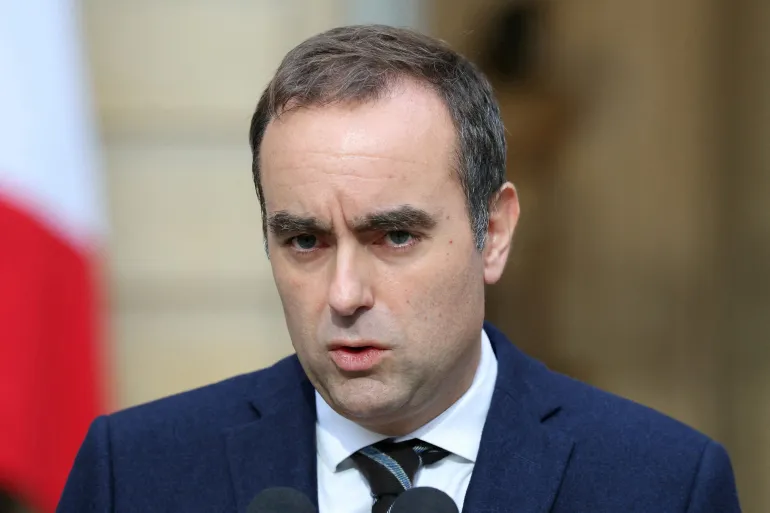
France was thrust into renewed political uncertainty on Monday following the abrupt resignation of Prime Minister Sébastien Lecornu, less than a month after he took office and fewer than 24 hours after presenting his new government. The unexpected departure marks yet another rapid turnover in the country’s leadership, intensifying concerns over stability at the highest levels of government.
Lecornu had stepped into the role to replace François Bayrou, becoming France’s fourth prime minister in roughly a year. His appointment was seen as an effort by President Emmanuel Macron to regain control of a fragmented political landscape, with legislative challenges mounting and his centrist coalition struggling to build consensus in the National Assembly. However, the swift resignation underscored the volatility and internal tensions that have defined Macron’s second term.
The French presidency confirmed that Macron accepted Lecornu’s resignation on Monday. No immediate successor was named, leaving open questions about the government’s ability to function effectively as the president faces mounting economic, social, and geopolitical pressures.
Lecornu, who had previously served as defense minister, was widely regarded as a loyal Macron ally with a reputation for discipline and political pragmatism. His appointment was initially interpreted as a sign that Macron wanted to project stability after a series of leadership changes that had eroded public confidence. But his tenure quickly became clouded by speculation over internal disputes and difficulties forming a durable cabinet capable of unifying Macron’s centrist camp with other parliamentary factions.
The resignation deepens an ongoing leadership crisis that has seen a revolving door of prime ministers since Macron began his second term. Bayrou himself had been appointed only months earlier amid hopes of forging broader political alliances, but his short-lived premiership faltered under legislative gridlock and declining approval ratings.
France now faces a moment of political reckoning. Macron’s government must navigate pressing issues including slowing economic growth, rising public discontent over cost-of-living pressures, and debates over security and immigration. Internationally, France is balancing its role in European Union policymaking and its military commitments abroad, challenges that require a steady hand at the head of government.
The president’s next appointment will be closely watched, both domestically and internationally. Analysts suggest Macron may be forced to reach beyond his traditional inner circle to find a figure who can stabilize his government and build cross-party alliances. Others warn that repeated leadership changes risk undermining France’s credibility and weakening the president’s political mandate.
As the search for a new prime minister begins, France enters another period of uncertainty, with Macron facing pressure to act swiftly to restore confidence in his administration. The resignation of Lecornu — so soon after taking office — highlights the fragility of France’s current political landscape and sets the stage for what could be a turbulent chapter in Macron’s presidency.