


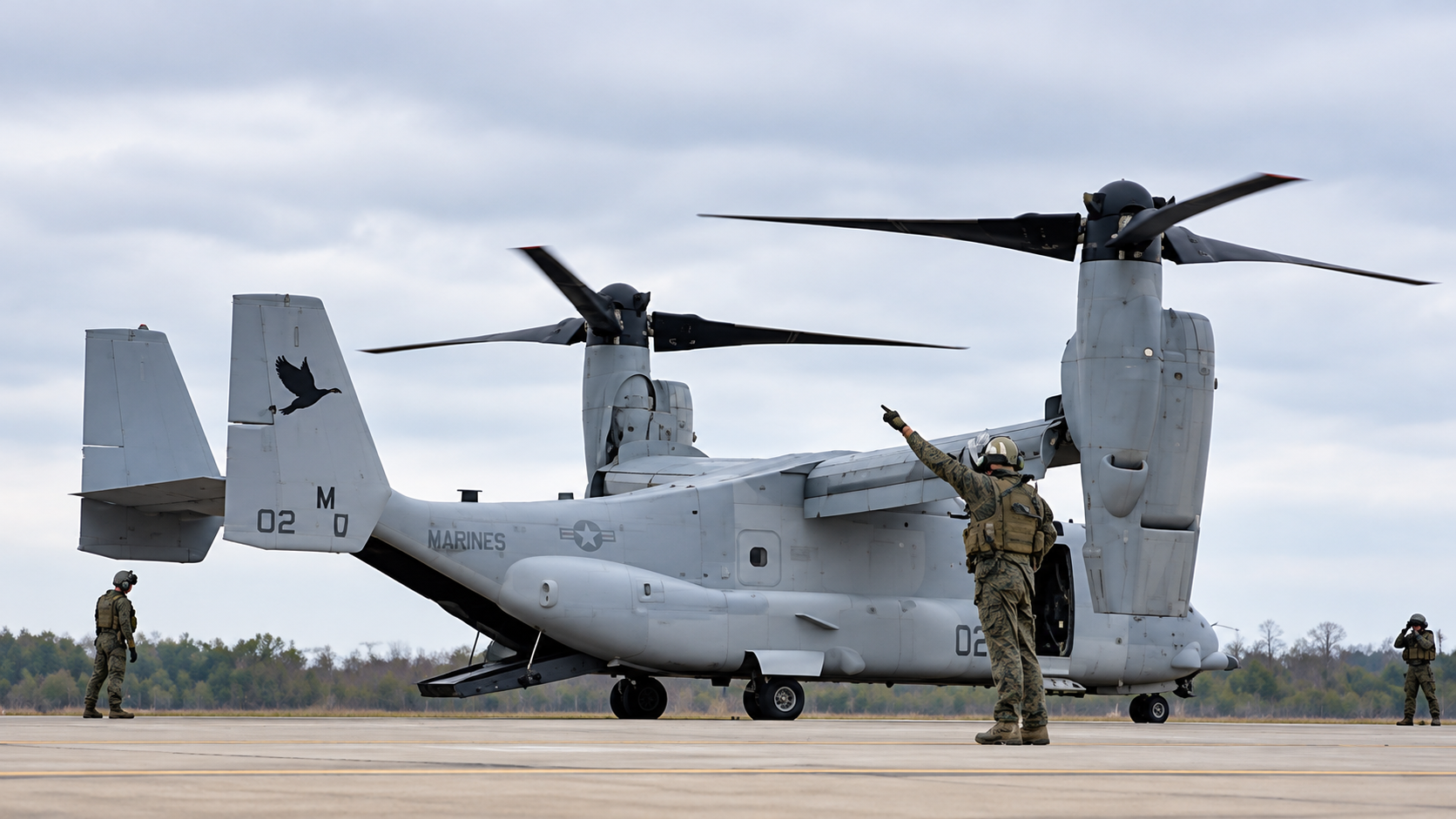
A United States Marine Corps MV-22B Osprey carrying four Marines crashed during a training operation in southeastern North Carolina Thursday morning, October 8, 2026, leaving one service member hospitalized with burn injuries after the aircraft made a hard landing and caught fire in a wooded military training area. The accident brought firefighters from multiple jurisdictions to the scene and prompted a military investigation into the cause of the emergency.
The aircraft went down at approximately 10:20 a.m. near Sweet Home Church Road in Bladen County, within the Bladen Lakes State Forest area outside Elizabethtown. The location, known as the Pappy Tatum Landing Area, is used by military aviation units conducting flight training and landing exercises away from established airfields.
The Osprey was assigned to Marine Medium Tiltrotor Squadron 162, part of Marine Aircraft Group 26 under the 2nd Marine Aircraft Wing, based at Marine Corps Air Station New River near Jacksonville, North Carolina. Four Marines were aboard the aircraft when it experienced the emergency.
One Marine suffered burns and was evacuated by medical helicopter to the University of North Carolina Jaycee Burn Center in Chapel Hill. The remaining three Marines were reported by local emergency officials to have escaped without physical injuries, although military authorities confirmed that all four personnel received medical attention following the accident.
The names of the Marines have not been released, and the military has not disclosed the severity of the hospitalized service member’s injuries. No civilian injuries were reported.
Firefighters responding to the crash encountered an aircraft burning in a heavily wooded area with limited access for emergency vehicles. White Lake Fire Chief Dale Brennan reported that the Osprey was carrying approximately 6,000 pounds of aviation fuel when the incident occurred, creating a significant fire hazard for personnel working near the wreckage.
Approximately six fire and rescue departments participated in the response, supported by the North Carolina State Highway Patrol and military personnel. Emergency crews extinguished the aircraft fire before flames could spread into the surrounding forest. State forestry officials reported no resulting wildfire.
The aircraft sustained substantial fire damage, although military officials had not released a final assessment of its condition or determined whether it could be repaired.
Investigators from the military community surrounding Camp Lejeune were dispatched to the scene following the accident. The Naval Criminal Investigative Service was identified in regional reporting as participating in the investigation, while military aviation authorities began examining the circumstances surrounding the aircraft’s hard landing.
The cause remained undetermined Friday. No official findings had established whether the aircraft experienced an engine malfunction, mechanical failure, flight-control problem or another emergency before reaching the ground. Authorities also had not publicly determined whether the fire began before or after the hard landing.
The Marine Corps had not released the aircraft’s maintenance history, flight information or the specific training assignment underway when the accident occurred.
The MV-22B Osprey is a twin-engine tiltrotor aircraft manufactured by Bell Boeing and designed to combine the vertical takeoff and landing capabilities of a helicopter with the speed and range of a fixed-wing airplane. Its rotating engine nacelles allow the aircraft to lift off vertically before transitioning into forward flight.
Marine Corps aviation units use the Osprey to transport troops, equipment and supplies between military installations, naval vessels and remote operational areas. The aircraft is a central component of Marine expeditionary aviation, supporting amphibious operations and rapid troop movements in locations where conventional runways are unavailable.
Marine Corps Air Station New River is one of the military’s primary East Coast installations for Osprey operations. Aircraft assigned to the installation routinely conduct training throughout eastern North Carolina, including operations at remote landing zones intended to simulate the conditions encountered during military deployments.
Thursday’s accident follows several serious Osprey incidents that have resulted in fatal casualties, military investigations and changes to flight operations.
In November 2023, a United States Air Force CV-22B Osprey crashed near Yakushima, Japan, killing all eight service members aboard. The accident resulted in a fleetwide grounding of military Osprey aircraft while investigators examined the failure and military officials reviewed flight safety procedures.
An Air Force investigation subsequently identified a catastrophic failure involving components of the aircraft’s left-hand prop rotor gearbox, along with contributing operational and decision-making factors.
In August 2023, a Marine Corps MV-22B Osprey crashed during a training exercise on Melville Island in Australia’s Northern Territory, killing three Marines and injuring others. The investigation into that accident identified pilot error and deficiencies involving mission planning and risk management.
In June 2022, five Marines were killed when an MV-22B Osprey crashed near Glamis, California, during a training mission. Investigators attributed that accident to a mechanical failure involving the aircraft’s dual hard clutch engagement system.
The accidents prompted extensive examinations of Osprey flight operations, maintenance procedures and mechanical reliability. Military authorities have implemented additional inspections, operational limitations and safety measures in response to findings from previous investigations.
No evidence released in connection with Thursday’s North Carolina accident has established that the aircraft experienced the same mechanical failures or operational problems identified in earlier crashes.
The Pappy Tatum Landing Area, where the latest incident occurred, is situated within a region containing extensive military training facilities, forests and designated aviation operating areas. Its remote location complicated the initial emergency response, requiring civilian and military personnel to coordinate access to the aircraft while firefighters worked to control the blaze.
Military authorities have not disclosed whether the Osprey was conducting an approach, landing maneuver, departure or another phase of training when the emergency developed. The flight crew’s communications and the aircraft’s operating condition immediately before the hard landing have not been publicly detailed.
The investigation will determine the circumstances of the accident and whether any mechanical, operational or maintenance factors contributed to the aircraft’s loss.
As of Friday, October 9, the hospitalized Marine’s condition had not been updated publicly, and the Marine Corps had not released a preliminary cause of the crash. The aircraft remained the subject of an active military investigation following the fire and emergency response in Bladen County.