


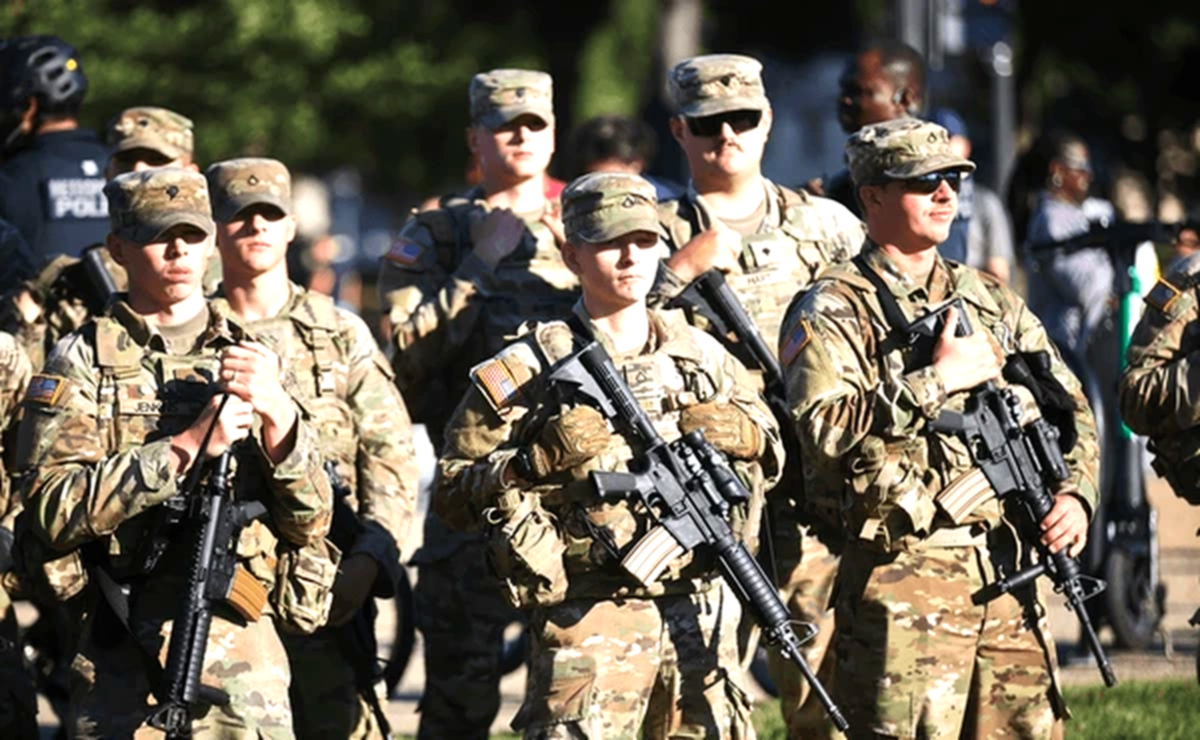
Washington, D.C. is no stranger to visible security, but the current reality unfolding across the nation’s capital has taken on a different tone, one that feels less temporary and more embedded with each passing week. Months after National Guard troops were first deployed under a federal emergency declaration, their presence remains not only intact but normalized, with no defined exit in sight.
More than 2,500 Guard members continue to operate throughout the city, moving through transit stations, tourist corridors, public parks, and neighborhoods that typically serve as the backdrop for everyday civic life. What once may have drawn double takes from visitors now blends into the scenery, with uniformed troops positioned alongside commuters, families, and federal workers in a capital city that increasingly feels under quiet watch.
The deployment began in August 2025, when federal authorities authorized the use of National Guard forces to support public safety efforts in response to concerns over crime. The mission was framed as a stabilizing force, intended to assist local law enforcement, deter criminal activity, and provide logistical support in maintaining order across key areas of the city. While troops do not operate as primary law enforcement officers, their role has included support functions and limited authority to detain individuals under specific circumstances.
What has shifted since those early days is not simply the scale of the deployment, but its duration. Initially presented as a response to a defined problem, the mission has extended far beyond its expected timeframe. Officials have indicated the possibility of maintaining the Guard presence through at least the end of 2026, raising a broader question about when, or if, the current posture will be scaled back.
That uncertainty has fueled an ongoing national debate, one that stretches well beyond the boundaries of Washington itself. Supporters of the deployment point to public safety concerns, arguing that the visible presence of troops has contributed to a sense of order and may be helping to suppress crime in areas that had seen rising incidents. For businesses, tourists, and some residents, the additional security is viewed as reassurance in a city that carries both symbolic and practical importance.
Critics see something different. They argue that the prolonged presence of military personnel in a civilian setting risks reshaping expectations about the role of federal power in everyday life. Concerns have been raised about civil liberties, the normalization of armed patrols in public spaces, and whether crime trends alone justify such a sustained deployment. Legal challenges have already emerged, with lower courts questioning the authority behind the mission before higher courts allowed it to continue while litigation moves forward.
At the center of the issue is Washington’s unique status. Unlike states, the District of Columbia operates under direct federal oversight, giving national leaders broader authority to deploy the Guard without the same level of local resistance that might exist elsewhere. That distinction has made the capital a testing ground for policies that might face stronger opposition in other parts of the country.
The financial cost has added another layer to the conversation. Estimates suggest the operation runs into the millions of dollars per day, a figure that accumulates rapidly as the deployment stretches into its second year. For some, the cost is justified as part of maintaining order in the nation’s capital. For others, it raises concerns about long term sustainability and priorities in federal spending.
The takeaway is not a simple conclusion, but a reflection of a country wrestling with competing values. On one side is the demand for safety and visible security in a city that serves as the heart of the federal government. On the other is a growing unease about how long emergency measures should remain in place before they begin to redefine the norm.
Washington now stands as a living example of that tension, where the lines between temporary response and lasting policy are becoming increasingly difficult to separate.