


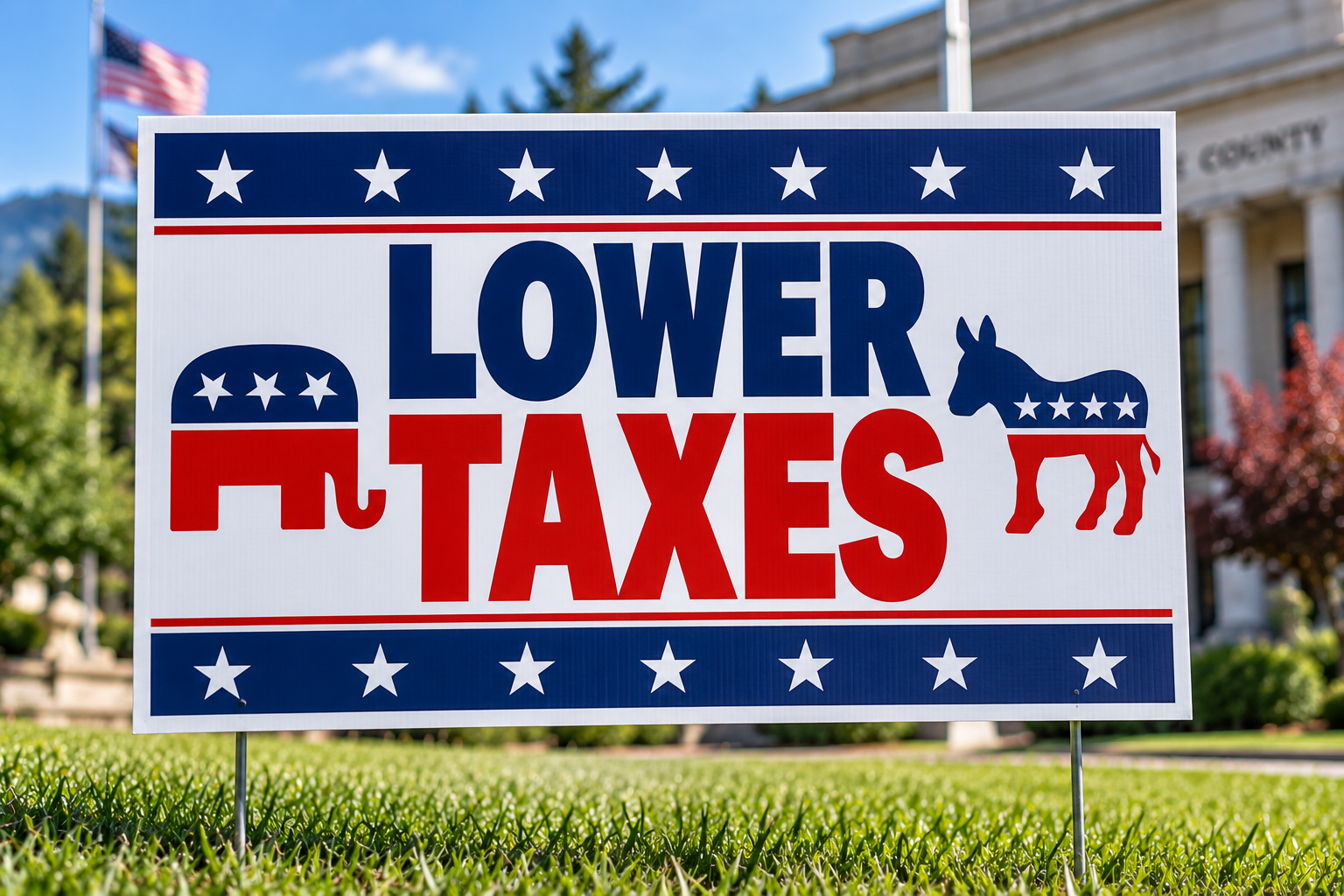
“Lower Taxes” is an extraordinarily powerful political promise. It requires two words on a campaign sign, appeals immediately to households struggling with rising expenses and suggests something every taxpayer understands: elect this candidate and government will take less of your money.
In Josephine County, however, those two words deserve considerably more examination than the space afforded by a roadside sign.
A candidate for the Josephine County Board of Commissioners is currently campaigning with “Lower Taxes” displayed among the messages presented to voters. The candidate is deliberately unnamed here because the larger issue extends beyond one campaign. It concerns something considerably more important to local government: whether promises made by candidates accurately reflect the legal authority of the offices they are asking voters to give them.
A Josephine County commissioner does not walk into office carrying a general power to lower taxes.
An individual commissioner cannot order property taxes reduced. A commissioner cannot rewrite Oregon’s constitutionally established property-tax system. A commissioner cannot lower taxes imposed by cities, school districts, fire districts, community colleges or other independent taxing districts. Even where Josephine County itself possesses discretion over taxation, one commissioner serves as a member of a governing board and cannot independently guarantee what that Board will ultimately approve.
Oregon law makes the limitations particularly significant when the promise involves property taxes.
The state’s modern property-tax structure is governed heavily by Measures 5 and 50. Measure 50 established permanent property-tax rate limits for taxing districts. According to the Oregon Department of Revenue, once that permanent rate limit has been established, the limit itself cannot be changed through action by the taxing district or its patrons.
A taxing district can choose to levy less than the maximum amount authorized under its permanent rate. That provides a legitimate avenue through which a governing body can affect the amount collected. It does not give an individual commissioner the authority to simply declare that property taxes have been lowered, nor does it allow the county to alter every other tax appearing on a resident’s bill.
The political promise consequently becomes considerably more difficult to execute than it is to advertise.
A Josephine County property-tax bill is not one tax controlled by the county commissioners. Oregon calculates a property’s total tax using the combined rates of the taxing districts serving that property. The county assessor administers the process, places certified taxes on the roll and calculates the resulting bill, while the tax collector collects and distributes revenue to the appropriate taxing districts.
Administration of the tax system does not transfer the taxing authority of those separate governments to the county.
The fact that Josephine County sends a property-tax statement does not mean the Board of Commissioners controls every tax printed upon it.
Local-option levies add another layer. Oregon allows taxing districts to seek temporary taxing authority from voters beyond their permanent rates. General-obligation bonds likewise involve voter authorization and are governed by restrictions concerning their use and repayment. A county commissioner cannot erase voter authorization with a campaign promise.
This does not leave county commissioners powerless over taxation.
A commissioner can propose that Josephine County levy less than its available permanent-rate authority. Commissioners can oppose new county tax proposals. They can oppose seeking renewal of temporary levies. They can propose county budgets built around lower revenue. They can support reductions in county-controlled taxes or other charges where Oregon law provides the county that discretion. They can advocate for changes requiring action by voters or other governments.
Those are identifiable governmental actions carrying identifiable financial consequences.
“Lower Taxes” identifies none of them.
If a candidate is campaigning on lower taxes, the public should not have to guess which taxes are supposedly being lowered. The candidate should be capable of identifying the tax, its present rate, the proposed new rate, the legal authority permitting the reduction, the votes necessary to approve it, the amount an average taxpayer would save and the amount of revenue the county would surrender.
Those are not technicalities designed to undermine a campaign. They constitute the substance necessary to turn a campaign promise into an executable government policy.
Suppose the proposed reduction affects only Josephine County’s portion of a property owner’s overall bill. Voters deserve to know that. If the reduction would save a homeowner $10, $50, $100 or $500 annually, the campaign should be capable of producing that calculation.
If the proposal requires two votes on the three-member Board, that should be explained.
If it requires voter approval, that should be explained.
If it requires action by the Oregon Legislature, that should be explained.
If the tax belongs to another taxing district and therefore cannot be reduced by the Board of County Commissioners, that should be explained too.
Most importantly, if county government collects less money, voters deserve an accounting of what happens next.
Tax reductions do not exist independently of budgets. County revenue finances county operations. A candidate proposing to remove revenue should therefore be capable of identifying the corresponding financial plan. Will expenditures be reduced? Will positions disappear? Will programs be eliminated? Will reserves absorb the difference? Will another source of revenue replace it?
The Oregon local-budget process reinforces that reality. Local governments must prepare and adopt budgets through prescribed procedures, and the governing body formally adopts appropriations and certifies applicable taxes. These are governmental decisions made through public processes, not powers exercised independently by one elected official.
Josephine County’s own assessment and taxation system further demonstrates the division of authority. The county assessor reviews rates and levies submitted by taxing districts and computes individual property-tax bills, while the tax collector collects those taxes for the benefit of the various taxing districts.
The issue reaches beyond taxation and beyond one candidate.
Voters should examine campaign promises against the actual legal authority of the office being sought.
Candidates for county commissioner should understand what county commissioners can control. Candidates for city government should understand municipal authority. Candidates for the Legislature should understand legislative authority. Promising an outcome that depends upon another government, another governing body or the electorate itself requires acknowledging those limitations.
A sweeping campaign promise is not automatically a lie simply because accomplishing it would be legally complicated, politically difficult or dependent upon other people. Deliberate deception requires evidence of knowledge and intent.
But neither should an unsupported political slogan automatically be accepted as a governing plan.
Its credibility can be measured against specific facts.
Which tax will be lowered?
What is its current rate?
What will the new rate be?
How much will taxpayers actually save?
What legal authority permits the reduction?
Who must approve it?
How much revenue will Josephine County lose?
What expenditure will be reduced to compensate for it?
If a candidate can answer those questions, voters have a tax proposal they can examine.
If a candidate cannot answer them, voters have something entirely different: two words printed on a campaign sign without a demonstrated plan showing how the promise will become public policy.
Public office is governed by legal authority, statutory limitations and defined responsibilities. Campaign advertising cannot enlarge those powers once the election is over.
Josephine County voters are not merely selecting personalities, slogans or campaign signs. They are selecting people who will exercise specifically defined governmental powers. Understanding the boundaries of those powers allows campaign promises to be measured against what the office can actually accomplish.
There is nothing improper about campaigning to reduce taxation. There is nothing unusual about believing government should collect less money or spend less of it. Those are legitimate political positions that voters can accept or reject for themselves.
Accountability begins when the political position becomes a campaign promise.
“Lower Taxes” tells voters what they are supposed to expect.
Oregon law determines what authority exists to deliver it.
And before anyone casts a ballot based upon those two words, the candidate displaying them should be prepared to explain exactly how.