


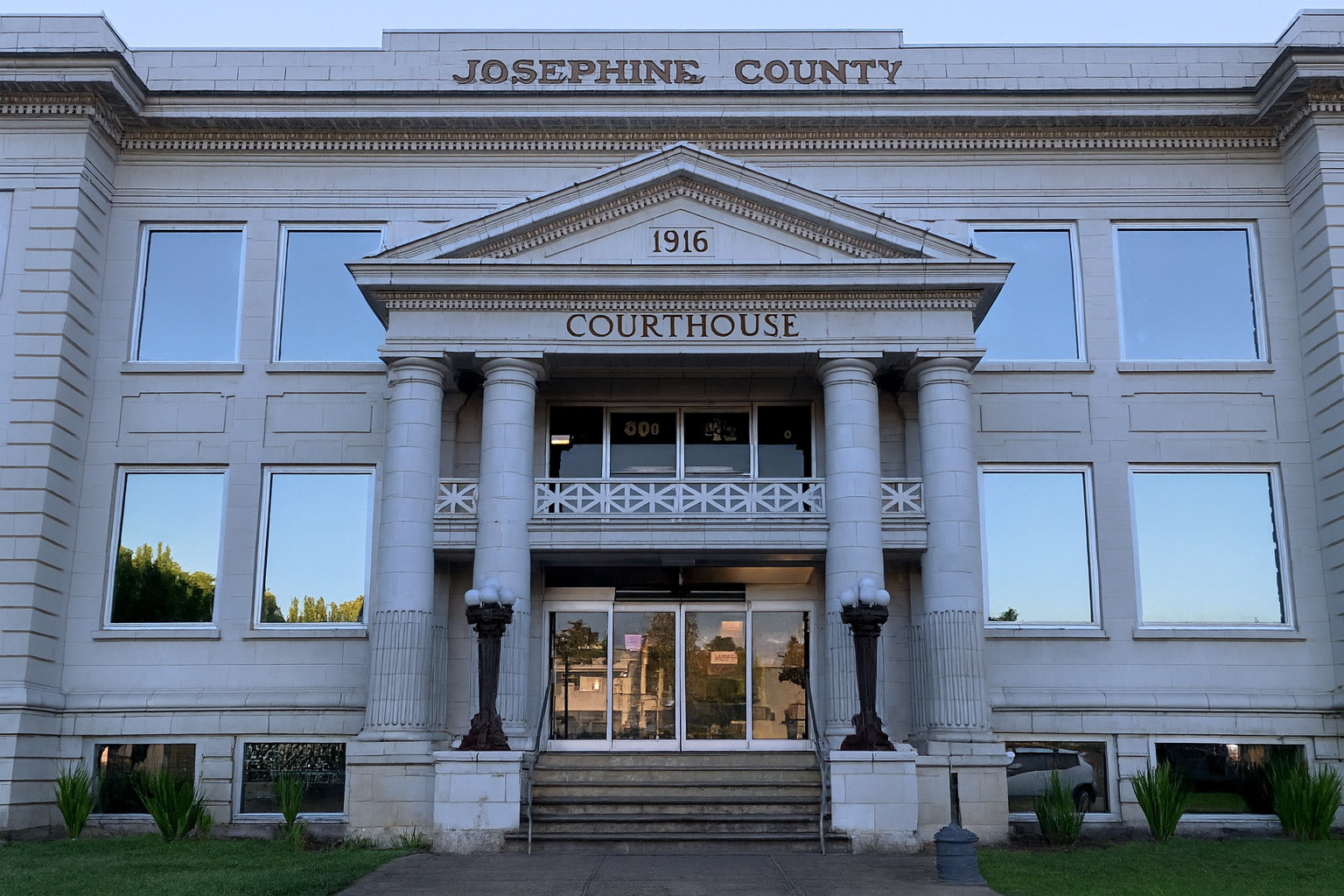
Josephine County has been rocked in recent months by allegations that its Board of County Commissioners has been playing fast and loose with public money, internal procedures, and even the livelihoods of county employees. After months of controversy surrounding questionable decisions and recall petitions targeting Commissioners Chris Barnett and Andreas Blech, the county’s own legal counsel has now stepped in — issuing a blunt, written warning that the rules of government are not optional.
The two-page memorandum, labeled “Confidential – Attorney Client Communication,” was circulated on October 1, 2025, by County Legal Counsel Wally Hicks and was obtained by the Grants Pass Tribune through multiple whistleblowers within county offices. The document reveals that Hicks was forced to formally warn the Board of County Commissioners to follow state law and the county charter—or risk personal liability. Addressed to all elected officials, department heads, and managers, the memo lays out in precise legal language what Oregon law already demands—and what this Board appears to have repeatedly ignored. Hicks’ message is clear: the decision-making process in Josephine County has drifted far from compliance, and if it continues, the financial and legal fallout could be severe.
At its core, the memo functions as a legal reality check. It reminds the commissioners and department leadership that Oregon’s Public Meetings Law — ORS 192.610 through 192.705 — requires that all county decisions be made openly, transparently, and on the public record. Any action taken outside those bounds, Hicks notes, can be voided by the courts. More troubling still, officials who knowingly violate those laws may be held personally responsible for paying fines, attorney fees, or restitution if a court finds they acted with willful misconduct.
The warning arrives at a time when transparency in Josephine County government is in short supply. Residents and county staff alike have grown increasingly frustrated by what many describe as a culture of secrecy within the Board of Commissioners — closed-door deliberations, last-minute budget decisions, and a disregard for established procedures. The ongoing recall drive against Barnett and Blech, launched recently centers on these very allegations: a breakdown of accountability and a governing style more improvisational than lawful.
In the memorandum, Hicks leaves no room for interpretation. Every department, he writes, must post clear and specific agendas that allow citizens to understand what subjects will be discussed and what actions are being proposed. When employment or financial matters are under consideration, only the department name and position title should be listed — not employee names — to balance transparency with security. Most importantly, the memo states that decisions affecting employees in non-supervisory or union roles may only be made by department heads authorized by county policy. Commissioners, Hicks reminds them, have no independent authority to direct personnel actions outside of an official meeting.
That statement strikes at the heart of what many insiders believe has been happening: commissioners privately directing pay raises, job reclassifications, cronyism, or budget reallocations without proper approval. Hicks cites ORS 244.020 and ORS 294.100, warning that any official who expends public money without lawful authorization can be held civilly liable and may be guilty of malfeasance in office. The memo goes so far as to describe specific examples of misconduct — such as approving pay increases without documentation, authorizing raises by only one commissioner, or issuing payments not supported by policy or budget line item. Each of those acts, Hicks states, would require the Finance Department to report the discrepancy, notify the county auditor, and recover the unlawful payment.
For longtime observers of county government, the memorandum reads less like a reminder and more like a rebuke — a legal department forced to put in writing what should have been second nature to every public servant: follow the law, follow the process, and respect the limits of authority. Hicks’ closing paragraph is particularly blunt, noting that explaining basic ethical conduct to public officials “is not an efficient use of my time,” and that any further violations could result in findings of willful neglect of duty and personal liability.
In practical terms, this document signals an internal reckoning. It formalizes what many inside and outside the courthouse have quietly said for months — that Josephine County’s leadership has blurred the lines between public duty and political power. With the recall movement gaining traction, and public trust already eroding, the county’s legal counsel has effectively placed the Board on notice that the law is not a suggestion.
If the commissioners heed this warning, the memorandum could mark a turning point toward restoring integrity and compliance in local government. If they don’t, it may serve once again as Exhibit A in what could become one of the most consequential political and legal reckonings Josephine County has faced in decades.