


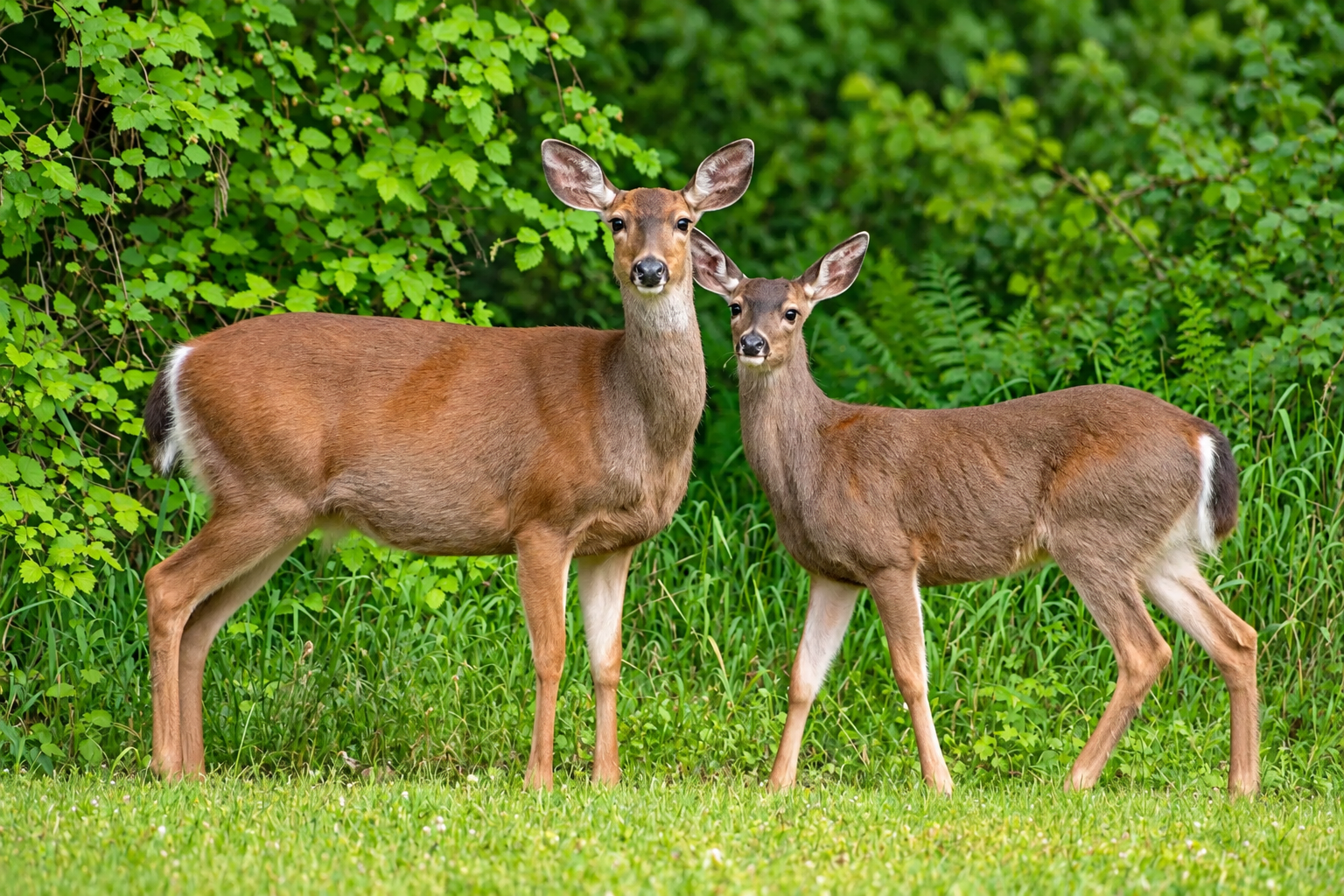
Few wild animals have become as thoroughly woven into everyday life in Josephine County as the black-tailed deer.
They cross neighborhood streets in Grants Pass, browse along the edges of rural properties, move quietly through the Applegate Valley and emerge from the timber along roads where drivers know to watch carefully after sunset. They are familiar enough to be taken for granted, yet the blacktail roaming a Southern Oregon backyard represents the surviving branch of an animal history measured not in centuries, but millions of years.
The deer commonly encountered across western Southern Oregon is the Columbian black-tailed deer, scientifically known as Odocoileus hemionus columbianus. It is a subspecies of mule deer and a native of western North America, with a range extending through the forested Pacific Coast region.
Josephine County happens to provide much of what a blacktail needs within a relatively compact landscape. Timbered mountains descend into brushy foothills and river valleys. Oak woodlands meet open meadows, rural acreage and residential neighborhoods. Dense vegetation provides cover within a short distance of the grasses, shrubs and other plants deer use for food.
That geography has placed people and blacktails alongside one another throughout much of the county.
Behind the familiar animal, however, is a journey that began on another continent.
The deer family, Cervidae, has ancient roots in Eurasia, where early deer evolved millions of years ago. Over enormous periods of geological time, their descendants spread across the Northern Hemisphere. Ancestors of the deer that would eventually populate the Americas reached North America from Asia through Beringia, the prehistoric land connection between Siberia and Alaska exposed during periods of lower sea level.
Those ancient migrations ultimately produced distinctly North American branches of the deer family, including Odocoileus, the genus containing today’s mule deer, black-tailed deer and white-tailed deer.
Western North America became home to the lineage that produced the blacktail now associated with Oregon’s forests.
The animal itself carries several clues to that heritage. Blacktails are generally darker and somewhat smaller than the mule deer encountered farther east. Their most obvious trademark is the tail that gave them their name, dark across the upper surface and contrasting sharply with the lighter underside.
Southern Oregon also occupies an interesting portion of the blacktail’s range. West of the Cascades, blacktails dominate much of the forested landscape. Continue east into the drier interior and mule deer become increasingly prevalent. The two remain so closely related that they can interbreed where their populations overlap.
Their success around Josephine County is also helped by an impressive ability to disappear.
Blacktails favor heavy cover and commonly become active around dawn and dusk. A wooded strip, blackberry thicket or brush-covered hillside can conceal several animals only yards from homes and roads. Their sudden appearances are often less a matter of deer arriving than deer finally becoming visible.
The blacktail should not be confused with Oregon’s Columbian white-tailed deer. Despite the similar name, the Columbian white-tail belongs to a different deer species and survives in limited areas including the lower Columbia River region and the Umpqua Basin.
Josephine County’s everyday deer is the blacktail, an animal so commonplace that its remarkable history can hide in plain sight.
Long before there were county lines across Southern Oregon, before settlements occupied the Rogue Valley and before the landscape carried the names familiar today, blacktails and their ancestors were adapting to western North America.
Millions of years later, one of their descendants may be standing beside a Grants Pass driveway eating the landscaping.