For many residents of Josephine County, following the actions of County Commissioner Chris Barnett has become less about tracking policy positions and more about trying to understand a recurring pattern of conduct that repeatedly places the county on uncertain legal and ethical ground. Over the past year, and accelerating in recent months, Barnett’s decisions, directives, and public behavior have raised persistent questions about respect for the law, transparency in governance, and the standards expected of an elected official entrusted with public authority.
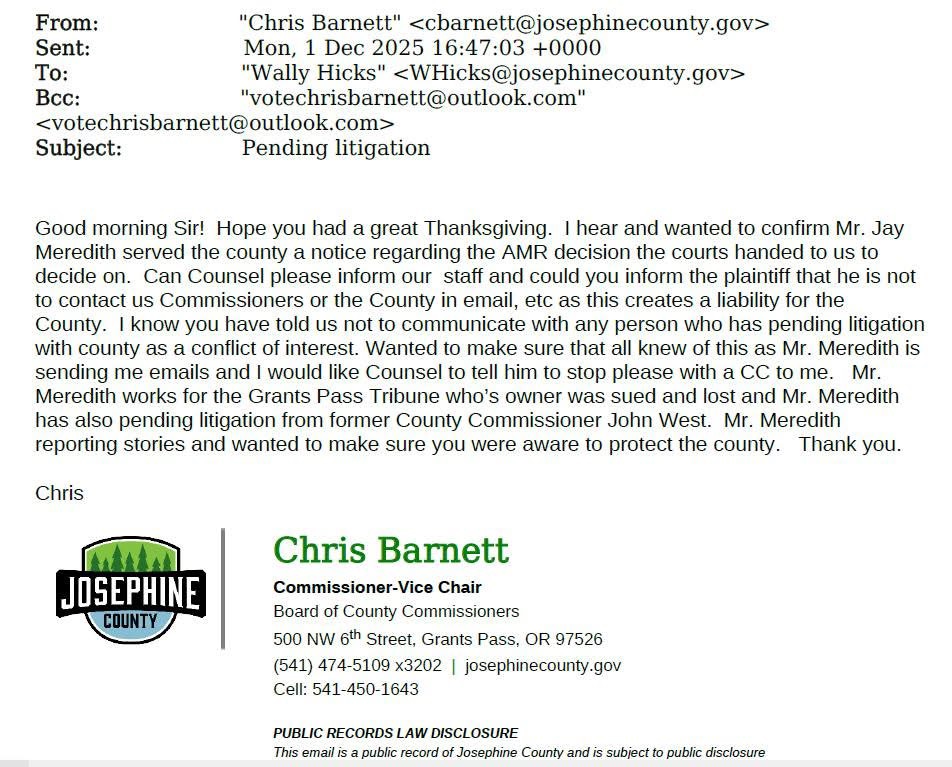
One of the most alarming documented incidents involves Barnett asking county legal counsel to contact a private citizen and request that the individual stop emailing or contacting the county and its commissioners. That request, made while Barnett was acting in his official capacity, cuts directly against the fundamental right of residents to communicate with their government. Elected officials are not granted discretion to decide which constituents may speak to them, nor may they use county legal staff to discourage lawful public engagement. The act itself reflects a troubling misunderstanding of the relationship between public servants and the public they serve.
Barnett’s grasp of basic facts has also been publicly disputed. He has characterized a local journalist and publisher as “working for” a newspaper, despite clear statements that the individual volunteers time, receives no compensation, and has done so for years. That distinction matters because it speaks to credibility and intent. Mischaracterizing a critic’s role may appear minor in isolation, but when combined with broader patterns of retaliation and disparagement, it takes on greater significance.
Legal conflict has followed Barnett repeatedly, particularly surrounding a long-pending mining lease application. That application sat undecided for more than two years because successive boards of commissioners ignored explicit requirements in county code. The failure began under former Commissioner John West and continued with the 2025 Board of Commissioners. Eventually, the Josephine County Circuit Court intervened and ordered the commissioners to make a decision, forcing the board to comply with its own laws.
That court intervention did not end the problem. When the board finally acted, it again failed to follow county code, a decision that has now exposed Josephine County to a second lawsuit. Video records of the meetings show Barnett playing a leading role in that decision-making process. The financial consequences of these actions do not fall on the commissioners personally. They fall on county taxpayers, who now bear the cost of litigation that could have been avoided through basic compliance with the law.
Barnett’s interactions with election administration officials have also drawn scrutiny. After submitting his statement of justification in response to a recall petition, Barnett sent multiple emails to the County Clerk seeking to revise the statement after the statutory deadline had passed. Those messages escalated in tone and urgency, despite the clerk’s lack of legal authority to grant the request. This episode mirrors an earlier demand by Barnett and another commissioner that the clerk verify 100 percent of recall petition signatures, a step explicitly prohibited under Oregon law. In both instances, Barnett pressed for outcomes the law does not allow, placing election officials in an untenable position.
The recall itself has become another arena in which Barnett’s judgment has been questioned. He has publicly disputed the recall effort and filed suit seeking to halt or delay it, arguing that petition signatures were gathered under misinformation, that the chief petitioner is barred by a severance agreement, and that the recall is politically motivated. County legal counsel has rejected these claims outright, telling Barnett that his arguments have no merit under applicable law. Oregon recall statutes do not require proof of wrongdoing, nor do they invalidate signatures based on political messaging or motivation. Signatures were verified by the county clerk, and the recall qualified with more valid signatures than required.
Beyond formal legal disputes, Barnett’s use of social media has deepened concerns. He operates multiple Facebook pages styled as news outlets, which critics say are used to attack and harass residents who criticize county leadership. That conduct prompted the issuance of a cease and desist letter after repeated defamatory and harassing posts targeting local citizens and journalists. Criticism of elected officials is protected speech. Using the appearance of “news” to target critics, however, undermines public trust and blurs the line between governance and personal grievance.
Recent rumors have surfaced this week that have further unsettled the community and intensified scrutiny of county operations. Among them are claims that an unapproved grant check was cashed after it had been canceled and rescinded by county accounting, with reports circulating that a local bank had already been informed the check was approved, allegedly with Commissioner Barnett’s involvement. While the full facts have not yet been publicly established, both the circumstances surrounding the grant payment and the related communications are currently under investigation by the Grants Pass Tribune, and the paper will report further as soon as the facts can be confirmed with documented evidence.
Another allegation, echoing an earlier firearm-related incident at a local restaurant, asserts that Barnett dropped his pistol inside the courthouse, reportedly within the Board of Commissioners’ offices. This marks the third reported instance in which Barnett has allegedly dropped his firearm, a pattern that the Grants Pass Tribune could no longer responsibly ignore as simple rumor. This allegation, like the grant issue, remains under active investigation, and no conclusions have been reached at this time. As with any claim involving public safety and official conduct, confirmation will depend on verifiable evidence. However, the recurrence of such reports, particularly in sensitive government spaces, has intensified concerns about judgment, safety, and professionalism in environments where public business is conducted.
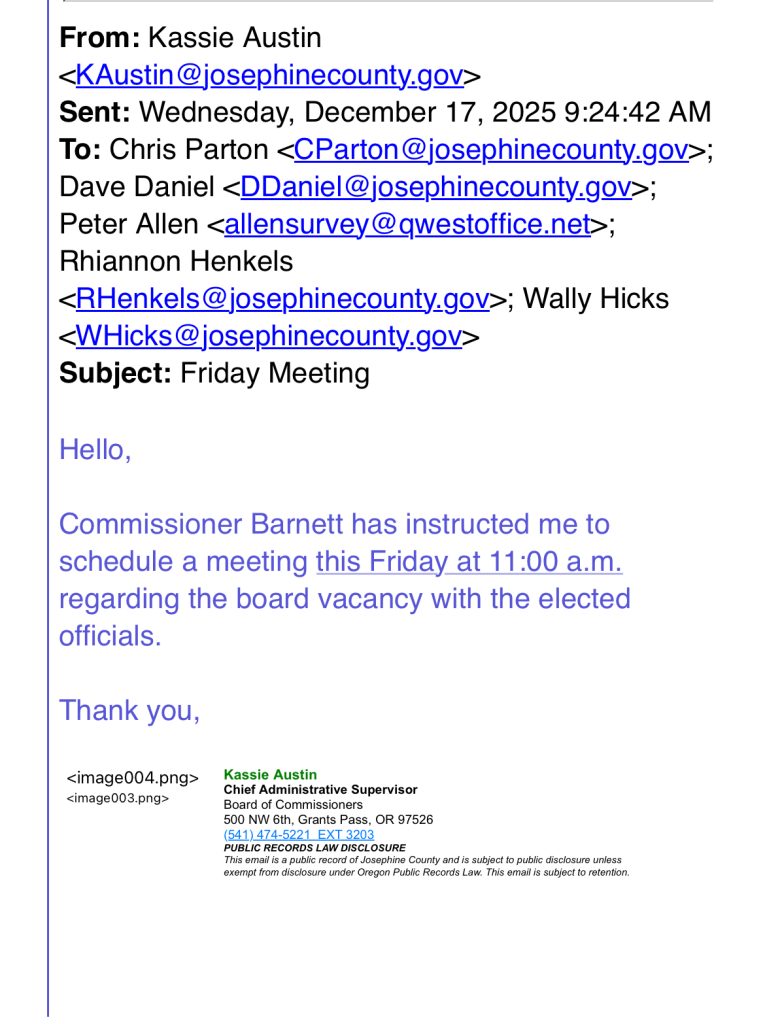
Those concerns intensified further with the circulation of internal county emails related to upcoming Board of Commissioners vacancies. In those emails, Chief Administrative Supervisor Kassie Austin wrote that Barnett instructed her to schedule a meeting with multiple elected officials to discuss board vacancies, including Seat 1 and the potential filling of Barnett’s own seat if the recall succeeds. The invitation raised immediate red flags about Oregon’s Public Meetings Law and the separation of authority in appointment processes.
The response from County Treasurer Dustin Calvo was particularly telling. Calvo declined the invitation, citing a confidential memo stating that commissioners do not have authority to participate in the Temporary Board process for appointing a new commissioner. He warned that Barnett’s involvement could be perceived as an attempt to insert himself into a process meant to proceed independently, creating the appearance of undue influence.
That objection underscores why transparency and restraint matter, especially in a recall context. When an official whose position may be vacated attempts to shape discussions about succession, even informally, it risks undermining public confidence in neutrality and fairness. The use of county staff time, official email systems, and administrative resources for such discussions further blurs the line between governance and political positioning.
Taken together, these episodes reveal a consistent theme. Whether dealing with constituents, courts, clerks, staff, or fellow officials, Barnett has repeatedly pushed against legal boundaries, often only to be corrected by others or by the courts. Josephine County residents are left not only with policy disagreements, but with mounting legal costs, ethical questions, and an erosion of trust in county leadership.
At its core, this is not about personal animosity or partisan politics. It is about whether an elected official understands that public office carries limits, obligations, and accountability. The law is not optional. Transparency is not a courtesy. And the public’s right to observe, question, and criticize its government is not a nuisance to be managed. As the recall process and potential board vacancies move forward, voters will ultimately decide whether this pattern reflects the leadership they want guiding Josephine County, or whether it signals the need for change grounded in respect for law, process, and the public itself.