


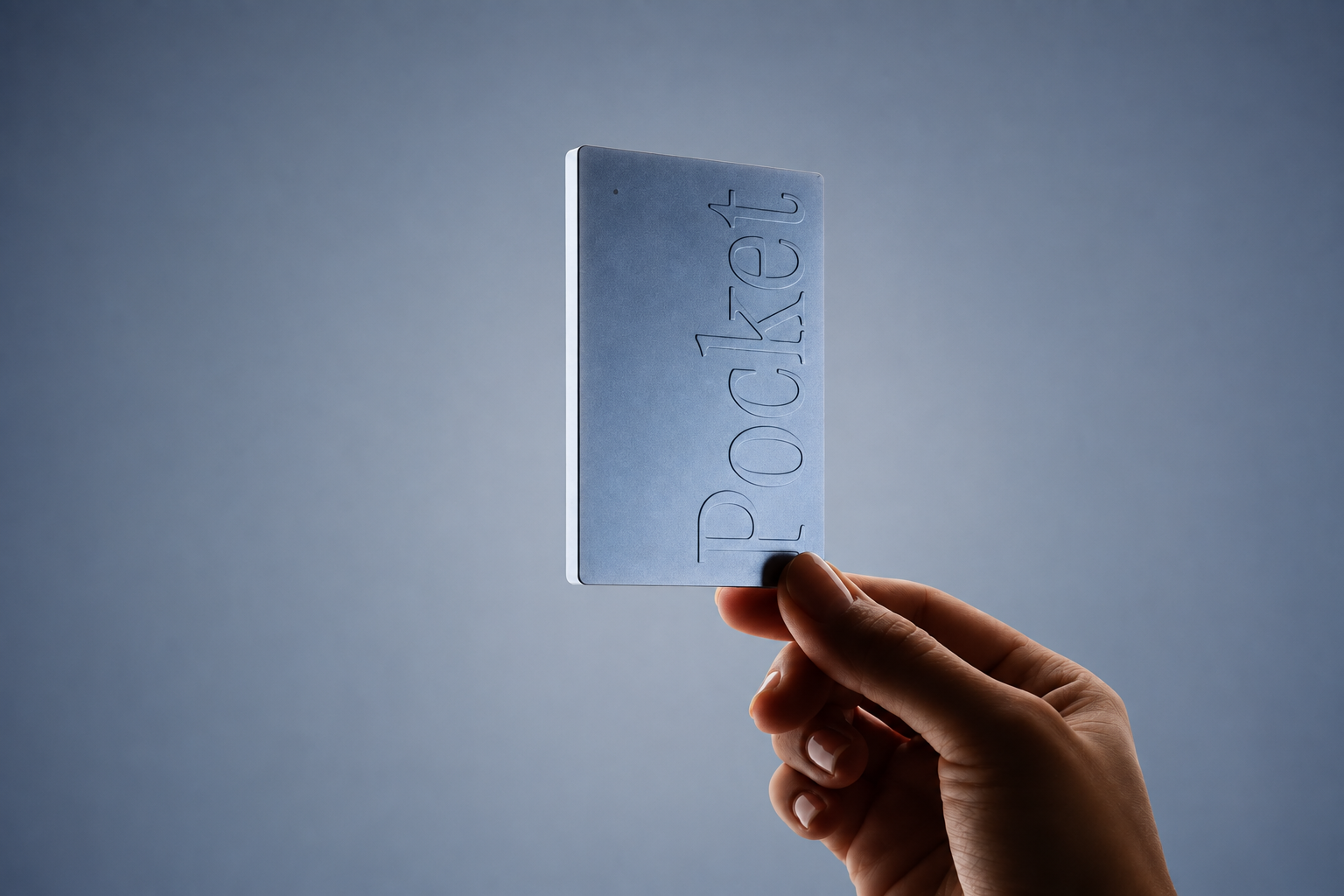
As students return to classrooms and college lecture halls, artificial intelligence is becoming as much a part of the back-to-school technology conversation as laptops, tablets and smartphones. One of the newest products competing for space in the backpack is Pocket, a compact recording device designed to capture conversations, lectures and meetings before using artificial intelligence to transform the audio into transcripts, summaries and organized notes.
Pocket is clever, portable and unusually focused on one job. The more difficult question for students and families watching their back-to-school budgets is whether that job requires another $129 piece of hardware.
Pocket is currently advertised at $129, discounted from a listed regular price of $199. The small device attaches magnetically to compatible phones and includes two microphones for room recording along with a contact microphone intended to capture telephone conversations. It carries 64GB of onboard storage, can record while offline, supports more than 120 languages and is advertised with up to four days of active battery life.
Once a recording is synchronized with the Pocket application, the software can produce a transcript, summarize the conversation, identify action items and generate a visual mind map. For a college student sitting through an hour-long lecture, those capabilities are easy to understand. Instead of frantically typing while simultaneously trying to absorb a professor’s explanation, a student can concentrate on the lecture and review an organized record afterward.
That convenience, however, enters a technology market in which the smartphone already sitting beside the notebook has become remarkably capable of doing many of the same things.
Recent iPhones, for example, can record audio directly inside Apple’s Notes application and automatically generate a transcript on supported devices and languages. The transcript can be searched, copied and incorporated into notes. Compatible iPhones equipped with Apple Intelligence can go another step and create summaries from recorded audio. Voice Memos can also provide transcripts on supported devices, giving students another built-in option without purchasing separate recording hardware.
Artificial-intelligence services expand those possibilities considerably. A recorded lecture or meeting can be supplied to an AI system for summarization, organization, study questions, outlines and explanations. ChatGPT also has a dedicated Record feature capable of transcribing and summarizing meetings, brainstorming sessions and voice notes, although its full recording mode is currently limited to the macOS desktop application on eligible plans rather than functioning as an equivalent Pocket-style recorder on every smartphone.
Pocket is not simply selling transcription. It is selling convenience through dedicated hardware.
A smartphone is expected to handle messages, calls, photographs, navigation, social media, school applications, entertainment and dozens of other responsibilities. Pocket separates recording from all of that. Pressing its physical button begins recording without navigating through menus or leaving another application open. Because recordings can be stored locally and synchronized later, an internet connection is not required during the actual recording.
For students who record several lectures every day, journalists conducting interviews, attorneys documenting meetings or professionals moving continuously between conversations, having a device devoted entirely to audio capture may have genuine practical value. A separate recorder also avoids consuming the phone’s battery during lengthy sessions and reduces the possibility that an incoming call, application change or other interruption will interfere with the recording process.
Pocket’s microphone arrangement is another advantage that cannot automatically be duplicated by downloading another application. Software can improve and analyze audio, but it cannot physically add microphones to a telephone. Pocket advertises a recording range of up to 49 feet, which could make the device useful in classrooms, conference rooms and other environments where the speaker is some distance away.
The economics become more complicated after the hardware purchase.
Pocket offers a free service tier that includes unlimited standard transcription, unlimited summaries retained for a limited period, mind maps, task features and basic exports. The company also offers Pocket Pro at $19.99 per month for users who want additional capabilities such as more extensive AI interaction, advanced speaker identification and separation, additional summary formats, expanded mind maps, advanced AI model choices, bulk exporting and unlimited cloud history.
A student therefore needs to distinguish between what Pocket can do and what he or she actually needs it to do.
If the objective is simply recording a professor, obtaining a transcript and creating a study summary, spending $129 may be difficult to justify when a compatible smartphone already provides much of the underlying functionality. Students also have access to free or limited-free AI services capable of reorganizing transcripts, explaining difficult material and generating study aids. For families already paying for a smartphone, laptop and internet service, another specialized device can become an unnecessary addition to an increasingly expensive collection of technology.
For a student who records several classes every day, however, the calculation changes. The value is no longer based solely on whether another device can technically perform the same task. It becomes a question of reliability, speed and convenience. One-button recording, independent battery power, onboard storage and dedicated microphones may be worth the expense to someone who depends heavily on recorded material.
There is another consideration that should not disappear beneath the excitement surrounding AI technology: accuracy.
Artificial intelligence can make transcription extraordinarily useful, but no automated transcript should automatically be treated as a perfect reproduction of what was said. Background noise, overlapping speakers, accents, technical terminology and poor microphone placement can produce errors. Students using AI-generated notes for examinations should compare important material with the original recording, course materials and information provided by the instructor rather than assuming every automated summary is correct.
Recording rules matter as well. Schools, colleges, professors and individual states may impose requirements governing the recording of lectures or conversations. A device capable of quietly recording from across a classroom does not automatically grant permission to do so. Students should understand institutional policies and applicable consent laws before recording other people.
Pocket consequently occupies an interesting position in the rapidly expanding AI hardware market. It performs a useful collection of tasks and packages them into a remarkably small dedicated device. Its microphones, offline recording, physical controls and independent battery give it advantages that an application alone cannot completely reproduce.
What it does not do is make the smartphone obsolete.
For students deciding where to spend limited back-to-school dollars, the better question is not whether Pocket works. It is whether dedicated recording hardware solves a problem they actually have.
A student who occasionally records a lecture may discover that the phone already in his or her pocket, combined with built-in transcription and available artificial-intelligence tools, is more than adequate. The $129 could remain available for textbooks, supplies, transportation or other school expenses.
A student recording hours of lectures every week may reach a different conclusion. Removing the recording workload from the phone, gaining dedicated microphones and turning hours of classroom audio into organized information could justify the purchase.
Pocket’s greatest accomplishment may therefore also be the simplest way to evaluate it. The device takes several increasingly common digital capabilities and makes them easier to access through one purpose-built piece of hardware.
For some students, that convenience will be worth $129.
For everyone else, the most capable AI recording device they need may already be sitting in their pocket.