


I am bold. I am blunt. I am direct. I do not sugarcoat reality, and I do not expect anyone to sugarcoat it for me. Anyone who has spent more than five minutes in conversation with me already knows this. Say what you mean. Mean what you say. Adult to adult. Full stop.
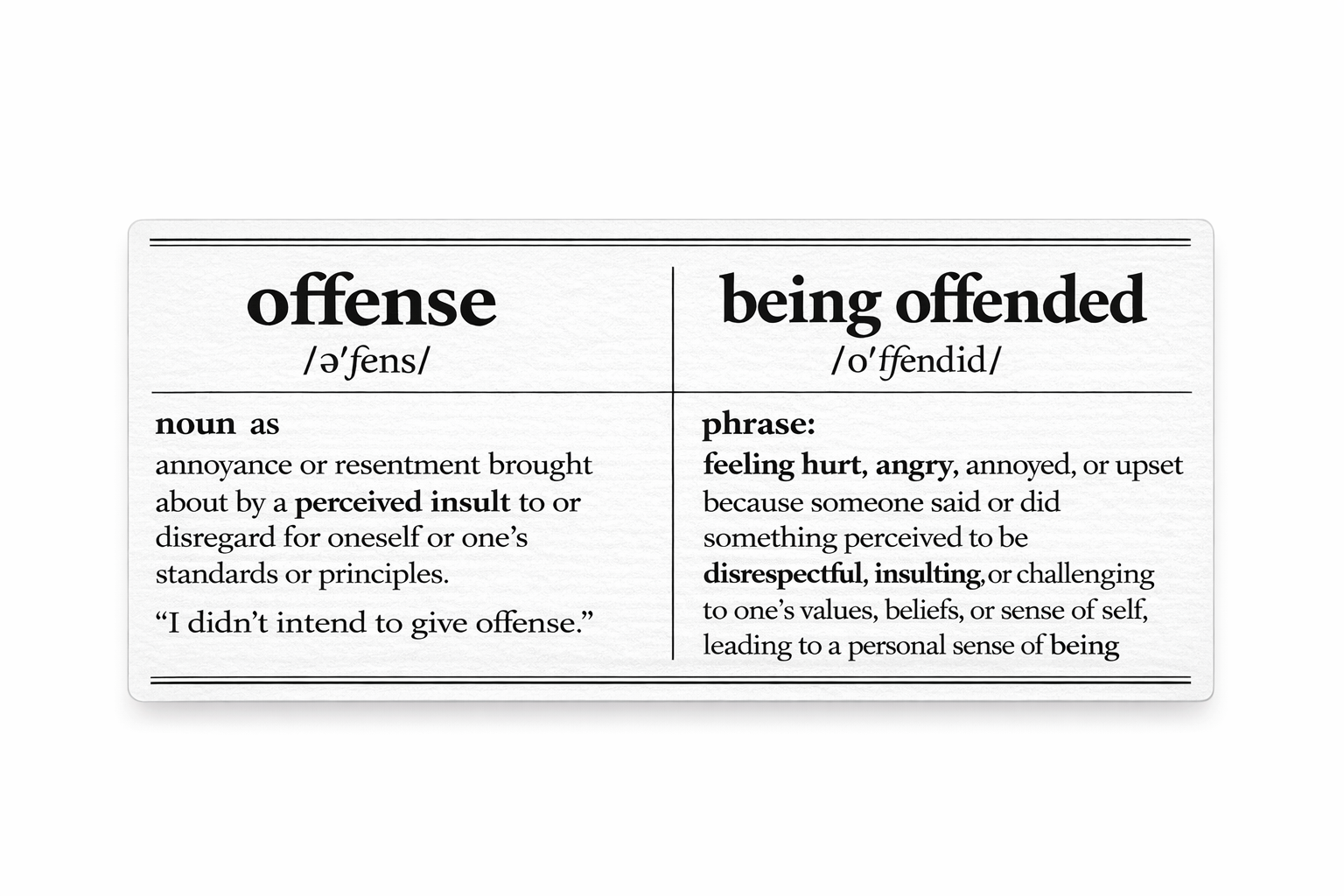
That expectation brings me to a concept that has grown louder, softer, and stranger all at once as the years pass and social behavior shifts. The word is offended. Taking offense. Being offended. It is a term used so casually now that it has lost any real weight, yet it carries an outsized authority in modern conversations.
When an adult claims to be offended by another person’s words or actions, what they are really saying is that something external has overpowered something internal. They are announcing that their emotional threshold has been crossed by input they could not process, absorb, or reject on their own terms. That is not strength. It is fragility being rebranded as virtue, or what I like to call a weak constitution.
Here is the part that seems to confuse people. No one can offend you without your participation. Offense is not a projectile. It is not forced upon you. It is a decision. You hear words. You interpret them. You decide whether they carry weight, truth, relevance, or meaning. Only after that internal process do you label the experience as offense. That label does not originate with the speaker. It originates with the listener.
If someone believes they have offended me, they are mistaken. I do not get offended. There is no upside to it. If someone criticizes me, challenges me, or speaks sharply, I take it in as information. I decide whether it is useful. If it is accurate, I adjust. If it is inaccurate, I discard it. At no point do I need to be wounded by it. That is what emotional adulthood looks like.
Most so called offense is simply unfiltered feedback. Often it is constructive criticism delivered without cushioning. People do not dislike the content nearly as much as they dislike the discomfort of hearing it. Instead of confronting that discomfort, they reframe it as harm. That reframing shifts responsibility away from self reflection and onto the person who spoke honestly.
This is where the conversation breaks down. We have confused emotional reaction with moral injury. Feeling uncomfortable is not the same as being wronged. Being challenged is not the same as being attacked. Disagreement is not violence. Criticism is not abuse. Yet offense has become a convenient stop sign that shuts down discussion before growth has a chance to occur.
If I accept an insult as an insult, that is on me. It means I decided it applied. It means it landed because something inside me allowed it to. A secure person can hear harsh words without collapsing. A confident person can be criticized without becoming defensive. A mature person can separate tone from truth and ego from learning.
Wisdom is not avoiding offense. Wisdom is knowing what deserves your attention and what does not. Experience teaches you that not every comment requires a response and not every opinion deserves space in your head. Strength is not demanding the world speak softly. Strength is being able to stand upright when it does not.
If people find me offensive, that is fine. I am not here to be palatable. I am here to be honest. If someone directs offense toward me, they are again mistaken. Their words are just words. What I do with them is my responsibility. That is accountability. That is agency. That is adulthood.
Life is input. How you process it determines your outlook. Maturity, wisdom, and experience do not insulate you from harsh realities. They equip you to face them without needing protection from language itself. If you are constantly offended, the problem may not be the world around you. The problem may be the filter you are using to interpret it.
Direct speech is not cruelty. Bluntness is not abuse. Truth does not require permission. Offense is optional. Choose accordingly.