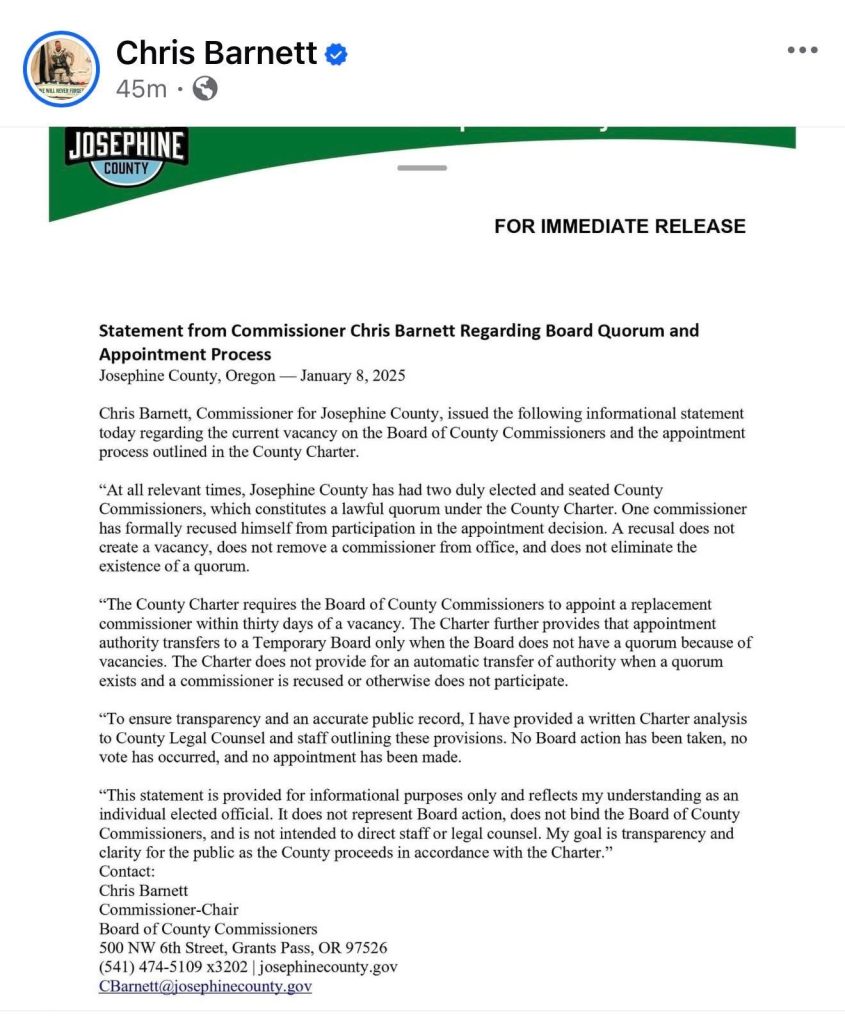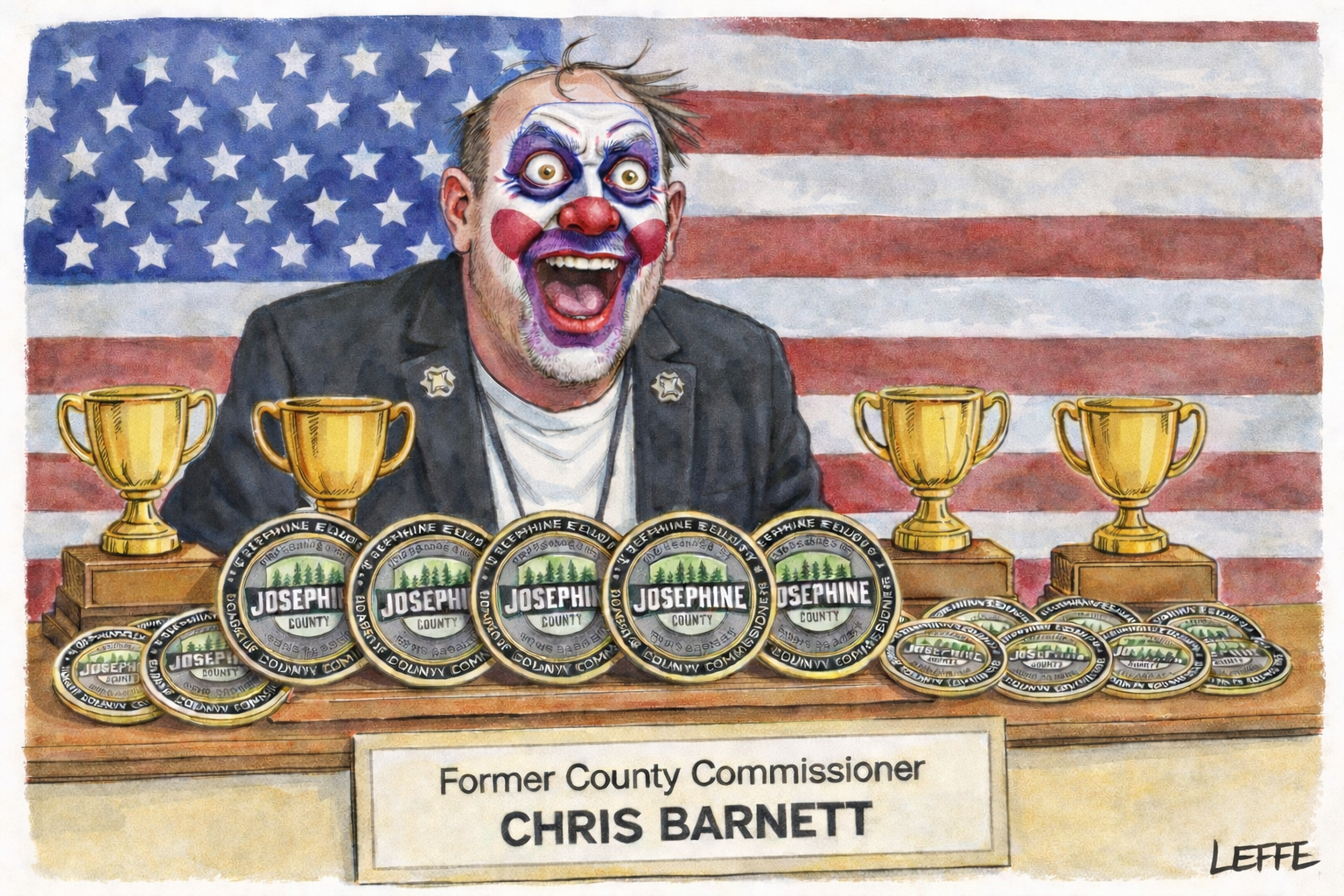
What was circulated last week Thursday under the bold banner of “FOR IMMEDIATE RELEASE” was not, in any meaningful sense, a press release. It was a personal statement, wrapped in official branding, written by a recently recalled county commissioner attempting to assert authority he no longer credibly holds. The distinction matters, because the document issued by recently recalled County Commissioner Chris Barnett was not an act of governance, but an act of interpretation, opinion, and frustration.
The document itself makes that clear, even if its author does not. Buried in its own language are repeated disclaimers that the statement does not represent board action, does not bind the Board of County Commissioners, does not direct staff, and reflects only the understanding of one recently recalled elected official. Those are not the hallmarks of an official county press release. They are the hallmarks of a personal position paper, issued unilaterally, and presented in a format designed to imply institutional authority where none exists.
What makes the episode more troubling is that this was done without any board vote or approval. After his press-release authority was stripped in October, the recalled commissioner nevertheless took it upon himself, once again, to play county legal at the taxpayers’ expense, using county time and county letterhead to advance a personal agenda. It is difficult to avoid the conclusion that he either ignored or rejected the reality of his recall. He no longer holds voting authority to select his own replacement, yet continues to behave as though the will of the people is an inconvenience rather than a final decision.
At the center of the controversy is the Josephine County Charter and the long-running dispute over quorum, vacancies, and appointment authority. Barnett’s statement argues that the board retained a lawful quorum and therefore retained the authority to appoint a replacement commissioner. That interpretation hinges on selectively emphasizing portions of the charter that suit his argument, while disregarding the broader legal framework, the timeline, and the practical consequences of the board’s inaction.
What the statement fails to acknowledge is the most basic and unavoidable fact: the thirty-day window to appoint a replacement has passed. The charter is explicit on this point. Once that deadline elapsed, the authority Barnett claims to be defending was no longer his to wield. No amount of rhetorical maneuvering, redefinition of quorum, or legal self-interpretation can rewind that clock.
This is precisely why Ron Smith’s decision to recuse himself from the process was consequential. By refusing to participate, Smith did not create chaos or violate the charter. He prevented what many residents viewed as a predetermined outcome, the appointment of another political ally under a strained and contested reading of county law. That recusal closed the door Barnett appeared determined to force open, and the subsequent statement reads less like clarification and more like retaliation.
Rather than accept that outcome, Barnett chose to issue a document asserting his personal legal theory, acting not as a commissioner operating within a board, but as his own attorney, prosecutor, and communications office. The irony is stark. The statement repeatedly invokes transparency, yet its very existence obscures the boundary between personal opinion and official action. It speaks of compliance while ignoring the most concrete compliance failure of all, the missed statutory deadline.
This pattern did not emerge in isolation. On October 31, Josephine County removed Barnett’s ability to publish on county-managed social media accounts, reflecting growing concern over the misuse of official platforms. That restriction did not stop him from continuing to use county letterhead, from presenting himself as chair after being recalled, or from issuing statements that visually and structurally mimic official county communications. Each step reinforces the same message: bravado and ego prioritized over accountability.
Equally important is what the public did not ask for. Residents did not request Barnett’s personal interpretation of the charter. Josephine County already employs legal counsel for precisely this purpose, and when questions of law arise, the public rightly looks to Wally Hicks, not to a recalled official advancing his own legal conclusions. Governance by personal opinion is not governance at all.
The continued release of these documents, framed as urgent explanations, has produced predictable results. They have frustrated voters, confused constituents, and prolonged a dispute that could have ended quietly with respect for the charter’s limits. Instead, Josephine County has been subjected to what increasingly resembles a daily temper tantrum, expressed through press-styled statements that disclaim their own authority while demanding attention.
At some point, the most constructive course of action becomes the simplest. Clear the office. Turn off the phone. Stop issuing statements that carry no legal weight but consume public oxygen. Let the county move forward without the constant churn of personal grievance disguised as institutional concern.
Josephine County deserves governance grounded in law, restraint, and respect for the voters’ decision. The recall was not ambiguous, and the charter is not optional. What remains is whether that reality will be honored or continually challenged through documents that say far more about one man’s refusal to accept accountability than about the actual requirements of county government.